Vision
May 22nd, 2024
## min read

Decentralization is not a meme: Part 1

What do we mean by “decentralization”? Why Aztec takes decentralization seriously? In this post, we explore Aztec’s efforts around protocol decentralization: sequencer, prover, and upgrade mechanism.

Share
Written by
Lisa A.
Edited by

Many thanks to Cooper, Prasad, Rafal, Mahima, and Elias for the review.

Contents

  • What do we mean by “decentralization”?
  • Why Aztec takes decentralization seriously
  • Aztec’s efforts around protocol decentralization: sequencer, prover, and upgrade mechanismsome text
  • Request for proposal (RFP)
  • Sequencer
  • Prover
  • Conclusion

1) What do we mean by “decentralization”?

Decentralization in blockchain is one of the most speculative topics, often thought about as a meme.
Source
Source

The questions around decentralization are:

  • Which components should be decentralized (both at the blockchain and application layers)?
  • To what extent?
  • Is decentralization of a specific part of the network a must-have or just a nice-to-have?
  • Will we die if a specific part of the network is not decentralized?
  • Is it enough to have a decentralization roadmap or should we decentralize for real?

The goal of this article is to shed some light on what we mean by decentralization, why it matters, and how decentralization is defined and provided in the context of the Aztec network.

Before we start figuring out the true meaning of decentralization, we should note that decentralization is not a final goal in itself. Instead, it is a way to provide rollups with a number of desired properties, including:

  • Permissionlessness (censorship resistance as a consequence) – anyone can submit a transaction and the rollup will process it (i.e. the rollup doesn’t have an opinion on which transactions are good and which are bad and can’t censor them).
  • Liveness – chain operates (processes transactions) nonstop irrespective of what is happening.
  • Security – the correctness of state transition (i.e. transactions' correct execution) is guaranteed by something robust and reliable (e.g. zero-knowledge proofs).

In the case of zk-rollups, these properties are tightly connected with “entities” that operate the rollup, including:

  • Sequencer – orders and executes transactions –> impacts permissionlessness and liveness.
  • Prover – generates proof that the transactions were executed correctly –> impacts security and liveness.
  • Governance mechanism (upgrade mechanism) – manages and implements protocol upgrades –> impacts security, liveness, and permissonlessness.

Even though we said at the beginning of the article that decentralization is a speculative topic, it’s not overly speculative. Decentralization is required for permissionlessness, censorship resistance, and liveness, which are required to reach the system’s end goal, credible neutrality (at least to some extent). “Credible neutrality” means the protocol is not “designed to favor specific people or outcomes over others” and is “able to convince a large and diverse group of people that the mechanism at least makes that basic effort to be fair”.

Credible neutrality is a crucial element for rollups as well, which is why we're prioritizing decentralization at Aztec, among other things. Progressive decentralization is not an option; Decentralization from the start is a must-have as the regulatory, political, and legal landscapes are constantly changing.

In the next section, we will dive into the specifics of Aztec’s case, looking at its components and their levels of decentralization.

2) Why Aztec takes decentralization seriously

Aztec network is a privacy-first L2 on Ethereum. Its goal is to allow developers to build dapps that are privacy-preserving and compliant (in any desired jurisdiction!) at the same time.

For Aztec, there are two levels of decentralization: protocol and organizational.

At the protocol level, Aztec network consists of a number of components, such as the P2P transaction pool (i.e. mempool), sequencer, prover, upgrade mechanism, economics, Noir (DSL language), execution layer, cryptography, web SDK, rollup contract, and more.

For each of these, decentralization might have a slightly different meaning. But the root reason why we care about it is to provide safety for the developers and users ecosystem.

  • For the rollup contract and upgrade mechanism, the question is who controls the upgrades and how we can diversify this process in terms of quantity and geography.
    A good mechanism should defend the protocol from forced upgrades (e.g. by the court). It should also mitigate the sanctions risk, isolating this risk at the application level, not the rollup level.
  • For sequencer and prover, we also need quantity and geographical decentralization as well as a multi-client approach where users can choose a vendor from a distributed set that may have various different priorities.
  • For economic decentralization, we need to ensure that “the ongoing balancing of incentives among the stakeholders — developers, contributors, and consumers — will drive further contributions of value to the overall system”. It covers the vesting of power, control, and ownership with system stakeholders in such a way that the value of the ecosystem as a whole accrues to a broader array of participants.
  • For all software components, such as client software, we need to ensure that copies of the software are distributed widely enough within the community to ensure access, even if the original maintainers choose to abandon the projects.

When it comes to long-term economic decentralization, the desired outcome is power decentralization, which in turn can be achieved through geographical decentralization.

In the context of geographical decentralization, we particularly care that:

  • diversification among different jurisdictions mitigates the risk of local regulatory regimes attempting to impose their will.
  • when reasoning about extremes and black swan events, having a global system is attractive from the point of view of safety and availability.
  • intuitively, a system that privileges certain geographies cannot be considered neutral and fair.

For more thoughts on geographical decentralization, check out the articleDecentralized crypto needs you: to be a geographical decentralization maxi” by Phil Daian.

3) Aztec’s efforts around protocol decentralization: sequencer, prover, and upgrade mechanism

The decentralization to-do list is pretty huge. Decentralization mechanism design is a complex process that takes time, which is why Aztec started working on it far in advance and called on the most brilliant minds to collaborate, cooperate, design, and produce the necessary mechanisms that will allow the Aztec network to be credibly neutral from day one.

Request for proposal (RFP)

Since last summer, we’ve announced a number of requests for proposal (RFPs) to invite the power of community and the greatest minds in the industry to find a range of solutions for the Aztec network protocol design:

Everyone was welcome to craft a proposal and post it on the forum. For each of the RFPs, we outlined a number of protocol requirements that will decentralize and diversify each part of Aztec, making it robust and credibly neutral.

For each RFP, we got a number of proposals (all of them are attached in the RFPs’ comments). Proposals were discussed on the forum by the community and analyzed in detail by partners (e.g. Block Science) and the Aztec Labs team.

In this section, we will describe and briefly discuss the chosen proposals.

Sequencer Selection

Some of the desired properties

There are a number of desired properties assigned to the sequencer. These include:

  • Permissionlessness sequencer role – any actor who adheres to the protocol can fill the role of sequencer.
  • Elegant reorg recovery – the protocol has affordance for recovering its state after an Ethereum reorg.
  • Denial of services – an actor cannot prevent other actors from using the system.
  • L2 chain halt – there is a healing mechanism in case of block proposal process failure.
  • Censorship resistance – it’s infeasibly expensive to maintain sufficient control of the sequencer role to discriminate on transactions.

Other factors to be considered are

  • How the protocol handles MEV
  • How costly it is to form a cartel
  • Protocol complexity
  • Coordination overhead – how costly it is to coordinate a new round of sequencers

Sequencer mechanism

The chosen sequencer design is called “Fernet” and was suggested by Santiago Palladino (“Palla”), one of the talented engineers at Aztec Labs. Its core component is randomized sequencer selection. To be eligible for selection, sequencers need to stake assets on L1. After staking, a sequencer needs to wait for an activation period of a number of L1 blocks before they can start proposing new blocks. The waiting period guards the protocol against malicious governance attacks.

Block proposal mechanism

Stage 0: Score calculation

  • In each round (currently expected to be ~12-36ss), staked sequencers calculate their round-based score, derived from a hash over RANDAO and a public key.

Stage 1: Proposal

  • Based on the calculated scores, if a sequencer determines its score for a given round as likely to win, it commits to a block proposal.
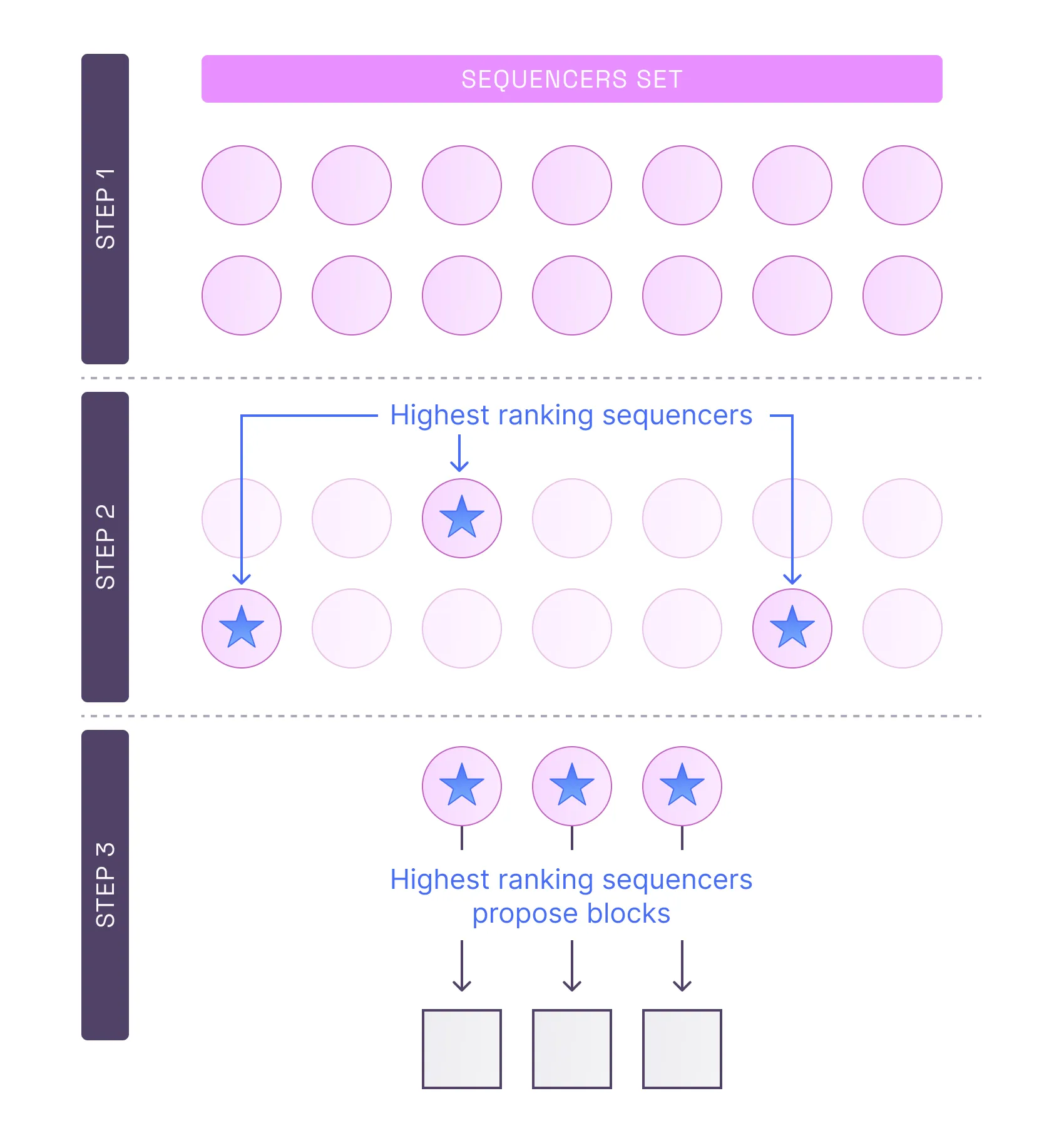
  • During the proposal stage, the highest ranking proposers (i.e. sequencers) submit L1 transactions, including a commitment to the Layer-2 transaction ordering in the proposed block, the previous block being built upon, and any additional metadata required by the protocol.

Stage 2: Prover commitment – estimated ~3-5 Ethereum blocks

  • The highest ranking proposers (i.e. sequencers) make an off-chain deal with provers. This might be a vertical integration (i.e. a sequencer runs a prover), business deal with a specific 3rd party prover, or a prover-boost auction between all of the third party proving marketplaces.
    On the sequencers' side, this approach allows them to generate proofs according to their needs. On the network side, it benefits from modularity, enjoying all proving systems innovations.
  • Provers build proofs for blocks with the highest scores.
  • This stage will be explicitly defined in the next section dedicated to the proving mechanism.

Stage 3: Reveal

  • At the end of the proposal phase, the sequencer with the highest ranking block proposal on L1 becomes the leader for this cycle, and reveals the block content, i.e. uploads the block contents to either L1 or a verifiable DA layer.
  • As stages 0 and 1 are effectively multi-leader protocols, there is a very high probability that someone will submit a proposal (though it might not be among the leaders according to the score).
    In the event that no one submits a valid block proposal, we introduce a “backup” mode, which enables a first-come, first-served race to submit the first proof to the L1 smart contracts. There is also a similar backup mode in the event that there is a valid proposal, but no valid prover commitment (deposit) by the end of the prover commitment phase or should the block not get finalized.
  • If the leading sequencer posts invalid data during the reveal phase, the sequencer for the next block will build from the previous one.

Stage 4: Proving – estimated ~40 Ethereum blocks

  • Before the end of this phase, it is expected for the block proof to be published to L1 for verification.
  • Once the proof for the highest ranking block is submitted to L1 and verified, the block becomes final, assuming its parent block in the chain is also final.
  • This would trigger new tokens to be minted, and payouts to the sequencer, prover commitment address, and the address that submitted the proofs.
  • If block N is committed to but doesn't get proven, its prover deposit is slashed.

The cycle for block N+1 can start at the end of the block N reveal phase.

How Fernet meets required properties

How Fernet meets required properties

Property
How Fernet addresses it
Permissionlessness sequencer role
Anyone who locked some funds on L1 can propose a block after a waiting period. 
Elegant reorg recovery
On L2, reorg is not possible as a new block can be proposed strictly after the previous block was finalized. However, L1 reorg might impact L2.
L2 chain halt
Relying on the Ethereum copy of Aztec network state between the last finalized epoch and the current safe block.
Censorship resistance
In order to censor a transaction, it must be the case that an entity can “guarantee” that they are repeatedly selected as sequencer while the transaction to be censored is awaiting processing. The VRF selection process will prevent such a guarantee.
MEV
For the public domain, MEV is extracted by the sequencer responsible for the current slot. In the private domain, there is no direct MEV extraction. However, there might be some probabilistically extracted MEV, though its feasibility will depend on the dapps landscape deployed on the chain.
Protocol complexity: engaged mechanisms can be adjusted over time because of modularity
The Aztec protocol design assumes modularity, allowing it to choose any prover and DA mechanisms and adjust them later if needed. 
Cost for private and public function calls
For public functions, call costs depend directly on the specific executed opcodes (as for any other rollup). For private function calls, there is a fixed cost for every state update and proof verification.

For a detailed analysis of the protocol's ability to satisfy the design requirements, check this report crafted by an independent third party, Block Science.

Prover

Context

In the previous section, we mentioned that at stage 3 proofs are supplied to the blocks. However, we didn’t explicitly define the specific prover mechanism.

To design a prover mechanism, Aztec also initialized an RFP after the sequencer mechanism was chosen to be Fernet (as described in the previous section).

Without going into too much detail, one should note that the Aztec network has two types of proofs: client-side proofs and rollup-side proofs. Client-side proofs are generated for each private function and submitted to the Aztec network by the user. The client-side proving mechanism doesn’t have any decentralization requirements, as all the private data is processed solely on the user’s device, meaning it’s inherently decentralized. Covering client-side proof generation is outside the scope of this piece, but check out one of our previous articles to learn more about it.

The Aztec RFP “Decentralized Prover Coordination” asked for a rollup-side prover mechanism, the goal of which is to generate proofs for blocks.
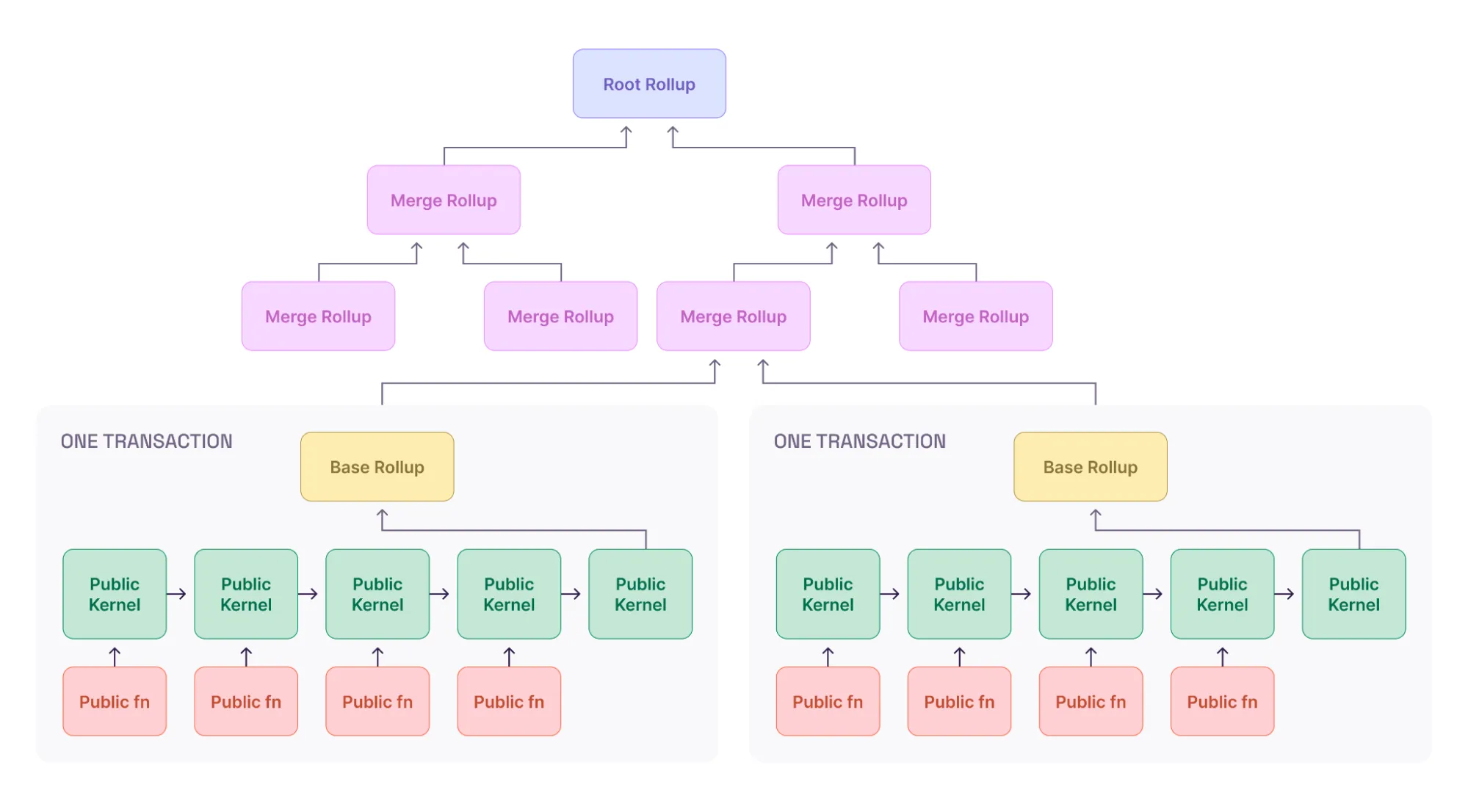
In particular, it means the sequencer executes every public function and the prover creates a proof of each function’s correct execution. That proof is aggregated into a kernel proof. Each kernel proof is aggregated into another kernel proof and so on (i.e. as a chain of kernel proofs). The final kernel proof is aggregated into a base rollup proof. The base rollup proofs are aggregated into pairs in a tree-like structure. The root of this tree is the final block proof.

Desired properties
There is a row of desired properties assigned to the prover mechanism. Among those:

  • Permissionlesness – anyone can run an Aztec prover.
  • The prover of each block can be recognized to be rewarded or slashed by the protocol.
  • Recovery mechanism in case provers stop supplying proofs.
  • Flexibility for future cryptography improvements.


Prover mechanism

The chosen prover mechanism is called “Sidecar” and was suggested by Cooper Kunz.

  • It is a minimally enshrined commitment and slashing scheme that facilitates the sequencer outsourcing proving rights to anyone, given an out-of-protocol prover marketplace. This allows sequencers to leverage reputation or other off-protocol information to make their choice.
  • In particular, it means anyone can take a prover role. For example, it can be a specialized proving marketplace, or a vertically integrated sequencer’s prover, or an individual independent prover.
  • After the sequencer chooses its prover, there is a Prover Commitment Phase by the end of which any sequencer who believes they have a chance to win block proposal rights must signal via an L1 transaction the prover’s Ethereum address and the prover specifies its deposit.
  • After the prover commits, the block content is revealed by the sequencer. Going with this specific order (i.e. first prover commitment then revealing block content) allows one to mitigate potential MEV-stealing (if sequencers have to publish all data to a DA layer before the commitment) and proof withholding attacks (i.e. putting up a block proposal that seems valid but never revealing the underlying data required to verify it).
  • The prover operates outside of Aztec protocol and the Aztec network. Hence, after the prover commitment stage, the protocol simply waits a predetermined amount of time for the proof submission phase to begin.

How Sidecar meets required properties

How Sidecar meets required properties

Property
How Sidecar addresses it
Permissionlessness
Anyone can run a prover.
Prover recognizability
Prover posts commitment to L1.
Recovery mechanism
Reorgs are not possible within the current design. 
Flexibility
There is no hard commitment to one specific proving system. 

Conclusion

Decentralization is neither a sentiment nor a meme. It’s one of the core milestones on the way to credible neutrality. And credible neutrality is one of the core milestones on the way to a long-lasting, secure, and robust Ethereum ecosystem.

If the network is not credibly neutral, the safety of users’ funds cannot be long-term guaranteed. Furthermore, if the network is not credibly neutral, the developers building on top of the network can’t be sure that the network will be there for them tomorrow, the day after tomorrow, in a year, in ten years, etc. They have to trust the network team that they are good, reliable people, and will continue maintaining the network and will fulfill all their promises. But what if that is not the case? Good intentions of a small number of people are not enough to secure hundreds of dapps, the thousands of developers building them, and the millions of users using them. The network should be designed in a credibly neutral way from the first to the last bit. Without compromises, without speculation, without promises.

That is what we are working on at Aztec Labs: systematically decentralizing all of the network’s components (e.g. sequencer and prover) with the help and support of a wide community (e.g. through RFP and RFC mechanisms) and top-notch partners (e.g. Block Science).

That is why, especially in the early days, Aztec prioritizes safety over other properties (e.g. impossibility of reorg attacks by design and unrolling upgrade mechanism allowing sequencers to have enough time to battle-test the mechanism before any assets come to the network).

Besides technical and economical decentralization, Aztec also considers its legal aspect that comes in the form of a foundation that is a suitable vehicle to promote decentralization.

If you want to contribute to Aztec’s decentralization – fill in the form.

This was the first part of the piece on Aztec’s decentralization. In the second part (coming soon), we will cover the upgrade mechanism.

Sources:

Read more
Aztec Network
Aztec Network
21 Jul
xx min read

Introducing Alpha V5

The Aztec Network today activated Alpha V5, a major protocol upgrade passed by token-holder governance and executed onchain. Alpha V5 reduces private-transaction proving times by more than 2x compared to the previous version, lowers the cost of a fully private transaction by roughly 50%, resolves the critical issues found in V4, and sees the first wave of apps go live. Users can now send private transactions and earn yield on Aave simply by connecting their Ethereum wallets on Nyx, bridge from Ethereum to Aztec using Shield or TRAIN, privately collect NFTs on RavenHouse, or play Dark Forest Aztec, a hidden-information strategy game in a universe that lives entirely onchain. 

"Alpha V5 continues Aztec's work at the frontier of client-side proving, with cryptographic breakthroughs that cut proving times by more than half this release," said Zac Williamson, Co-founder, Aztec Foundation. "We believe Aztec is now the fastest system in the world for proving a fully private transaction entirely on a user's own device, and every release moves the industry closer to private transactions at public transaction speeds."

As the only decentralized privacy L2, Aztec is the credibly neutral privacy layer for Ethereum. Aztec allows anyone to write smart contracts that include both private and public aspects – every private transaction is proven on the user's own device, so no operator, sequencer, or intermediary can see the data. The Alpha V5 proving improvements come from cryptographic advances that make this client-side proving faster than any prior release. The network remains in alpha, but with V5 it is ready for teams to begin building and deploying applications.

Performance - 2.5 second fully private transactions 

Making private transactions practical comes down to how quickly a proof can be generated on a user's own device, without offloading that work to a server that would learn what the user is doing. On Alpha V5, proving a private token transfer natively now takes approximately 2.5 seconds on a consumer laptop, down from 5.2 seconds on V4, and about 6.8 seconds in a browser, down from 12.5 seconds. Across every measured transaction flow, client-side proving times improved by approximately 2x compared with V4.

Bench machine: an M2 MacBook (12 cores, throttled to 8). "Native" runs Aztec's C++ proving binary; "WASM" runs the same prover in a browser engine (Node on V8).

Alpha V5 lowers ECDSA signature-verification cost by approximately 2x, speeds up Poseidon2 hashing by approximately 3x, and reduces the protocol circuit gate count by approximately 50% (gate count is the number of individual operations a proving circuit must perform, and it is the main driver of how long a proof takes to generate). Each of these lowers the amount of work a device performs to prove a transaction, and the reduction in gate count in particular compounds across every proof the network generates.

Apps - send, receive, and earn privately on Ethereum

Alpha V5 launches the first wave of apps on a network where privacy is built into the protocol rather than managed by an operator. On other networks that claim privacy, transactions still pass through an operator or node that reads them in plaintext, or depend on a viewing key that a third party holds, so users rely on someone else to protect their data and to decide when it gets disclosed. On Aztec, every private transaction is proven on the user's own device, so the app, the sequencer, and any operator never need to see the underlying data. Nyx is one of these apps, allowing users to privately send transactions and privately earn yield on Aave. 

"On Ethereum, everything you do is public. That's why we built Nyx: a private account governed by your Ethereum wallet", said Nikhil, Co-founder of Nyx. "Now you can send, receive and earn in private. Nyx was the first app live on the Aztec Alpha, and we're excited to expand participation to more users with the added stability of Alpha V5."

Other apps on Alpha V5 include Azguard and Nethermind (wallets), Shield, TRAIN, and RavenHouse (bridges), and the Aztecscan block explorers. Also launching is Dark Forest Aztec, a game where users explore a universe, control planets, manage planetary energy, expand territory, and launch attacks through strategic play with private state and hidden actions.

Dark Forest Aztec private universe-building gameplay

Lower costs, higher security 

Transaction fees on Aztec come from two main sources: the cost of proving a transaction and the cost of verifying the rollup proof on Ethereum. Alpha V5 reduces both. It lowers the network's proving-cost parameter by 50%, and it reduces the L1 gas required to verify a rollup proof by approximately 40%. Because rollup proofs are verified on Ethereum and that cost is shared across all transactions in a batch, the L1 reduction lowers fees for every user, while the lower proving-cost parameter reduces the per-transaction proving fee directly. Together, these bring the average cost of a fully private token transfer to under a $0.05 transaction cost.

Alpha V5 also hardens the network on several fronts. It resolves critical vulnerabilities found in Alpha V4 along with additional bugs discovered since launch. Aztec's bug bounty program on Cantina also drew more than 234 security researchers to participate. The network remains in alpha, and further bugs may surface as usage grows, but each release has closed the issues found in the last and strengthened the protocol against new ones. With the critical V4 issues resolved and these safeguards in place, Alpha V5 is stable enough for teams to begin building and deploying applications.

Availability

Alpha V5 is live now, view the Alpha V5 landing page for a full list of features, performance updates, and live apps to explore. 

About Aztec

Aztec is the only decentralized, privacy-first Layer 2 on Ethereum. Developers write private and public logic in the same smart contract, and private functions are executed and proven on the user's own device, so no operator sees the underlying data. The protocol is upgraded through onchain governance, and the network settles to Ethereum. For more information, visit aztec.network.

Aztec Network
Aztec Network
30 Jun
xx min read

Inside an Aztec Transaction

On Ethereum today, each transaction reveals everything publicly. The token you moved, the size, the timing, the wallet it came from, every action you take. Given the limitations of this type of transparent network, the industry is now focusing on bringing privacy onchain as a top priority. The response to this has mostly been to enable private transactions that shield transfers in various ways. But when we look at how privacy works on Web2, it’s clear that users and developers need granular privacy controls: the ability to decide what is public or private and who is able to see different types of data.

Aztec was built so that one transaction can carry two halves. A private half that runs on your own device and never leaves it, and a public half that the network runs in the open. Apps can choose which aspects are private or public, and users can choose what they want to reveal and when.

This article will follow an example transaction on Aztec: a vote in an onchain election built on Aztec, where who you are and which candidate you chose stay private, while the running tally for each candidate stays public for anyone to verify.

Public and private in one move

Picture the vote you cast in our example as two aspects that seamlessly weave together. In the first step, you act in private: an app records your vote on your device and hands the network a proof that the vote is valid without revealing it. In the second, the network acts in public: it checks that proof, then adds one to the chosen candidate's public tally. It is one transaction: one part stays with you, one part goes to the network. Both parts end up recorded onchain, in two separate state trees, one private and one public. The walkthrough below follows how these two aspects work together and what this means for how your transaction lands onchain. 

It starts on your device

You open the voting app and connect an Aztec wallet. That first step looks like any onchain app. The difference is inside the wallet. An Aztec wallet carries a private execution environment, the PXE, pronounced "pixie", which runs on your phone or in your browser. The PXE is where the private half of your transaction executes, and where the proof of that work gets made, on your hardware, under your exclusive control.

Every account on Aztec is a smart contract rather than a bare key. That design, account abstraction, allows a wallet to authorize a transaction however its owner chooses without writing an identity onto the network for everyone to read. The wallet is the front door, and on Aztec you can decide if the door is open or closed, who you share your information with. 

The private half runs on your device

The voting app is a smart contract with two kinds of functions. The private functions run first, and they run inside your PXE. Your identity and the candidate you picked are the private inputs, and they stay on your device.

The only thing to leave your device is a proof confirming the legitimacy of your vote. Aztec's client-side proving system, Chonk, takes the private execution and produces a zero-knowledge proof: a compact cryptographic receipt that your vote followed the rules, that you are eligible, and have not voted before, while revealing nothing about who you are or who you voted for. Think of it as a sealed ballot the network can confirm is valid without opening it. The network learns only that a legitimate vote happened. It does not learn how you voted, or even which account voted. 

This is the part that used to be too slow to be practical. Generating a proof on a phone was the bottleneck every privacy app hit. Aztec’s Chonk is purpose-built for fast proving on low-memory devices, both natively and in the browser, so the private half runs on the device in your hand instead of on someone else's server.

The public half runs in the open

Some elements of a vote should be public. The tally is shared infrastructure, the number everyone relies on to trust the result. Thanks to programmable privacy on Aztec, the app marks that part public. Public functions live on the network and run in the open, the way functions do on Ethereum.

On Aztec, private and public logic live in the same contract, and the developer decides which is which, function by function and variable by variable. Programmable privacy is a dimmer, not a switch. The voting app turns it up on the individual ballot and turns it down on the running tally. That boundary is a design decision written into the contract, and it is the thing no transparent chain and no fixed-privacy chain can offer.

The network checks the proof and runs the public part

Your vote leaves your device as a bundle: the zero-knowledge proof of the private half, plus the call to the public function that updates the count. It goes to Aztec's sequencers, a decentralized set of thousands of independent operators, with more than 3,500 of them running the network today.

The sequencers do two jobs at once. They verify the proof of your private vote, confirming it is valid and eligible without seeing the choice behind it, and they run the public function that adds one to the chosen candidate and updates the public tally. Your ballot stays sealed. The count goes up by one for everyone to see. The same proof guarantees you cannot vote twice, even though no one learns which ballot is yours.

Two state trees, both onchain

Aztec has two main state trees, and both live onchain. One holds private state, the other holds public state, so the full record of what happened sits on the network rather than on any one person's laptop. The two trees store each record in two different ways depending on if it needs to be private or public. 

The private tree uses a UTXO model, the same note-based design used by Zcash. In this model, state is written as commitments: each entry is a sealed record that a valid vote was cast, with the voter and the choice kept private. Just like with Zcash or Bitcoin, you do not edit a private entry in place. You write a new one, and the design stops the same vote from being cast twice (old state is nullified). The vote stays private, and the record of a legitimate vote happening is onchain for the network to check.

The public tree uses an account-based model, the same shape Ethereum uses: values that update in place, readable by anyone. This is where each candidate's tally lives.

One transaction wrote information to both trees. The private tree recorded that you voted, sealed. The public tree recorded the new totals, in the open. Everything is onchain. The difference between the two trees is how much each one reveals.

Every private app on Aztec writes into that same private tree. A vote, a payment, and a payroll run all land in one shared record of activity, so each user's privacy grows stronger as the network grows, instead of splitting into a separate pool for every app.

A block is proposed, and Ethereum records it

Aztec is an L2 on Ethereum, so everything settles to Ethereum L1. A sequencer on Aztec gathers transactions into a proposed block. Other sequencers validate it before it goes to Ethereum's pending chain. At that point the block sits on Ethereum, ordered and recorded, waiting for its proof. The network has agreed on what happened and the proposed block is just waiting a final proof. 

Anyone can prove it

Proving a block is its own job, and on Aztec, it belongs to no one in particular. A decentralized, permissionless set of provers competes to take a full epoch, a 32-block stretch of the chain, and compresses it into a single zero-knowledge proof of the entire epoch. Anyone with the hardware can run a prover and bid for the work. There is no privileged operator, no committee you have to trust, no outside network holding a key.

That openness is the whole point of a privacy layer. A system that protects your data but routes it through one trusted server has only moved the exposure rather than removed it. Aztec keeps proving permissionless and your private inputs on your device, thereby avoiding any exposure.

The economics land in the voter's favor too. As an L2 network, Aztec spreads the cost of that one L1 proof across thousands of transactions in the rollup, so a vote costs pennies, not the millions of gas a private proof would cost verified alone on Ethereum.

Settled on Ethereum, verifiable by anyone

A prover then posts the epoch proof to Ethereum's proven chain, and the Aztec state is final. Ethereum verifies one proof and inherits the correctness of everything inside it. Aztec extends Ethereum and settles to Ethereum, so your hybrid transaction carries Ethereum's security without carrying Ethereum's enforced transparency.

Anyone can now verify that the result is valid and that every counted vote was legitimate. No one can see how any individual voted. The tally is on the shared ledger where it belongs, and your ballot stayed yours the whole way through.

What this unlocks

For the voter, their ballot was never a broadcast. The candidate you chose stayed yours, with no record tying your wallet to a name for anyone to read later, and you can still check that your vote was counted and the result is honest. You took part without your choice becoming data for systems built to act on it.

For a founder, the election app in this walkthrough is easy to implement without needing to build extensive custom code. Secret ballots with a public, verifiable count, in one contract, is a product category that opens up only because the boundary is programmable. You can build governance, elections, and polls where people vote without fear and the result still proves itself. And of course you can build anything that requires both public and private state to work seamlessly together. 

For an infrastructure provider, the same machinery serves clients who need a result they can stand behind without exposing the people who produced it. Selective disclosure lets a client prove exactly what a counterparty needs to see, the count and the integrity of the process, and protect everything else, on their own terms. That is a guarantee a transparent chain cannot make.

A real vote needs two things at once: a secret ballot and a count anyone can check. A transparent chain makes you give up the first to get the second. On Aztec, you get both. The tally settled on Ethereum for anyone to verify, and how you voted stayed yours. The infrastructure is in place, what will you create with it? 

->Review the Aztec Basics

->Head to the docs and start building today

Aztec Network
Aztec Network
23 Jun
xx min read

The Devil's Bargain - Privacy Without Credible Neutrality

Crypto is in a long night. It is no secret that the industry is facing challenging circumstances and there has been a clear consolidation of the industry. Right now we are seeing a focus on real traction, demonstrable value projects shipping practical solutions that will meaningfully reach users. 

Some of that discipline is overdue. However, in times like these the properties that made crypto structurally different begin to look expendable. Decentralization slows you down. It makes upgrades harder. It makes institutional sales harder. It removes the control surfaces that the existing financial world knows how to buy.

We used to accept those costs as the price of building something durable. But, in a famine, they look like unaffordable affectations. Discarding them wholesale, however, is like selling the land out from under our feet.

Permissionless, uncensorable transaction networks with rich composability - this is the clay from which our industry was grown. The long term commercial health of our industry depends on preserving these properties in an age of privacy and institutional adoption.

These trade-offs become more challenging and pernicious when privacy is involved. Privacy is the narrative for crypto in 2026, and for good reason. It’s the missing piece that will deliver the traction and real use-cases that the industry so desperately needs. 

The challenges of decentralization multiply under the constraints of privacy and what we are seeing in the industry is not a pivot, but a complete capitulation of all of the differentiable value that made crypto valuable.

I have spent nearly a decade building a network that marries programmable privacy with decentralization. A network where users keep their data, where applications are composable with one another, where transactions can settle without a privileged party learning everyone’s business or deciding which products are allowed to exist. That required new cryptography, new programming models, new state architecture, new wallets, and a fairly insane number of tradeoffs that are invisible until you try to build the thing yourself. There are easier products to ship. 

A centralized privacy service can give institutions something legible quickly, replicating how the existing financial sector works: a responsible operator, a viewing key, a way to block transactions, a way to explain the whole thing to a risk committee. Some of these products will be useful. Some will be good businesses. But they are not the thing we came here to build.

The Devil’s Bargain

Institutional and enterprise adoption is one of the core growth areas in this crypto-winter and the playbook is simple: use the language of crypto as a skin-suit to sell products and services that pattern match onto existing financial rails, with their need for complete visibility, censorship, centralized network operators and all of the liabilities this incurs.

This is a tempting bargain because it shortens the path to adoption. It gives buyers and regulators a shape they understand. A company. A contract. A switch. But the moment you accept that bargain, the system changes character. It may still be encrypted. It may still contain proofs. It may still call itself private. But, it now behaves like and is an operated service. 

There is a party with privileged knowledge and privileged control. Builders must shape themselves around it. Institutions negotiate with it. Regulators may pressure it. Attackers target it. Users ultimately depend on it. By a backdoor I mean something specific: a network or protocol-level viewing key where the product developer does not control who can see their users’ data, especially when paired with network-level controls that can block transactions or ban smart contracts entirely. I do not mean application-level controls. I do not mean user-authorised disclosure. I do not mean a dapp deciding that users must prove something before using it. Regulated applications will need rules. The issue is that the disclosure boundary of your application belongs to somebody else, and the same layer that sees can also decide whether your users are allowed to transact. In short, users lack a platform that has credible neutrality.

The Platform Risk

Privacy on top of centralized rails is fatal. If one party can see everything and stop anything, that party may be treated as responsible for seeing and stopping.

This compounds into substantial platform risk. If an entity builds on top of such a system they must surrender visibility and control to the network operator to satisfy their liabilities without consideration for yours. Decentralization and ultimately credible neutrality is the difference between whether you own durable infrastructure or are renting a service whose rules can change on a whim. Worse, you cannot “just build things”. For novel transaction flows approval must be sought and granted. Tell me, would Ethereum have grown if every smart contract deployment required approval from the Ethereum Foundation?

Privacy needs the same freedom. A private credit market, for example, touches identity, collateral, repayment history, payment flows, liquidation logic, lender disclosures, auditor access and borrower privacy. If every component lives inside a different permissioned service, each with its own operator and viewing assumptions, that is a bureaucratic friction that negates blockchain’s core value proposition; composability.

A decentralized and credibly neutral privacy network prevents the settlement layer from becoming the single place where all surveillance and censorship obligations naturally accumulate. It allows product developers to scope their code to satisfy their own narrow requirements without consideration for the obligations of a centralized operator.

Building for credible neutrality

A lot of today’s privacy narrative treats architecture as if it were a detail. It is not. You cannot take a transparent ledger, staple confidentiality onto the edge, add a viewing key for comfort, and expect to get programmable private infrastructure.

If the state model is not private from the ground up you get wrappers, third party tools, data custodians, ad hoc disclosure paths and a pile of assumptions that every application drags into the next. Developers do not get a normal programming model where private contracts can call private contracts and users keep state on their own devices. They do not get composability.

The difference matters. In a real private execution environment, users generate transactions locally. They do not outsource their intent to a third party who learns what they are doing. Private contracts interact through a state model designed for privacy. The network settles proofs without becoming the party that knows everyone’s business. Privacy is part of the architecture.

This is why Aztec has taken so long. We built something that makes programmable private state and decentralised settlement live inside the same system. That means proving systems that run on consumer hardware, a transaction architecture built around local private execution, and a programming model where privacy is idiomatic and just works out of the box.

A centralized service can skip much of this. It can hold the key, run the prover, approve the flow and call the result privacy. It gets to market faster because it is not trying to arrive at the same place.

The edge

Adding decentralization does not make obligations disappear. Applications, issuers, frontends, custodians and regulated businesses will continue to exist in a web of obligations and responsibilities. Anyone pretending otherwise is unserious.

The question is where those obligations live. If they are pushed into the settlement layer, the settlement layer is no longer credibly neutral. It needs visibility into everyone and controls over everyone. 

The better answer is selective disclosure. Users and applications should prove specific facts to specific parties for specific purposes. A regulated application may need to know that a user passed a check, that a transaction satisfies a policy, or that an auditor can inspect a particular flow. None of that requires the base network to hold a permanent key into everyone’s activity.

This will be harder to explain to the existing world. New infrastructure always fails to fit the categories built for the old infrastructure. Bitcoin did not arrive as a neatly regulated bank product. Ethereum did not wait for every lawyer to understand smart contracts. Stablecoins and DeFi forced institutions, regulators and users to develop new language around rails that kept existing.

If the standard for privacy infrastructure is to plug into the old world without changing anything, the answer will always be a service with a backdoor. And the result will be to catch crumbs falling from the tables of the old world.

The market worth building

The market we should be building is, well, a market. A private financial system that compounds: assets, liquidity, identity, credentials, credit and applications interacting through a shared settlement layer without forcing users to surrender their data to whoever sits in the middle. 

Traditional finance is built out of vertically integrated information silos. Those silos are its moat. Banks, exchanges, custodians, payment processors and data brokers all benefit from controlling the information that flows through them. A global private settlement layer attacks that advantage directly. It lets liquidity and credentials move while outsourcing information custody to neutral cryptographic infrastructure. 

A company wants a moat. A settlement layer wants surface area. A permissioned privacy provider can ration access, raise fees, exclude applications, shape disclosure rules and define acceptable use around its own risk tolerance. These are products pretending to be networks, and not durable financial infrastructure. What bothers me is this compounding category confusion. Networks adding protocol-level viewing keys and transaction controls are using the same language as decentralised programmable privacy, and commentators are treating them as variations of the same thing. They are not.

We have spent nine years walking the hard road. Now, just as we are close, the market has lost faith. Everyone is reaching for whatever lifeline looks immediate. Some of those lifelines will be real. Some will make money. But if crypto responds to its long night by rebuilding financial privacy as permissioned services, then we will have survived by surrendering the property that made the industry worth building.

Markets can grow when the platform is removed from the position where it can dictate the rules. It would be perverse to forget that lesson while building privacy, the domain where control over information matters most.

The land we till

Crypto is in a famine. The land is struggling. We could sell our land for a pittance and survive the season. But the famine will pass, and when it does the land will blossom again. Without the land we are nothing.

We have struggled immensely to create a permissionless network that can marry privacy with decentralisation: an indestructible network whose users cannot be surveilled and whose transactions cannot be censored. This is the soil we have to grow our crops. To surrender a backdoor or a centralized operator for temporary relief is to sell our land for the price of a stablecoin. And we cannot sell the land.


Follow Zac on X to get more insights
Follow Aztec on X for updates & breaking news

Aztec Network
Aztec Network
2 Jun
xx min read

Who controls your privacy off-switch?

Privacy has become a baseline requirement for L1s and L2s who care about bringing real-world users onchain. Users don't want their activity broadcast to competitors or the general public, but applications operating at scale also need some form of auditability, whether for regulators, compliance requirements, or tax reporting. Selective disclosure resolves that tension: privacy by default, with the ability to prove specific facts when required. What separates these networks is not whether they offer that switch, but who gets to hold it.

Aztec, Canton, Starknet, Tempo, and zkSync all offer some form of privacy with selective disclosure, but under the hood they make fundamentally different architectural decisions about who can see your data and who can turn your privacy off. Those decisions determine whether your privacy stays under your own control or sits behind a switch that someone else operates.

Three questions reveal where these networks actually diverge:

  1. Who sees your data?
  2. Who can prove the network followed its own rules?
  3. Who controls when something gets disclosed?

The answers determine whether your privacy off-switch is held by a policy, by an operator's good behavior, or by you alone through a cryptographic proof. As you'll see in this post, there are legitimate reasons to use each one with different tradeoffs. Aztec is the only network, however, where that switch stays in the user's hands, answering all three questions without putting a permissioned set of operators or a standing viewing key in control of your privacy. That gives developers the flexibility to build apps that comply with applicable laws while still keeping full privacy under the user's control.

This article will compare the privacy approaches of Aztec, Canton, Starknet, Tempo, and zkSync to give developers insight into the privacy tradeoffs of each network.

TL;DR

Here’s how each network handles the selective disclosure privacy off-switch, and who has control over your privacy: 

  • Aztec: Only you can see your data, client-side proofs settled to Ethereum let anyone verify every transaction without trusting an operator, and the off-switch stays in your hands, allowing you selectively share information.
  • Canton: Participant nodes read your data in plaintext, no outside party can verify the global ledger, and your off-switch sits with those nodes rather than with you, since disclosure depends on them staying honest.
  • Starknet: No operator ever sees your plaintext because proofs are generated client-side, and those proofs verify the rules, but your off-switch is a standing viewing key that a designated auditor can use to decrypt and trace your entire history on request.
  • Tempo: The zone operator sees every transaction in plaintext, mainnet validity proofs let anyone verify the zone ran correctly, and the operator holds the off-switch, so you are private from the public but not from the operator.
  • zkSync: The operator reads every transaction in plaintext while a validity proof on Ethereum proves it cannot forge state, and the operator holds the off-switch over who sees what, giving you privacy from the outside world but not from the operator.

The Comparison In One View

Comparison chart of privacy on Aztec, Canton, Starknet, Tempo, and zkSync

Comparing your privacy off-switch 

Each of these networks offers privacy with selective disclosure, but each rests on a different network design with its own tradeoffs. We have ordered them by who holds your privacy off-switch, starting with designs where a third party controls access to your data and ending with designs where that control stays with you. At the top, the switch sits behind a policy promise and an honest operator, and further down it is replaced by proofs that the user generates and controls.

Canton

Canton keeps data private by controlling viewing permissions for the various actors on its network. A transaction splits into per-participant views, so each party receives only the sub-transactions that name it, and the parts it is not entitled to never reach it. The sequencer and mediator move those views without reading them, which is real privacy against those roles.

However, the data is still read in plaintext by the participant nodes that host the relevant parties, and in the common regulated-asset pattern where the issuer is a signatory on its own token, the issuer's node sees every transfer. The harder gap is verification, because no third party can reconstruct the global ledger, so correctness rests on the confirming nodes staying honest and their keys staying safe. In practice the off-switch sits with those nodes rather than with you, since you cannot see when your data is read and cannot stop it.

Tempo

Tempo is designed for payments and uses validity proofs to verify that each zone is executing correctly, while still giving the zone operator full plaintext visibility into every transaction within that zone. Privacy comes from Tempo Zones, which are parallel execution environments connected to the Tempo mainnet.

By design, the zone operator has visibility into all transactions within the zone, while users see only their own and the public sees only a proof that the zone is valid. Token issuers set compliance controls, allowlists, blocklists, and freezes, enforced across zones. The mainnet checks each zone's validity, so execution is verified, while the operator still reads every transaction in plaintext and holds the off-switch over what is revealed. Your privacy is from the public, not from the operator.

zkSync Prividium

zkSync Prividium adds the verifiability piece that Canton lacks. Every batch produces a validity proof settled to Ethereum, so a compromised operator cannot forge state or mint tokens from nothing without also forging a proof, which it cannot do. The tradeoff is that the operator processes every transaction in plaintext and decides who sees what, which means the off-switch stays with the operator and your privacy is from the outside world rather than from the operator itself.

This tradeoff has legitimate uses in high-trust institutional environments. If Bank of America, JPMorgan, and Wells Fargo are transacting on a shared network, a zone where BofA's infrastructure processes BofA-originated transactions satisfies internal control requirements while still delivering genuine ZK privacy from the other banks and the rest of the world. Where this model breaks down is in lower-trust environments where giving an operator full plaintext access and the switch that comes with it holds back product design possibilities. 

Starknet STRK20

Starknet's STRK20 breaks from relying on an operator for privacy. It shields ERC-20 balances and transfers in a privacy pool, and every private transaction carries a zero-knowledge proof generated client-side, so no operator sees your plaintext in order to build it.

Disclosure is where STRK20 diverges from Aztec. To join the Starknet Privacy Pool, you register an encrypted viewing key onchain, and it sits there for the life of your participation. On a regulatory request, a designated auditing entity can decrypt that key and trace your complete transaction history, forwards and backwards. StarkWare calls this ‘not a backdoor’ but a carefully scoped access mechanism, and the safeguard is a policy promise that the auditor decrypts only when required. The privacy is cryptographic, but the off-switch is a standing key that someone else holds and can flip whether or not you are watching.

Aztec

On Aztec your private state lives as encrypted private data that only you can decrypt. The contract developer can choose what state is public and what is private, and whether your encrypted private data is emitted onchain as a private log or shared off-chain instead.

Your transactions get proven client-side on your own device, so no sequencer or operator sees your unencrypted private data. Those proofs settle to Ethereum, which gives the same integrity anchor marketed by Prividium, with every transaction verified and no forged state, but without a single operator who reads your data. The base protocol decentralizes sequencing, proving, and governance, so there is no operator to choose and trust in the first place.

Disclosure is your choice too: you decide who learns your private data, and whether they learn it in encrypted or decrypted form. To grant discovery without readability, you share an app-specific tagging secret that lets an auditor find your data in encrypted form without being able to decrypt and read it. This is enough to prove things calculated from that data, such as a tax basis or a profit and loss figure. Granting permission to actually read the data works differently. There's no per-contract read key you can hand out, because decryption uses your master viewing key, which would unlock all your data across every contract. So instead of sharing a key, you share the data itself, plus a proof that your plaintext is what encrypts to the on-chain ciphertext.

Aztec has true selective disclosure in that you can selectively share it, and nothing else you don’t need to. This is app specific, meaning that private data discoverability access on one app does not grant access on another. Most importantly, the off-switch stays in your hands, and you never need to trust the network to handle access to any of your private data and activity.

This is not just conceptual: here is a working proof-of-concept of this model on Aztec. PrivPNL takes you from private DEX trades through a tagging-key disclosure to a browser-generated ZK proof of your PnL. The auditor verifies a proof while the prover only has to reveal the amount they owe, and your portfolio stays private.

Users need to hold their own off-switch, not a promise to look away

Canton keeps the switch with the participant nodes that read your data in plaintext, so disclosure rests on those nodes staying honest rather than on anything you control. Tempo similarly gives the off-switch to a zone-based node operator, but allows you to verify the correctness of transactions using validity proofs. Prividium hardens that promise with a proof settled to Ethereum, a real improvement, but the operator still reads every transaction and still decides who sees what. This can work well for large institutions, but small to medium sized enterprises are left with the same privacy as their current banks unless they run their own Prividium nodes. STRK20 moves the switch into a standing viewing key and asks you to trust that a designated auditor reaches for it only when needed. In each of these models the real question is not whether your privacy can be switched off, but who gets to do the switching, and whether you would even know it happened.

Aztec takes the operator and the standing key out of the question entirely. You keep the data, you generate the proof, and you disclose the result, one fact at a time and only when you choose to. The off-switch never leaves your hands, and no operator, auditor, or node can reach it on your behalf. This is one of the benefits of a network that offers fully programmable, privacy-preserving smart contracts that put you in control. 

Selective disclosure is how privacy survives contact with a regulator, and the model you pick decides who can open your history when you are not looking. On Aztec, that answer is no one but you.

Let's Build

Dive into the technical details: Try a live demo of selective disclosure on Aztec and read the technical article on how it was built. 

Integrate with Aztec: Reach out if you are interested in integrating privacy into your project.