Aztec Network
Dec 10th, 2024
## min read

The Best of Both Worlds: How Aztec Blends Private and Public State

In this article, we’ll talk about one of the core components unlocking privacy on Ethereum: state management. We’ll shed some light on programmable and composable privacy which allows dApp developers to choose what they want to make private and what to leave public. That allows for an ecosystem of privacy-preserving dApps that can communicate with each other as well as Ethereum.

Share
Written by
Lisa A.
Edited by

From the early days of blockchain, great minds and stakeholders have been concerned about on-chain privacy. The reason is simple: no matter how excited we are about DeFi, on-chain identity, or any other area, it just doesn’t make sense to store all personal data on-chain. Doing so would make it accessible to anyone, anywhere, at any time. 

However, to convert a system that is designed to be transparent into a private one is a tricky task. It’s even harder if the goal is to provide dApps with “privacy as a feature” (i.e. privacy should be optional and flexible) not something that changes a transparent system into a fully private one. 

In this article, we’ll talk about one of the core components unlocking privacy on Ethereum: state management. We’ll shed some light on programmable and composable privacy which allows dApp developers to choose what they want to make private and what to leave public. That allows for an ecosystem of privacy-preserving dApps that can communicate with each other as well as Ethereum.

Building programmable and composable privacy on Ethereum is Aztec’s core mission. There are two critical pieces needed to make this happen:

  • Smart Contracts: the anatomy of an Aztec smart contract needs to accommodate both private and public functions and variables. 
  • Network: the Aztec network needs to have both private and public states.

In this piece, we will explore how different state modes enable this functionality, and explain how state management works on the Aztec Network. 

State Management on Ethereum: Account-Based Model

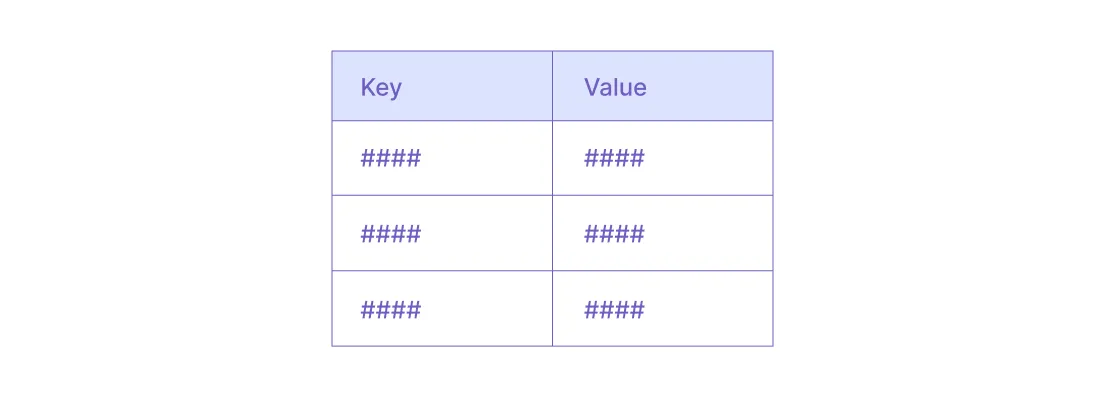
For state management, Ethereum utilizes an account-based model. Whatever data needs to be stored, it takes the form of “key: value,” where “key” is derived from the account address, and “value” can be, for example, the account’s balance.


Here is a database showing some sample keys and associated values:

When a new transaction is executed, account balances are adjusted. For example, if Alice sends Bob $10, the new state will be the following:

This is the core property of the account-based model: account states are adjusted with each transaction.

Can the Account-Based Model Suggest Privacy?

But, what if we want a transaction—for example, a transfer—to be private? Can we simply encrypt all entries in the database to create privacy?
The answer is no, we can’t. 

It leaks privacy. 

If we execute a transaction on encrypted entries, people can still see which entries were modified: that constitutes a leak in privacy. If two transactions engage the same account one by one, it’s clear that this particular account state was modified. 

By retrospectively analyzing account activity and the connections between them, one can retrieve tons of information. This means the account-based model doesn’t qualify for privacy needs.

UTXO Model Meets Privacy Needs

UTXO stands for unspent transaction output. In the UTXO model, the account state is represented as a record of unspent assets.

Unlike in the account-based model, in the UTXO model, account states cannot be modified. Instead, the model operates in an append-only manner. Whenever someone needs to update an account state—for example, the balance—they have to destroy some existing notes and create some new notes.

Going back to our previous example, Alice transfers $10 to Bob. 

The updated database is:
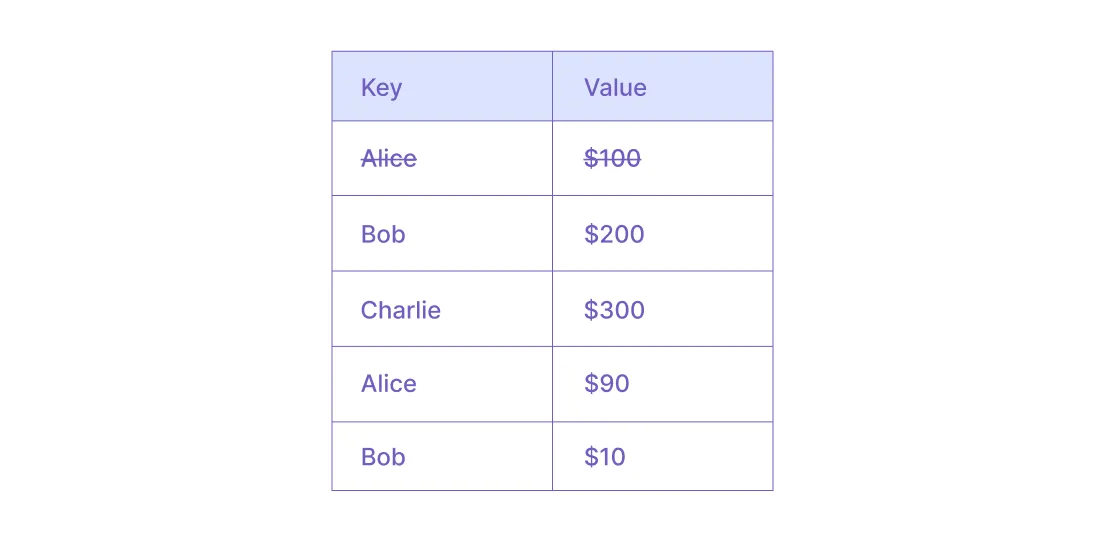
*In the example above, “crossed-out” indicates destroyed entries. 

So using UTXO, if we want a transaction to remain private, we can encrypt all the entries without causing a privacy leak:
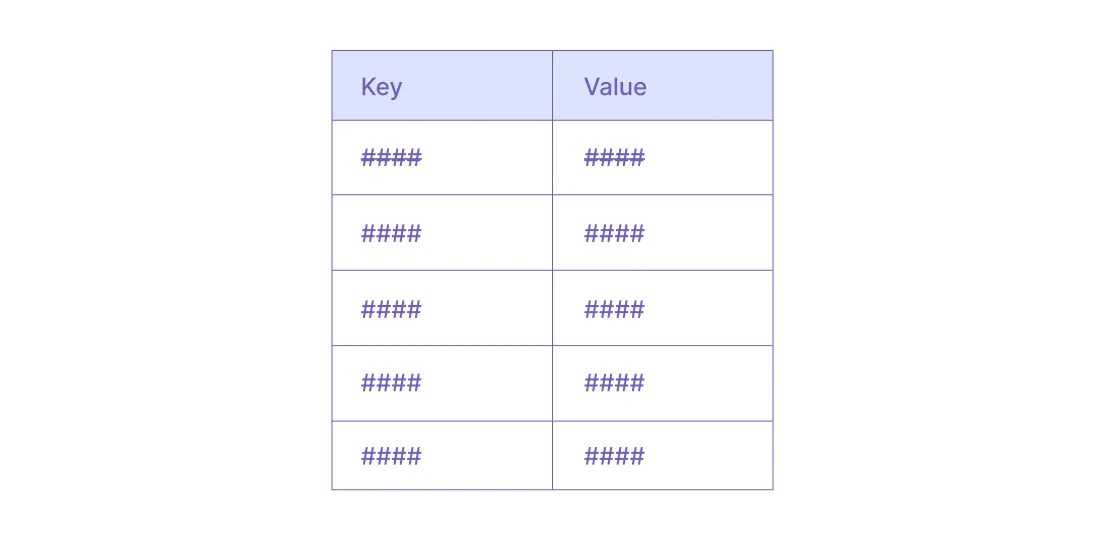
When one entry is destroyed and a new entry is created, observers can’t determine if these entries refer to the same account or to different accounts. No additional information can be gleaned by analyzing accounts’ activity. 

And that’s exactly what we need.

Aztec Meets the Needs of Ready-to-Use Privacy

Blended State Model on Aztec

Aztec utilizes the UTXO model for private state management and the account-based model for public state management. Public state is universal (i.e. one for the whole network and available for anyone) while private state is individual to every user. 

A smart contract on Aztec consists of both private and public functions. When a smart contract is executed, the first thing that happens is all private functions are executed client-side and the user's private state is updated. After that, all public functions are executed and the transaction execution is reflected in the public state update. 

Specifics of Aztec’s Private State 

As we discussed earlier, for the sake of privacy, private state operates in the append-only mode. At the same time, modifying an entry in the UTXO model means “destroying” the existing entry (or multiple entries) and creating new entries reflecting the transaction. (In our example, a note with a transfer to the receiver and Alice’s updated balance).

How can the note be destroyed in an append-only mode? Using nullifiers.

A nullifier is a commitment corresponding to a private entry that was destroyed. Only the note owner is aware of the correspondence between notes and nullifiers. For everyone else, it’s impossible to define which nullifier was created for which note.
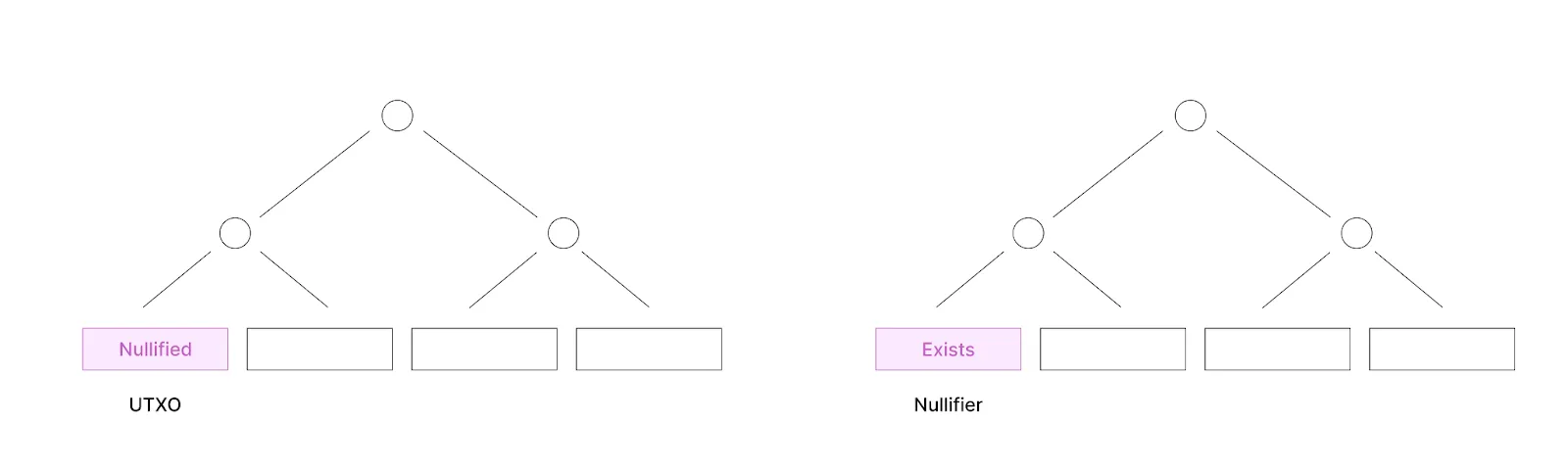
Every note can be consumed only once. When a new transaction emits a nullifier the sequencer has to check that this nullifier hasn’t existed before (to prevent double-spend).

Let’s circle back to our example: Alice has $100 and she is sending Bob $10. 

  • For simplicity’s sake, let’s first assume that Alice’s $100 is a single note.
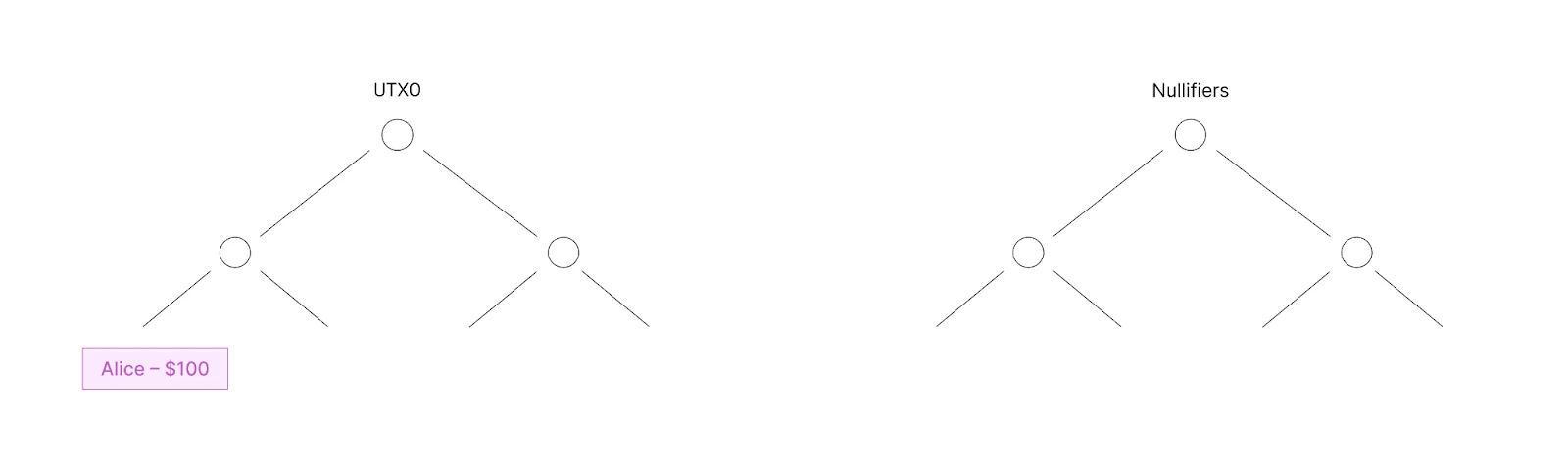
  • When Alice makes a transfer of $10, she destroys (or “consumes”) her $100 note. Meaning that she creates a nullifier corresponding to this particular note, and only she will know that this nullifier corresponds to the $100 note. She also creates a $10 note for Bob and a note for herself reflecting her updated balance of $90.
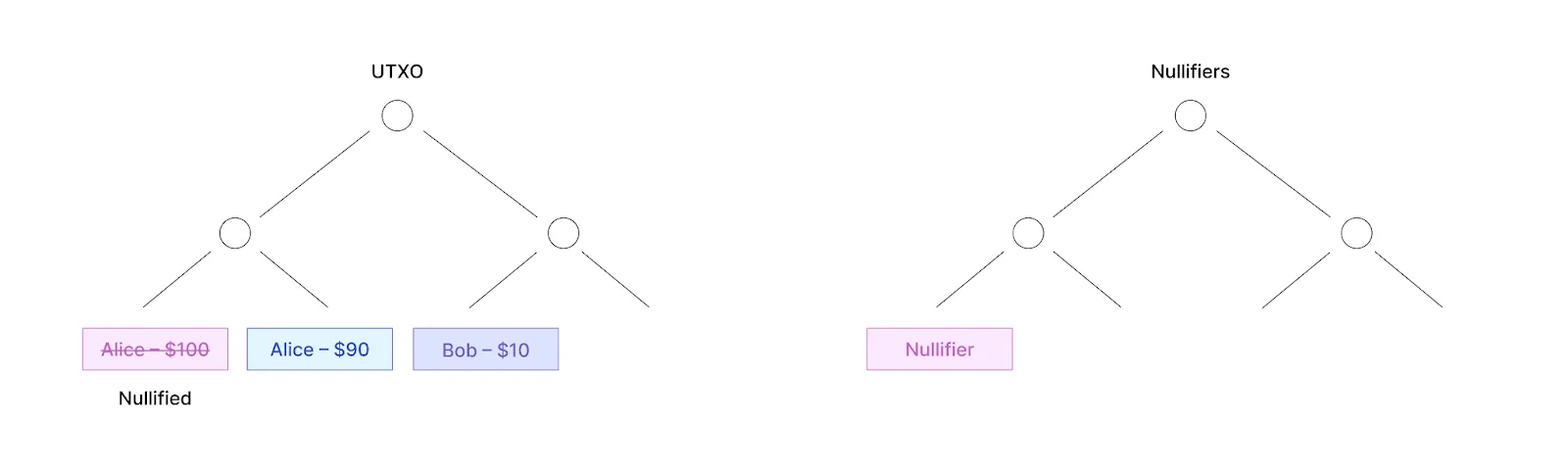
  • Bob then can decrypt the note and get access to the $10 transferred to him by Alice. No other action is required because in Alice's transaction, she has already added the commitment to Bob's note ($10) to the database.

Let’s think of another example. Alice has two notes, $50 and $60, and she wants to transfer $100 to Bob. For this transaction, she has to destroy both notes, emit a note for Bob with a value of $100, and emit a note for herself updating her remaining balance of $10. That is to say that an arbitrary amount of notes can be consumed per transaction. 

More generally, any state (i.e. not just balances) can be represented with notes. For example, if someone keeps a counter that they increase every time they send a transaction, they can store the value of the counter in a note. Every time they send a new transaction, they nullify the existing counter note and create a new one with the updated value.

Although notes and nullifiers are emitted client-side, it’s the sequencer who grabs the notes’ hashes and nullifiers (as commitments) and adds them to the databases (i.e. updates the state). That is to say, a client is always running its private execution environment in an “old” state.
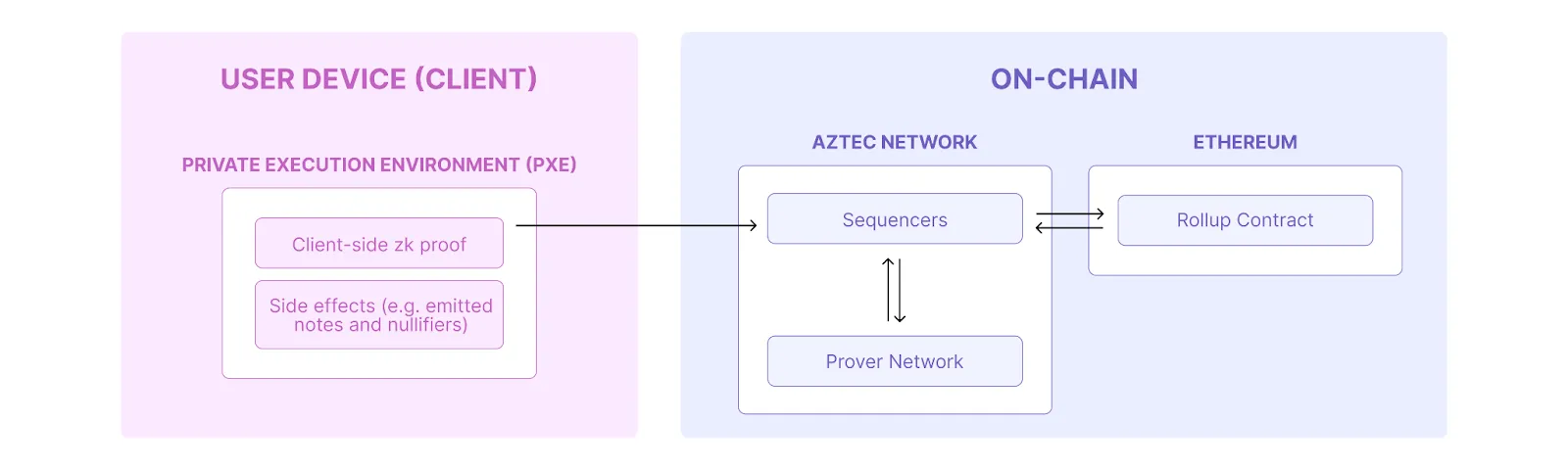
However, what if someone picks an old state root that satisfies some logic that the current state root would not satisfy? 

Circling back to our second example, imagine someone has a note where they keep an increasing counter. The counter owner is allowed to do something only if that counter is less than 10. So they can always pick a state root where the counter was less than 10 (even if it was 10 years ago) and just run their transaction over that state.

To mitigate this issue, the note must be nullified even if it was only read without spending it. This introduces the nullify-on-read concept that whenever someone reads a private note and performs some action on it (e.g. reading a note grants permission to make a call), they must nullify it and recreate it with the same value. Which means the content of each unique note can be read only once.

To Wrap it Up

In this article, we’ve explored the core concepts behind Aztec’s state management mechanism, which allows builders to get programmable and composable privacy. Now, it’s your turn!

Ready to put your hands on on-chain privacy and kick off the next big thing for Ethereum? – this is your next step.

Stay updated on all things Noir and Aztec by following Noir and Aztec on X, and join the Aztec developer community on Discord.

Read more
Aztec Network
Aztec Network
22 Jul
xx min read

How Gas Works on Aztec

Gas on Aztec

Gas on Aztec is known as Fee Juice and is used to pay for transaction costs. This is the same as $ETH on Ethereum. Some apps will handle transaction costs for you under the hood, but if you are using a browser extension wallet, you will not be able to send transactions without it. Fee Juice can be obtained by bridging the $AZTEC token on Ethereum to the Aztec Network L2. This means that under the hood, all activity that happens on Aztec is underpinned by the $AZTEC token bridged into the network. Some bridges like Shield (by human.tech) handle this for you, allowing you to allocate a portion of your bridged transaction to convert into Fee Juice and land in your wallet automatically.

Public vs Private Assets

Assets and transactions on the Aztec Network can be either public or private. If you bridge publicly, your tokens will arrive as public, traceable tokens visible to all. Privately bridging, on the other hand, will give you private assets that are visible only to you. These assets can then be sent privately to another user or wallet without ever revealing who you are, what tokens were sent, how many, or who the recipient is.

Public vs Private Gas

Like tokens on the Aztec Network, Fee Juice (gas) can also be public or private. The reason for this is that even if what you are sending is private, the gas you spend to execute that transaction could still be visible if you are using public Fee Juice, potentially revealing transaction patterns and activity. Private Fee Juice keeps your entire transaction footprint hidden. When you send a private transaction, you can use private Fee Juice, and when you send a public transaction, you can use public Fee Juice, which means your transaction costs are always aligned with the type of transaction you're making.

Fee Juice in Apps

Aztec has native fee abstraction, which means apps could let you pay for transactions in any token you want, or cover your fees entirely. Apps like Nyx may choose to cover part or all of a user's transaction costs, or allow you to pay in tokens that are convenient for you. This means you will most likely never see Fee Juice in an app; instead, you'll pay in whatever makes sense for what you're doing, on your terms. Similarly, you might never even see an Aztec wallet at all, because the app itself becomes your interface that you connect to using your MetaMask wallet.

Fee Juice in Browser Wallets

If you're using a browser extension like Azguard, you'll manage Fee Juice directly in your wallet alongside your private and public balances, converting between tokens as needed to cover transaction costs.

When you bridge tokens in, you'll need enough Fee Juice to cover the cost of your first transaction, then you'll need to monitor how much Fee Juice you have available to make transactions. Browser wallets will allow you to send either publicly or privately to other users and will default to using either public or private Fee Juice depending on the type of transaction. Both private Fee Juice and public Fee Juice will appear by default in your token list.

Wrapping up

How you handle Fee Juice depends on where you're transacting: apps can abstract it away entirely and let you pay in any token, while a browser wallet like Azguard puts it in your hands to manage across public and private balances. Match your gas to your transaction, keep private activity private down to the fee, and you move on your terms.

Aztec Network
Aztec Network
21 Jul
xx min read

Introducing Alpha V5

The Aztec Network today activated Alpha V5, a major protocol upgrade passed by token-holder governance and executed onchain. Alpha V5 reduces private-transaction proving times by more than 2x compared to the previous version, lowers the cost of a fully private transaction by roughly 50%, resolves the critical issues found in V4, and sees the first wave of apps go live. Users can now send private transactions and earn yield on Aave simply by connecting their Ethereum wallets on Nyx, bridge from Ethereum to Aztec using Shield or TRAIN, privately collect NFTs on RavenHouse, or play Dark Forest Aztec, a hidden-information strategy game in a universe that lives entirely onchain. 

"Alpha V5 continues Aztec's work at the frontier of client-side proving, with cryptographic breakthroughs that cut proving times by more than half this release," said Zac Williamson, Co-founder, Aztec Foundation. "We believe Aztec is now the fastest system in the world for proving a fully private transaction entirely on a user's own device, and every release moves the industry closer to private transactions at public transaction speeds."

As the only decentralized privacy L2, Aztec is the credibly neutral privacy layer for Ethereum. Aztec allows anyone to write smart contracts that include both private and public aspects – every private transaction is proven on the user's own device, so no operator, sequencer, or intermediary can see the data. The Alpha V5 proving improvements come from cryptographic advances that make this client-side proving faster than any prior release. The network remains in alpha, but with V5 it is ready for teams to begin building and deploying applications.

Performance - 2.5 second fully private transactions 

Making private transactions practical comes down to how quickly a proof can be generated on a user's own device, without offloading that work to a server that would learn what the user is doing. On Alpha V5, proving a private token transfer natively now takes approximately 2.5 seconds on a consumer laptop, down from 5.2 seconds on V4, and about 6.8 seconds in a browser, down from 12.5 seconds. Across every measured transaction flow, client-side proving times improved by approximately 2x compared with V4.

Bench machine: an M2 MacBook (12 cores, throttled to 8). "Native" runs Aztec's C++ proving binary; "WASM" runs the same prover in a browser engine (Node on V8).

Alpha V5 lowers ECDSA signature-verification cost by approximately 2x, speeds up Poseidon2 hashing by approximately 3x, and reduces the protocol circuit gate count by approximately 50% (gate count is the number of individual operations a proving circuit must perform, and it is the main driver of how long a proof takes to generate). Each of these lowers the amount of work a device performs to prove a transaction, and the reduction in gate count in particular compounds across every proof the network generates.

Apps - send, receive, and earn privately on Ethereum

Alpha V5 launches the first wave of apps on a network where privacy is built into the protocol rather than managed by an operator. On other networks that claim privacy, transactions still pass through an operator or node that reads them in plaintext, or depend on a viewing key that a third party holds, so users rely on someone else to protect their data and to decide when it gets disclosed. On Aztec, every private transaction is proven on the user's own device, so the app, the sequencer, and any operator never need to see the underlying data. Nyx is one of these apps, allowing users to privately send transactions and privately earn yield on Aave. 

"On Ethereum, everything you do is public. That's why we built Nyx: a private account governed by your Ethereum wallet", said Nikhil, Co-founder of Nyx. "Now you can send, receive and earn in private. Nyx was the first app live on the Aztec Alpha, and we're excited to expand participation to more users with the added stability of Alpha V5."

Other apps on Alpha V5 include Azguard and Nethermind (wallets), Shield, TRAIN, and RavenHouse (bridges), and the Aztecscan block explorers. Also launching is Dark Forest Aztec, a game where users explore a universe, control planets, manage planetary energy, expand territory, and launch attacks through strategic play with private state and hidden actions.

Dark Forest Aztec private universe-building gameplay

Lower costs, higher security 

Transaction fees on Aztec come from two main sources: the cost of proving a transaction and the cost of verifying the rollup proof on Ethereum. Alpha V5 reduces both. It lowers the network's proving-cost parameter by 50%, and it reduces the L1 gas required to verify a rollup proof by approximately 40%. Because rollup proofs are verified on Ethereum and that cost is shared across all transactions in a batch, the L1 reduction lowers fees for every user, while the lower proving-cost parameter reduces the per-transaction proving fee directly. Together, these bring the average cost of a fully private token transfer to under a $0.05 transaction cost.

Alpha V5 also hardens the network on several fronts. It resolves critical vulnerabilities found in Alpha V4 along with additional bugs discovered since launch. Aztec's bug bounty program on Cantina also drew more than 234 security researchers to participate. The network remains in alpha, and further bugs may surface as usage grows, but each release has closed the issues found in the last and strengthened the protocol against new ones. With the critical V4 issues resolved and these safeguards in place, Alpha V5 is stable enough for teams to begin building and deploying applications.

Availability

Alpha V5 is live now, view the Alpha V5 landing page for a full list of features, performance updates, and live apps to explore. 

About Aztec

Aztec is the only decentralized, privacy-first Layer 2 on Ethereum. Developers write private and public logic in the same smart contract, and private functions are executed and proven on the user's own device, so no operator sees the underlying data. The protocol is upgraded through onchain governance, and the network settles to Ethereum. For more information, visit aztec.network.

Aztec Network
Aztec Network
30 Jun
xx min read

Inside an Aztec Transaction

On Ethereum today, each transaction reveals everything publicly. The token you moved, the size, the timing, the wallet it came from, every action you take. Given the limitations of this type of transparent network, the industry is now focusing on bringing privacy onchain as a top priority. The response to this has mostly been to enable private transactions that shield transfers in various ways. But when we look at how privacy works on Web2, it’s clear that users and developers need granular privacy controls: the ability to decide what is public or private and who is able to see different types of data.

Aztec was built so that one transaction can carry two halves. A private half that runs on your own device and never leaves it, and a public half that the network runs in the open. Apps can choose which aspects are private or public, and users can choose what they want to reveal and when.

This article will follow an example transaction on Aztec: a vote in an onchain election built on Aztec, where who you are and which candidate you chose stay private, while the running tally for each candidate stays public for anyone to verify.

Public and private in one move

Picture the vote you cast in our example as two aspects that seamlessly weave together. In the first step, you act in private: an app records your vote on your device and hands the network a proof that the vote is valid without revealing it. In the second, the network acts in public: it checks that proof, then adds one to the chosen candidate's public tally. It is one transaction: one part stays with you, one part goes to the network. Both parts end up recorded onchain, in two separate state trees, one private and one public. The walkthrough below follows how these two aspects work together and what this means for how your transaction lands onchain. 

It starts on your device

You open the voting app and connect an Aztec wallet. That first step looks like any onchain app. The difference is inside the wallet. An Aztec wallet carries a private execution environment, the PXE, pronounced "pixie", which runs on your phone or in your browser. The PXE is where the private half of your transaction executes, and where the proof of that work gets made, on your hardware, under your exclusive control.

Every account on Aztec is a smart contract rather than a bare key. That design, account abstraction, allows a wallet to authorize a transaction however its owner chooses without writing an identity onto the network for everyone to read. The wallet is the front door, and on Aztec you can decide if the door is open or closed, who you share your information with. 

The private half runs on your device

The voting app is a smart contract with two kinds of functions. The private functions run first, and they run inside your PXE. Your identity and the candidate you picked are the private inputs, and they stay on your device.

The only thing to leave your device is a proof confirming the legitimacy of your vote. Aztec's client-side proving system, Chonk, takes the private execution and produces a zero-knowledge proof: a compact cryptographic receipt that your vote followed the rules, that you are eligible, and have not voted before, while revealing nothing about who you are or who you voted for. Think of it as a sealed ballot the network can confirm is valid without opening it. The network learns only that a legitimate vote happened. It does not learn how you voted, or even which account voted. 

This is the part that used to be too slow to be practical. Generating a proof on a phone was the bottleneck every privacy app hit. Aztec’s Chonk is purpose-built for fast proving on low-memory devices, both natively and in the browser, so the private half runs on the device in your hand instead of on someone else's server.

The public half runs in the open

Some elements of a vote should be public. The tally is shared infrastructure, the number everyone relies on to trust the result. Thanks to programmable privacy on Aztec, the app marks that part public. Public functions live on the network and run in the open, the way functions do on Ethereum.

On Aztec, private and public logic live in the same contract, and the developer decides which is which, function by function and variable by variable. Programmable privacy is a dimmer, not a switch. The voting app turns it up on the individual ballot and turns it down on the running tally. That boundary is a design decision written into the contract, and it is the thing no transparent chain and no fixed-privacy chain can offer.

The network checks the proof and runs the public part

Your vote leaves your device as a bundle: the zero-knowledge proof of the private half, plus the call to the public function that updates the count. It goes to Aztec's sequencers, a decentralized set of thousands of independent operators, with more than 3,500 of them running the network today.

The sequencers do two jobs at once. They verify the proof of your private vote, confirming it is valid and eligible without seeing the choice behind it, and they run the public function that adds one to the chosen candidate and updates the public tally. Your ballot stays sealed. The count goes up by one for everyone to see. The same proof guarantees you cannot vote twice, even though no one learns which ballot is yours.

Two state trees, both onchain

Aztec has two main state trees, and both live onchain. One holds private state, the other holds public state, so the full record of what happened sits on the network rather than on any one person's laptop. The two trees store each record in two different ways depending on if it needs to be private or public. 

The private tree uses a UTXO model, the same note-based design used by Zcash. In this model, state is written as commitments: each entry is a sealed record that a valid vote was cast, with the voter and the choice kept private. Just like with Zcash or Bitcoin, you do not edit a private entry in place. You write a new one, and the design stops the same vote from being cast twice (old state is nullified). The vote stays private, and the record of a legitimate vote happening is onchain for the network to check.

The public tree uses an account-based model, the same shape Ethereum uses: values that update in place, readable by anyone. This is where each candidate's tally lives.

One transaction wrote information to both trees. The private tree recorded that you voted, sealed. The public tree recorded the new totals, in the open. Everything is onchain. The difference between the two trees is how much each one reveals.

Every private app on Aztec writes into that same private tree. A vote, a payment, and a payroll run all land in one shared record of activity, so each user's privacy grows stronger as the network grows, instead of splitting into a separate pool for every app.

A block is proposed, and Ethereum records it

Aztec is an L2 on Ethereum, so everything settles to Ethereum L1. A sequencer on Aztec gathers transactions into a proposed block. Other sequencers validate it before it goes to Ethereum's pending chain. At that point the block sits on Ethereum, ordered and recorded, waiting for its proof. The network has agreed on what happened and the proposed block is just waiting a final proof. 

Anyone can prove it

Proving a block is its own job, and on Aztec, it belongs to no one in particular. A decentralized, permissionless set of provers competes to take a full epoch, a 32-block stretch of the chain, and compresses it into a single zero-knowledge proof of the entire epoch. Anyone with the hardware can run a prover and bid for the work. There is no privileged operator, no committee you have to trust, no outside network holding a key.

That openness is the whole point of a privacy layer. A system that protects your data but routes it through one trusted server has only moved the exposure rather than removed it. Aztec keeps proving permissionless and your private inputs on your device, thereby avoiding any exposure.

The economics land in the voter's favor too. As an L2 network, Aztec spreads the cost of that one L1 proof across thousands of transactions in the rollup, so a vote costs pennies, not the millions of gas a private proof would cost verified alone on Ethereum.

Settled on Ethereum, verifiable by anyone

A prover then posts the epoch proof to Ethereum's proven chain, and the Aztec state is final. Ethereum verifies one proof and inherits the correctness of everything inside it. Aztec extends Ethereum and settles to Ethereum, so your hybrid transaction carries Ethereum's security without carrying Ethereum's enforced transparency.

Anyone can now verify that the result is valid and that every counted vote was legitimate. No one can see how any individual voted. The tally is on the shared ledger where it belongs, and your ballot stayed yours the whole way through.

What this unlocks

For the voter, their ballot was never a broadcast. The candidate you chose stayed yours, with no record tying your wallet to a name for anyone to read later, and you can still check that your vote was counted and the result is honest. You took part without your choice becoming data for systems built to act on it.

For a founder, the election app in this walkthrough is easy to implement without needing to build extensive custom code. Secret ballots with a public, verifiable count, in one contract, is a product category that opens up only because the boundary is programmable. You can build governance, elections, and polls where people vote without fear and the result still proves itself. And of course you can build anything that requires both public and private state to work seamlessly together. 

For an infrastructure provider, the same machinery serves clients who need a result they can stand behind without exposing the people who produced it. Selective disclosure lets a client prove exactly what a counterparty needs to see, the count and the integrity of the process, and protect everything else, on their own terms. That is a guarantee a transparent chain cannot make.

A real vote needs two things at once: a secret ballot and a count anyone can check. A transparent chain makes you give up the first to get the second. On Aztec, you get both. The tally settled on Ethereum for anyone to verify, and how you voted stayed yours. The infrastructure is in place, what will you create with it? 

->Review the Aztec Basics

->Head to the docs and start building today

Aztec Network
Aztec Network
23 Jun
xx min read

The Devil's Bargain - Privacy Without Credible Neutrality

Crypto is in a long night. It is no secret that the industry is facing challenging circumstances and there has been a clear consolidation of the industry. Right now we are seeing a focus on real traction, demonstrable value projects shipping practical solutions that will meaningfully reach users. 

Some of that discipline is overdue. However, in times like these the properties that made crypto structurally different begin to look expendable. Decentralization slows you down. It makes upgrades harder. It makes institutional sales harder. It removes the control surfaces that the existing financial world knows how to buy.

We used to accept those costs as the price of building something durable. But, in a famine, they look like unaffordable affectations. Discarding them wholesale, however, is like selling the land out from under our feet.

Permissionless, uncensorable transaction networks with rich composability - this is the clay from which our industry was grown. The long term commercial health of our industry depends on preserving these properties in an age of privacy and institutional adoption.

These trade-offs become more challenging and pernicious when privacy is involved. Privacy is the narrative for crypto in 2026, and for good reason. It’s the missing piece that will deliver the traction and real use-cases that the industry so desperately needs. 

The challenges of decentralization multiply under the constraints of privacy and what we are seeing in the industry is not a pivot, but a complete capitulation of all of the differentiable value that made crypto valuable.

I have spent nearly a decade building a network that marries programmable privacy with decentralization. A network where users keep their data, where applications are composable with one another, where transactions can settle without a privileged party learning everyone’s business or deciding which products are allowed to exist. That required new cryptography, new programming models, new state architecture, new wallets, and a fairly insane number of tradeoffs that are invisible until you try to build the thing yourself. There are easier products to ship. 

A centralized privacy service can give institutions something legible quickly, replicating how the existing financial sector works: a responsible operator, a viewing key, a way to block transactions, a way to explain the whole thing to a risk committee. Some of these products will be useful. Some will be good businesses. But they are not the thing we came here to build.

The Devil’s Bargain

Institutional and enterprise adoption is one of the core growth areas in this crypto-winter and the playbook is simple: use the language of crypto as a skin-suit to sell products and services that pattern match onto existing financial rails, with their need for complete visibility, censorship, centralized network operators and all of the liabilities this incurs.

This is a tempting bargain because it shortens the path to adoption. It gives buyers and regulators a shape they understand. A company. A contract. A switch. But the moment you accept that bargain, the system changes character. It may still be encrypted. It may still contain proofs. It may still call itself private. But, it now behaves like and is an operated service. 

There is a party with privileged knowledge and privileged control. Builders must shape themselves around it. Institutions negotiate with it. Regulators may pressure it. Attackers target it. Users ultimately depend on it. By a backdoor I mean something specific: a network or protocol-level viewing key where the product developer does not control who can see their users’ data, especially when paired with network-level controls that can block transactions or ban smart contracts entirely. I do not mean application-level controls. I do not mean user-authorised disclosure. I do not mean a dapp deciding that users must prove something before using it. Regulated applications will need rules. The issue is that the disclosure boundary of your application belongs to somebody else, and the same layer that sees can also decide whether your users are allowed to transact. In short, users lack a platform that has credible neutrality.

The Platform Risk

Privacy on top of centralized rails is fatal. If one party can see everything and stop anything, that party may be treated as responsible for seeing and stopping.

This compounds into substantial platform risk. If an entity builds on top of such a system they must surrender visibility and control to the network operator to satisfy their liabilities without consideration for yours. Decentralization and ultimately credible neutrality is the difference between whether you own durable infrastructure or are renting a service whose rules can change on a whim. Worse, you cannot “just build things”. For novel transaction flows approval must be sought and granted. Tell me, would Ethereum have grown if every smart contract deployment required approval from the Ethereum Foundation?

Privacy needs the same freedom. A private credit market, for example, touches identity, collateral, repayment history, payment flows, liquidation logic, lender disclosures, auditor access and borrower privacy. If every component lives inside a different permissioned service, each with its own operator and viewing assumptions, that is a bureaucratic friction that negates blockchain’s core value proposition; composability.

A decentralized and credibly neutral privacy network prevents the settlement layer from becoming the single place where all surveillance and censorship obligations naturally accumulate. It allows product developers to scope their code to satisfy their own narrow requirements without consideration for the obligations of a centralized operator.

Building for credible neutrality

A lot of today’s privacy narrative treats architecture as if it were a detail. It is not. You cannot take a transparent ledger, staple confidentiality onto the edge, add a viewing key for comfort, and expect to get programmable private infrastructure.

If the state model is not private from the ground up you get wrappers, third party tools, data custodians, ad hoc disclosure paths and a pile of assumptions that every application drags into the next. Developers do not get a normal programming model where private contracts can call private contracts and users keep state on their own devices. They do not get composability.

The difference matters. In a real private execution environment, users generate transactions locally. They do not outsource their intent to a third party who learns what they are doing. Private contracts interact through a state model designed for privacy. The network settles proofs without becoming the party that knows everyone’s business. Privacy is part of the architecture.

This is why Aztec has taken so long. We built something that makes programmable private state and decentralised settlement live inside the same system. That means proving systems that run on consumer hardware, a transaction architecture built around local private execution, and a programming model where privacy is idiomatic and just works out of the box.

A centralized service can skip much of this. It can hold the key, run the prover, approve the flow and call the result privacy. It gets to market faster because it is not trying to arrive at the same place.

The edge

Adding decentralization does not make obligations disappear. Applications, issuers, frontends, custodians and regulated businesses will continue to exist in a web of obligations and responsibilities. Anyone pretending otherwise is unserious.

The question is where those obligations live. If they are pushed into the settlement layer, the settlement layer is no longer credibly neutral. It needs visibility into everyone and controls over everyone. 

The better answer is selective disclosure. Users and applications should prove specific facts to specific parties for specific purposes. A regulated application may need to know that a user passed a check, that a transaction satisfies a policy, or that an auditor can inspect a particular flow. None of that requires the base network to hold a permanent key into everyone’s activity.

This will be harder to explain to the existing world. New infrastructure always fails to fit the categories built for the old infrastructure. Bitcoin did not arrive as a neatly regulated bank product. Ethereum did not wait for every lawyer to understand smart contracts. Stablecoins and DeFi forced institutions, regulators and users to develop new language around rails that kept existing.

If the standard for privacy infrastructure is to plug into the old world without changing anything, the answer will always be a service with a backdoor. And the result will be to catch crumbs falling from the tables of the old world.

The market worth building

The market we should be building is, well, a market. A private financial system that compounds: assets, liquidity, identity, credentials, credit and applications interacting through a shared settlement layer without forcing users to surrender their data to whoever sits in the middle. 

Traditional finance is built out of vertically integrated information silos. Those silos are its moat. Banks, exchanges, custodians, payment processors and data brokers all benefit from controlling the information that flows through them. A global private settlement layer attacks that advantage directly. It lets liquidity and credentials move while outsourcing information custody to neutral cryptographic infrastructure. 

A company wants a moat. A settlement layer wants surface area. A permissioned privacy provider can ration access, raise fees, exclude applications, shape disclosure rules and define acceptable use around its own risk tolerance. These are products pretending to be networks, and not durable financial infrastructure. What bothers me is this compounding category confusion. Networks adding protocol-level viewing keys and transaction controls are using the same language as decentralised programmable privacy, and commentators are treating them as variations of the same thing. They are not.

We have spent nine years walking the hard road. Now, just as we are close, the market has lost faith. Everyone is reaching for whatever lifeline looks immediate. Some of those lifelines will be real. Some will make money. But if crypto responds to its long night by rebuilding financial privacy as permissioned services, then we will have survived by surrendering the property that made the industry worth building.

Markets can grow when the platform is removed from the position where it can dictate the rules. It would be perverse to forget that lesson while building privacy, the domain where control over information matters most.

The land we till

Crypto is in a famine. The land is struggling. We could sell our land for a pittance and survive the season. But the famine will pass, and when it does the land will blossom again. Without the land we are nothing.

We have struggled immensely to create a permissionless network that can marry privacy with decentralisation: an indestructible network whose users cannot be surveilled and whose transactions cannot be censored. This is the soil we have to grow our crops. To surrender a backdoor or a centralized operator for temporary relief is to sell our land for the price of a stablecoin. And we cannot sell the land.


Follow Zac on X to get more insights
Follow Aztec on X for updates & breaking news