On Ethereum today, each transaction reveals everything publicly. The token you moved, the size, the timing, the wallet it came from, every action you take. Given the limitations of this type of transparent network, the industry is now focusing on bringing privacy onchain as a top priority. The response to this has mostly been to enable private transactions that shield transfers in various ways. But when we look at how privacy works on Web2, it’s clear that users and developers need granular privacy controls: the ability to decide what is public or private and who is able to see different types of data.
Aztec was built so that one transaction can carry two halves. A private half that runs on your own device and never leaves it, and a public half that the network runs in the open. Apps can choose which aspects are private or public, and users can choose what they want to reveal and when.
This article will follow an example transaction on Aztec: a vote in an onchain election built on Aztec, where who you are and which candidate you chose stay private, while the running tally for each candidate stays public for anyone to verify.
Public and private in one move
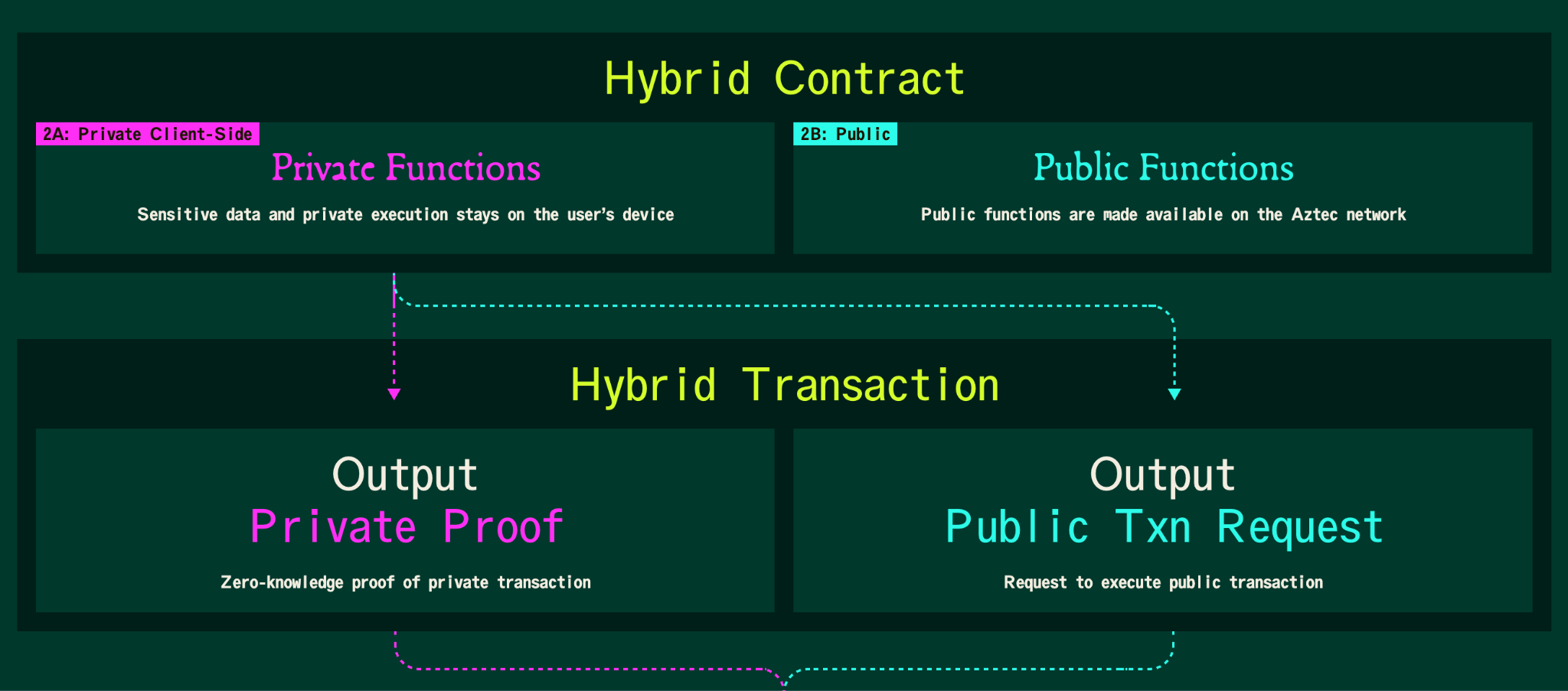
Picture the vote you cast in our example as two aspects that seamlessly weave together. In the first step, you act in private: an app records your vote on your device and hands the network a proof that the vote is valid without revealing it. In the second, the network acts in public: it checks that proof, then adds one to the chosen candidate's public tally. It is one transaction: one part stays with you, one part goes to the network. Both parts end up recorded onchain, in two separate state trees, one private and one public. The walkthrough below follows how these two aspects work together and what this means for how your transaction lands onchain.
It starts on your device
You open the voting app and connect an Aztec wallet. That first step looks like any onchain app. The difference is inside the wallet. An Aztec wallet carries a private execution environment, the PXE, pronounced "pixie", which runs on your phone or in your browser. The PXE is where the private half of your transaction executes, and where the proof of that work gets made, on your hardware, under your exclusive control.
Every account on Aztec is a smart contract rather than a bare key. That design, account abstraction, allows a wallet to authorize a transaction however its owner chooses without writing an identity onto the network for everyone to read. The wallet is the front door, and on Aztec you can decide if the door is open or closed, who you share your information with.
The private half runs on your device
The voting app is a smart contract with two kinds of functions. The private functions run first, and they run inside your PXE. Your identity and the candidate you picked are the private inputs, and they stay on your device.
The only thing to leave your device is a proof confirming the legitimacy of your vote. Aztec's client-side proving system, Chonk, takes the private execution and produces a zero-knowledge proof: a compact cryptographic receipt that your vote followed the rules, that you are eligible, and have not voted before, while revealing nothing about who you are or who you voted for. Think of it as a sealed ballot the network can confirm is valid without opening it. The network learns only that a legitimate vote happened. It does not learn how you voted, or even which account voted.
This is the part that used to be too slow to be practical. Generating a proof on a phone was the bottleneck every privacy app hit. Aztec’s Chonk is purpose-built for fast proving on low-memory devices, both natively and in the browser, so the private half runs on the device in your hand instead of on someone else's server.
The public half runs in the open
Some elements of a vote should be public. The tally is shared infrastructure, the number everyone relies on to trust the result. Thanks to programmable privacy on Aztec, the app marks that part public. Public functions live on the network and run in the open, the way functions do on Ethereum.
On Aztec, private and public logic live in the same contract, and the developer decides which is which, function by function and variable by variable. Programmable privacy is a dimmer, not a switch. The voting app turns it up on the individual ballot and turns it down on the running tally. That boundary is a design decision written into the contract, and it is the thing no transparent chain and no fixed-privacy chain can offer.
The network checks the proof and runs the public part
Your vote leaves your device as a bundle: the zero-knowledge proof of the private half, plus the call to the public function that updates the count. It goes to Aztec's sequencers, a decentralized set of thousands of independent operators, with more than 3,500 of them running the network today.
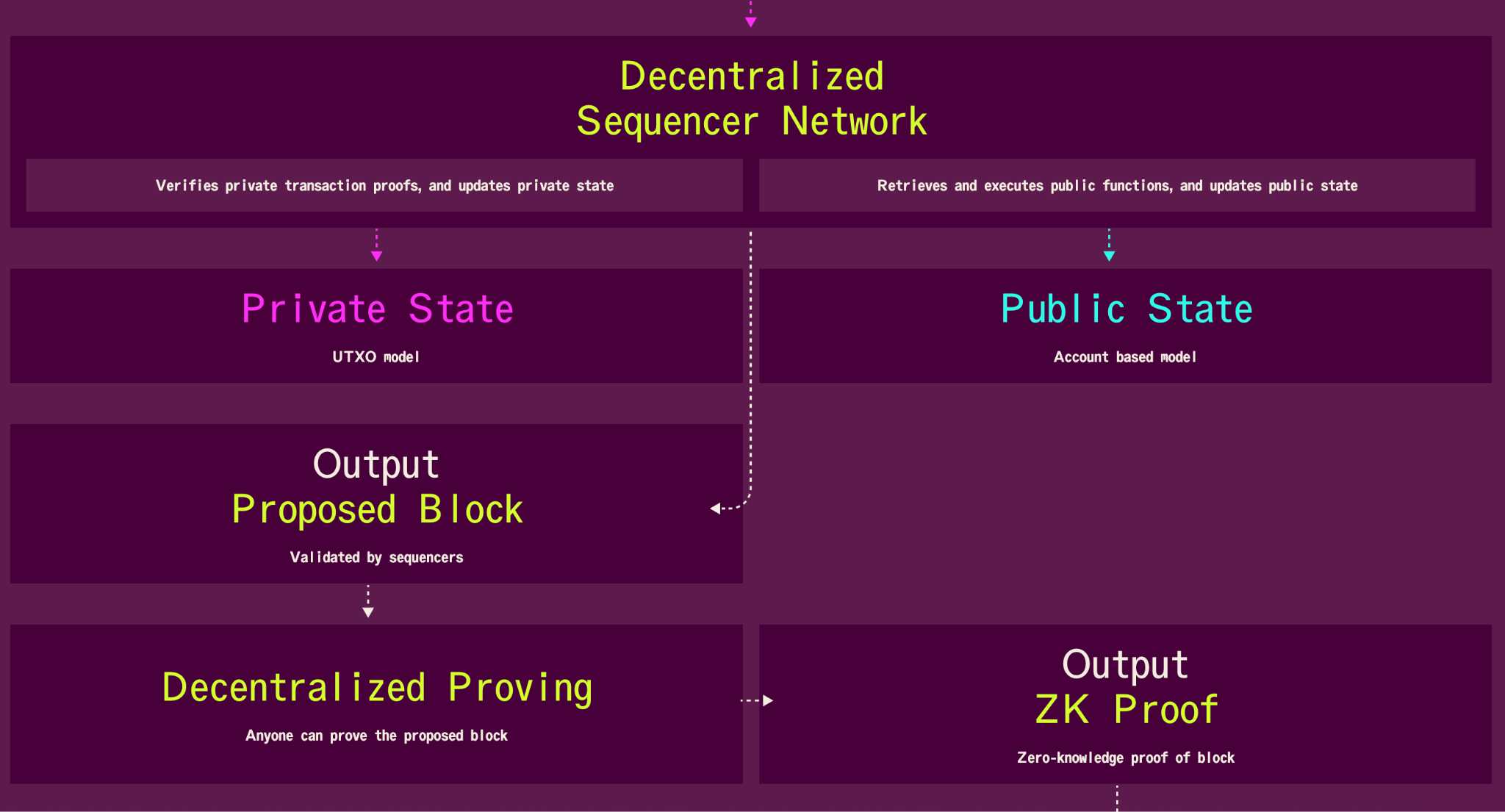
The sequencers do two jobs at once. They verify the proof of your private vote, confirming it is valid and eligible without seeing the choice behind it, and they run the public function that adds one to the chosen candidate and updates the public tally. Your ballot stays sealed. The count goes up by one for everyone to see. The same proof guarantees you cannot vote twice, even though no one learns which ballot is yours.
Two state trees, both onchain
Aztec has two main state trees, and both live onchain. One holds private state, the other holds public state, so the full record of what happened sits on the network rather than on any one person's laptop. The two trees store each record in two different ways depending on if it needs to be private or public.
The private tree uses a UTXO model, the same note-based design used by Zcash. In this model, state is written as commitments: each entry is a sealed record that a valid vote was cast, with the voter and the choice kept private. Just like with Zcash or Bitcoin, you do not edit a private entry in place. You write a new one, and the design stops the same vote from being cast twice (old state is nullified). The vote stays private, and the record of a legitimate vote happening is onchain for the network to check.
The public tree uses an account-based model, the same shape Ethereum uses: values that update in place, readable by anyone. This is where each candidate's tally lives.
One transaction wrote information to both trees. The private tree recorded that you voted, sealed. The public tree recorded the new totals, in the open. Everything is onchain. The difference between the two trees is how much each one reveals.
Every private app on Aztec writes into that same private tree. A vote, a payment, and a payroll run all land in one shared record of activity, so each user's privacy grows stronger as the network grows, instead of splitting into a separate pool for every app.
A block is proposed, and Ethereum records it
Aztec is an L2 on Ethereum, so everything settles to Ethereum L1. A sequencer on Aztec gathers transactions into a proposed block. Other sequencers validate it before it goes to Ethereum's pending chain. At that point the block sits on Ethereum, ordered and recorded, waiting for its proof. The network has agreed on what happened and the proposed block is just waiting a final proof.
Anyone can prove it
Proving a block is its own job, and on Aztec, it belongs to no one in particular. A decentralized, permissionless set of provers competes to take a full epoch, a 32-block stretch of the chain, and compresses it into a single zero-knowledge proof of the entire epoch. Anyone with the hardware can run a prover and bid for the work. There is no privileged operator, no committee you have to trust, no outside network holding a key.
That openness is the whole point of a privacy layer. A system that protects your data but routes it through one trusted server has only moved the exposure rather than removed it. Aztec keeps proving permissionless and your private inputs on your device, thereby avoiding any exposure.
The economics land in the voter's favor too. As an L2 network, Aztec spreads the cost of that one L1 proof across thousands of transactions in the rollup, so a vote costs pennies, not the millions of gas a private proof would cost verified alone on Ethereum.
Settled on Ethereum, verifiable by anyone
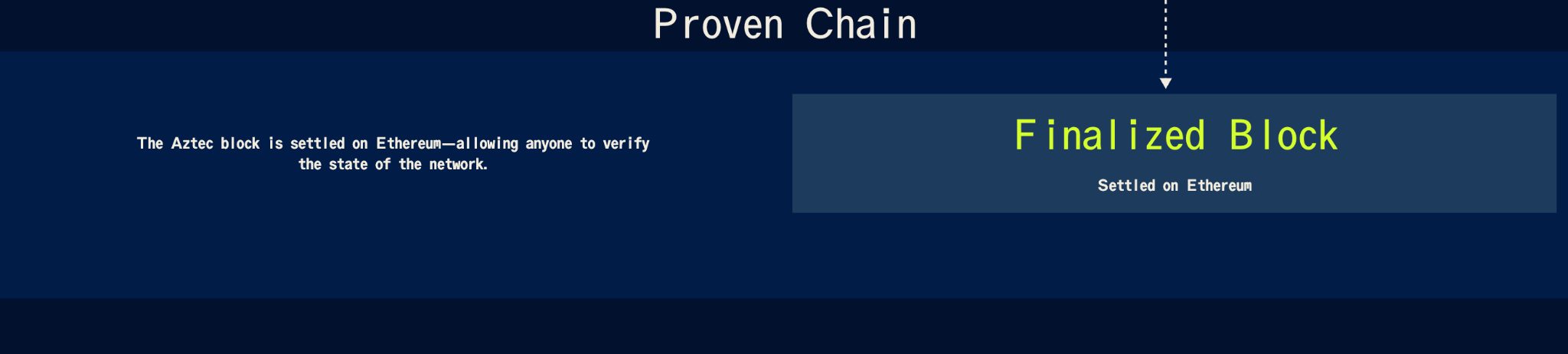
A prover then posts the epoch proof to Ethereum's proven chain, and the Aztec state is final. Ethereum verifies one proof and inherits the correctness of everything inside it. Aztec extends Ethereum and settles to Ethereum, so your hybrid transaction carries Ethereum's security without carrying Ethereum's enforced transparency.
Anyone can now verify that the result is valid and that every counted vote was legitimate. No one can see how any individual voted. The tally is on the shared ledger where it belongs, and your ballot stayed yours the whole way through.
What this unlocks
For the voter, their ballot was never a broadcast. The candidate you chose stayed yours, with no record tying your wallet to a name for anyone to read later, and you can still check that your vote was counted and the result is honest. You took part without your choice becoming data for systems built to act on it.
For a founder, the election app in this walkthrough is easy to implement without needing to build extensive custom code. Secret ballots with a public, verifiable count, in one contract, is a product category that opens up only because the boundary is programmable. You can build governance, elections, and polls where people vote without fear and the result still proves itself. And of course you can build anything that requires both public and private state to work seamlessly together.
For an infrastructure provider, the same machinery serves clients who need a result they can stand behind without exposing the people who produced it. Selective disclosure lets a client prove exactly what a counterparty needs to see, the count and the integrity of the process, and protect everything else, on their own terms. That is a guarantee a transparent chain cannot make.
A real vote needs two things at once: a secret ballot and a count anyone can check. A transparent chain makes you give up the first to get the second. On Aztec, you get both. The tally settled on Ethereum for anyone to verify, and how you voted stayed yours. The infrastructure is in place, what will you create with it?