
Aztec is built on one idea: smart contracts on Ethereum where developers choose what is public and what is private. That doesn't just mean shielded transactions. It means who acts (identity), what they transact (state), and how they execute (computation) can all be private. Aztec makes end-to-end privacy possible; even the contracts themselves can be private.
But privacy also has to be practical. Aztec integrates private and public execution in the same contract, so apps can seamlessly weave together private and public state. Every account is a smart contract, letting users grant granular, revocable access for selective disclosure, which is useful for compliance, tax reporting, or agent permissions.
Finally, Aztec is a decentralized L2, with 3,500+ sequencers participating in the network today. That permissionlessness is what makes Aztec a credible foundation for a global privacy layer.
In this article we’re going to explore the Aztec stack and how we make programmable privacy a reality. We’ll answer questions like ‘what can you do on Aztec?’, ‘how does it all work?’, and ‘what are the core layers of the system that makes it all possible?’
TL;DR
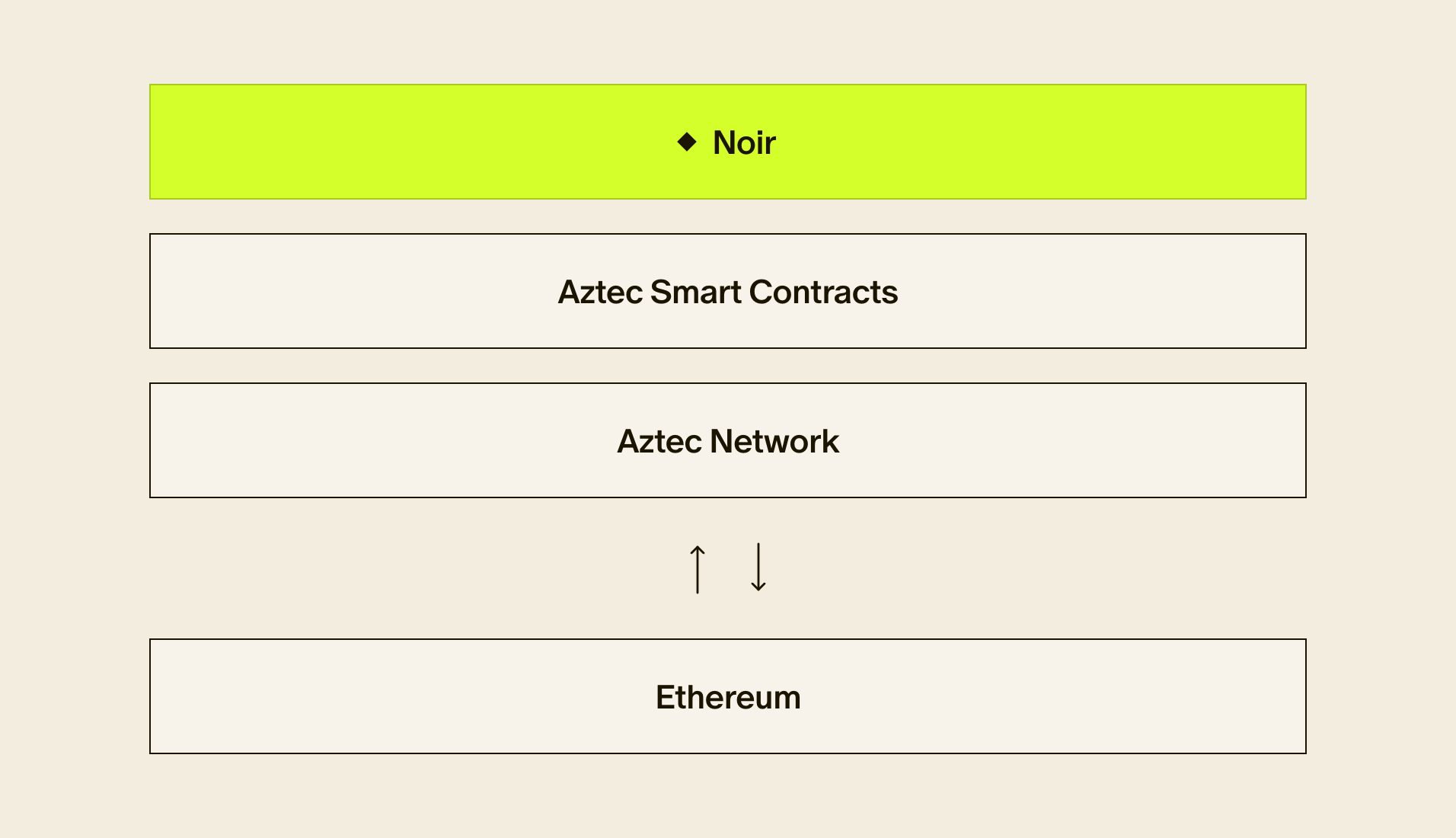
The four layers of the Aztec stack, all live today on the Alpha network:
- Noir: a programming language for writing private programs with simple, familiar syntax.
- Aztec smart contracts: written in Noir using the Aztec.nr framework, allowing you to easily write smart contracts with both public and private state.
- Aztec Network: a fully decentralized, privacy-preserving Ethereum L2 for building useful applications. Private state uses a UTXO model, public state uses an account-based model like Ethereum.
- Ethereum: L2 txn rollup proofs are stored on Ethereum, inheriting strong economic security.
Layer 1: Noir, the Universal Language of ZK
Aztec smart contracts are written in Noir, a programming language with Rust-like syntax optimized for writing private programs. Noir is an open-source project developed by Aztec and is now the industry-leading language for writing private apps using zero-knowledge proofs. Let’s dive into what Noir is, and why we use it as the building block for writing smart contracts.
Writing zk programs is extremely difficult without a background in cryptography. When developing Noir, our first goal was to create a highly optimized and easy-to-write zk Domain Specific Language (zkDSL) where developers don’t need to know any of the underlying mathematics. As a result, Noir handles all the cryptographic complexities, and will automatically convert your code into fancy zk circuits.
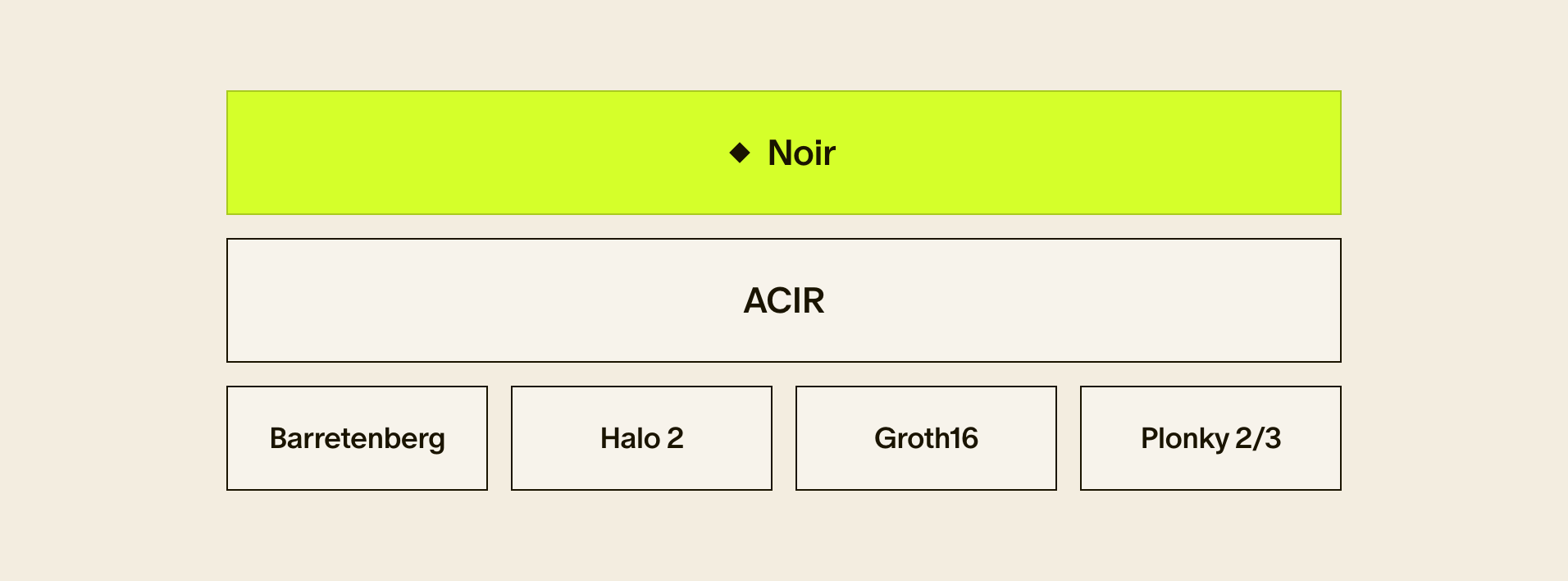
Noir compiles down to the Abstract Circuit Intermediate Representation (ACIR), an adaptable intermediary language that makes it easy to plug in a variety of popular proving backends. These proving backends, such as Aztec’s Barretenberg proving system, take the compiled zero-knowledge circuits and generate proofs attesting to the validity of the program’s execution, all without revealing any private inputs. From authorization systems that keep a password on the user's device, to complex onchain state channels with recursive proofs to verify offchain state; Noir and a proving backend handle everything from compilation to cryptography for you.
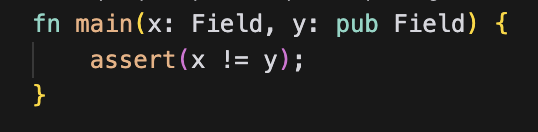
In addition to simplifying the developer experience, we also wanted to make it intuitive to specify which elements you want to keep private and which you want to make public. With Noir, privacy is baked in as a default, so all variables and functions are automatically kept completely private, and executed on the user’s device.
If you want to make any part of your code public, you can do so by simply adding a pub attribute.
Noir on its own is great for writing programs that need to execute stateless functions, such as proving that you reside in a specific country based on passport data, or that you hold a certain number of tokens without revealing how many. Projects are already starting to build with Noir outside of Aztec on Base, Scroll, Starknet, and other chains. However, if you are looking to write privacy-preserving apps that store private state data onchain, it’s helpful to utilize a smart contract library that deliberately handles those complexities for you. That’s exactly what we’ve built at Aztec and what we’ll explore in the next section.
Layer 2: Smart Contracts

Aztec smart contracts leverage Noir to create apps with onchain private and public state. This section covers how smart contracts work on Aztec and how you deploy and interact with your contracts.
An Aztec smart contract is a set of public and private functions written in Noir, deployed on the Aztec Network. They are written using the Aztec.nr framework which handles all the cryptography under the hood for managing private and public state and interacting with other contracts on the network.
To build useful applications, developers need to be able to incorporate both private and public components into their contracts. For example, an onchain voting contract might want to keep the information of the voter private and prevent someone from voting twice, but publicly display how many votes have been cast, and the outcome.
Because contracts are written in Noir, this functionality is as easy as adding a ‘private’ annotation above your function. The following function will be executed privately on the user device, allowing a user to cast a vote without revealing their address:
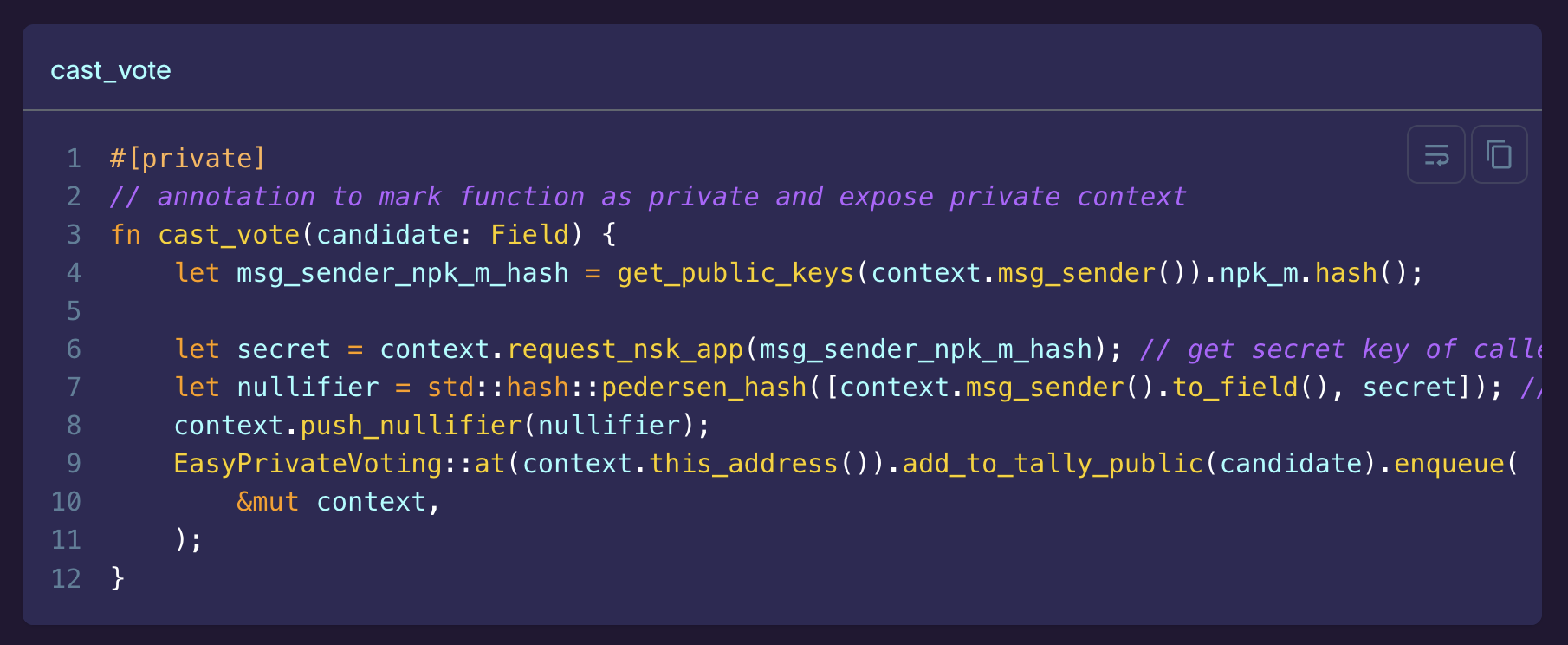
The output of this private, local execution will be sent to the network, where the correctness of execution is verified and public function calls are executed. The following function is designed to be executed publicly, adding a vote to the total tally without revealing where it came from.
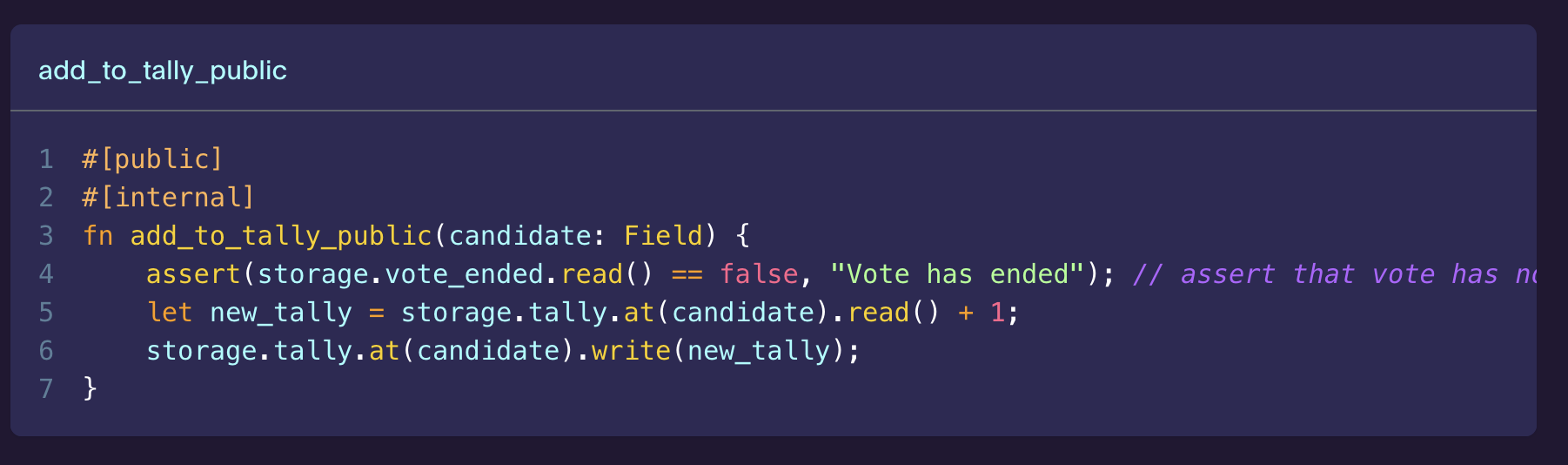
To seamlessly weave together private and public components that can easily interact with onchain state, Aztec smart contracts utilize the Aztec.nr framework to execute private functions on the user’s device and bundle the proofs for these transactions together with the public functions that will be executed by the Aztec Virtual Machine (AVM).
This framework adds the functionality needed to build onchain, privacy-preserving apps, including defining contracts, accessing private or public context, and interacting with the Aztec Network. Similar to how a vanilla Noir program would compile down into zk circuits, Aztec smart contracts are compiled into zk circuits for private functions or AVM bytecode for public functions, and stored in the Aztec contract tree.
Aztec accounts are also written as smart contracts, implementing what is known as account abstraction. Account abstraction allows application developers to create programmable accounts to dramatically improve user experience, including social recovery, sponsored transactions, and multi-factor authentication. It also makes compliance practical, allowing for granular access controls on accounts.
Layer 3: The Aztec Network
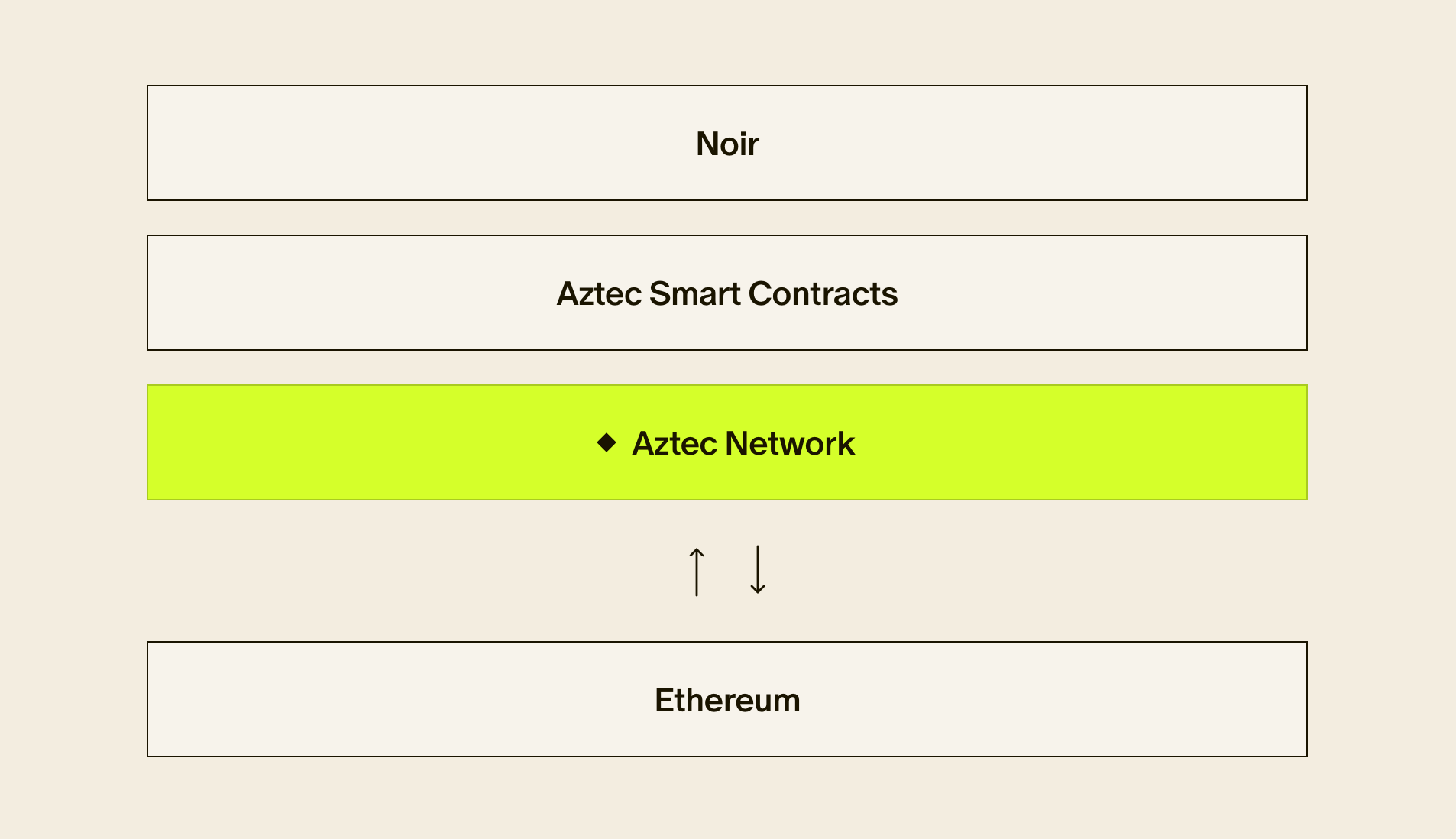
The Aztec Network is the only decentralized L2 on Ethereum. There are currently over 3,500 sequencers running the alpha network. View the live block explorer for the alpha network.
In order for a network to fully protect users and their data, it must guarantee three levels of privacy:
- Private data: input and output values are hidden
- Private identity: addresses are hidden
- Private compute: contract functions are hidden
When you write Aztec smart contracts, everything listed above is taken care of for you. As discussed in the previous two sections, you can easily opt into privacy protections at a granular level by weaving together public and private functions.
To understand how all of these components fit together, let’s examine how a transaction is executed on the Aztec Network.
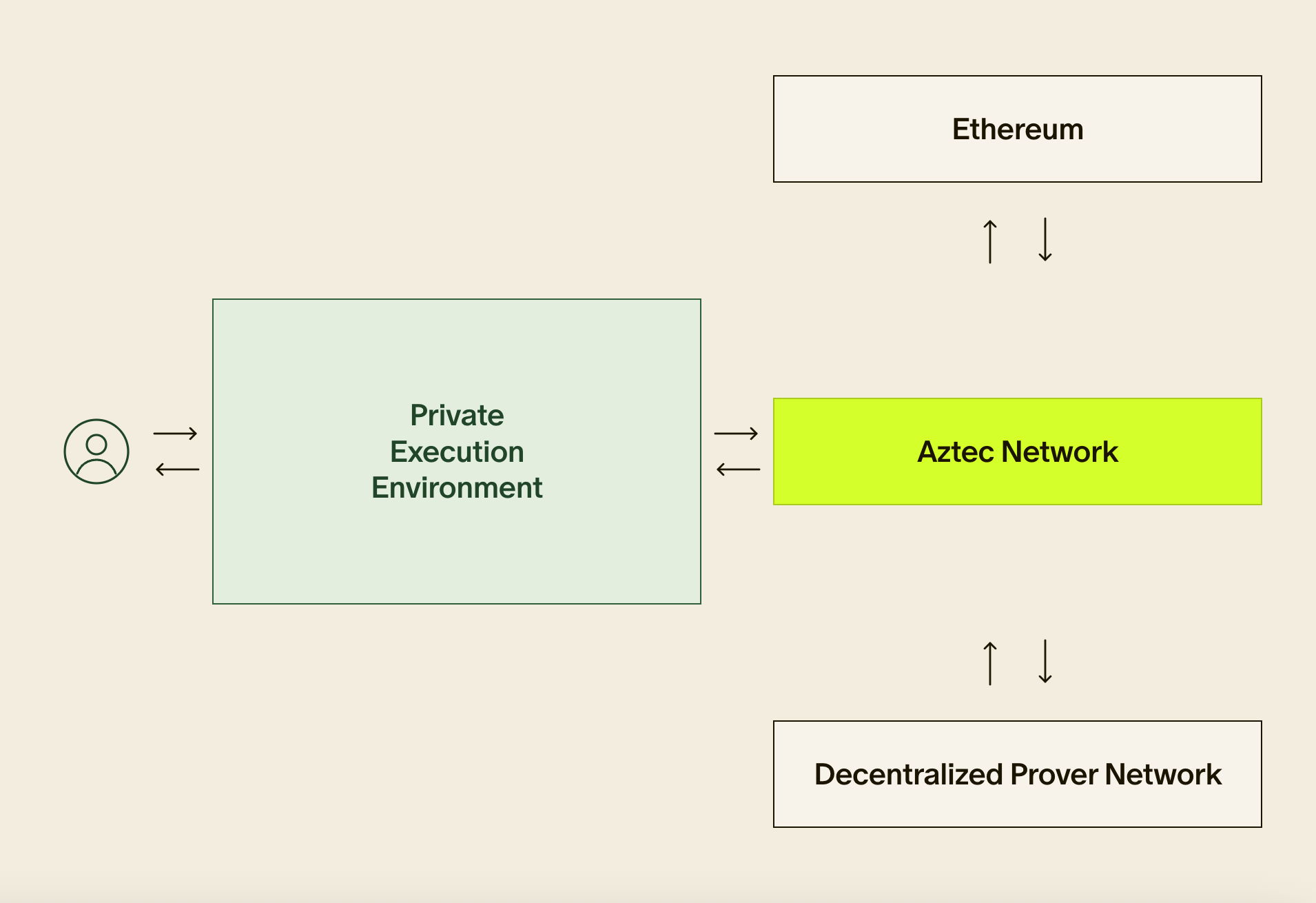
When a user interacts with your application, private functions are executed client-side on the user’s device: a phone, a personal computer, etc. This happens in a private execution environment (PXE) that is able to create highly-efficient zk proofs even on browsers and mobile devices. Any private state updates are added to the state of the network in an append-only database (UTXO tree). Because the proof is generated client-side, no information can be leaked about the inputs, outputs, accounts, or even the functions that were executed.
On the other hand, public transactions are bundled together with the private client-side proofs and sent off to the Aztec Network, powered by a decentralized network of independent community-run sequencers. Sequencers check the validity of private execution proofs, execute any public functions and update the public state, propose blocks, and publish state updates (“diffs”) to Ethereum L1. Sequencers also coordinate with a decentralized network of provers who compute the final proof for every Aztec “epoch” - defined as a contiguous sequence of 32 L2 blocks - and publish it to Ethereum. Any public functions executed by sequencers update an account-based database similar to Ethereum.
Sequencer and prover roles are fully permissionless. Anyone can spin up the required hardware and join the sequencer set or run provers and start bidding to produce proofs of Aztec epochs.
Conclusion
Aztec delivers on a simple but powerful idea: smart contracts on Ethereum where you choose what's public and what's private across identity, data, and compute. The four layers we've walked through are what make that possible.
Noir gives developers a Rust-like language for writing zero-knowledge programs without a cryptography background, with privacy as the default. Aztec smart contracts build on Noir through the Aztec.nr framework, letting you weave private and public functions into a single contract and use account abstraction to unlock granular access controls for compliance, tax reporting, and selective disclosure. The Aztec Network is the only decentralized L2 on Ethereum, with over 3,500 sequencers powering end-to-end programmable privacy across data, identity, and compute. And it all settles to Ethereum, inheriting L1's economic security.
The result is the first practical platform for privacy on Ethereum, and a credible candidate to become the global settlement layer of the future.
Now it's your turn to build. Head to docs.aztec.network to ship your first privacy-preserving app.
Follow Aztec on X for updates on the current state of the network.