The Ignition Chain launched late last year, as the first fully decentralized L2 on Ethereum– a huge milestone for decentralized networks. The team has reinvented what true programmable privacy means, building the execution model from the ground up— combining the programmability of Ethereum with the privacy of Zcash in a single execution environment.
Since then, the network has been running with zero downtime with 3,500+ sequencers and 50+ provers across five continents. With the infrastructure now in place, the network is fully in the hands of the community, and the culmination of the past 8 years of work is now converging.
Major upgrades have landed across four tracks: the execution layer, the proving system, the programming language, Noir, and the decentralization stack. Together, these milestones deliver on Aztec’s original promise, a system where developers can write fully programmable smart contracts with customizable privacy.
The infrastructure is in place. The code is ready. And we’re ready to ship.
What’s New on the Roadmap?
The Execution Layer
The execution layer delivers on Aztec's core promise: fully programmable, privacy-preserving smart contracts on Ethereum.
A complete dual state model is now in place–with both private and public state. Private functions execute client-side in the Private Execution Environment (PXE), running directly in the user's browser and generating zero-knowledge proofs locally, so that private data never leaves the original device. Public functions execute on the Aztec Virtual Machine (AVM) on the network side.
Aztec.js is now live, giving developers a full SDK for managing accounts and interacting with contracts. Native account abstraction has been implemented, meaning every account is a smart contract with customizable authentication rules. Note discovery has been solved through a tagging mechanism, allowing recipients to efficiently query for relevant notes without downloading and decrypting everything on the network.
Contract standards are underway, with the Wonderland team delivering AIP-20 for tokens and AIP-721 for NFTs, along with escrow contracts and logic libraries, providing the production-ready building blocks for the Alpha Network.
The Proving System
The proving system is what makes Aztec's privacy guarantees real, and it has deep roots.
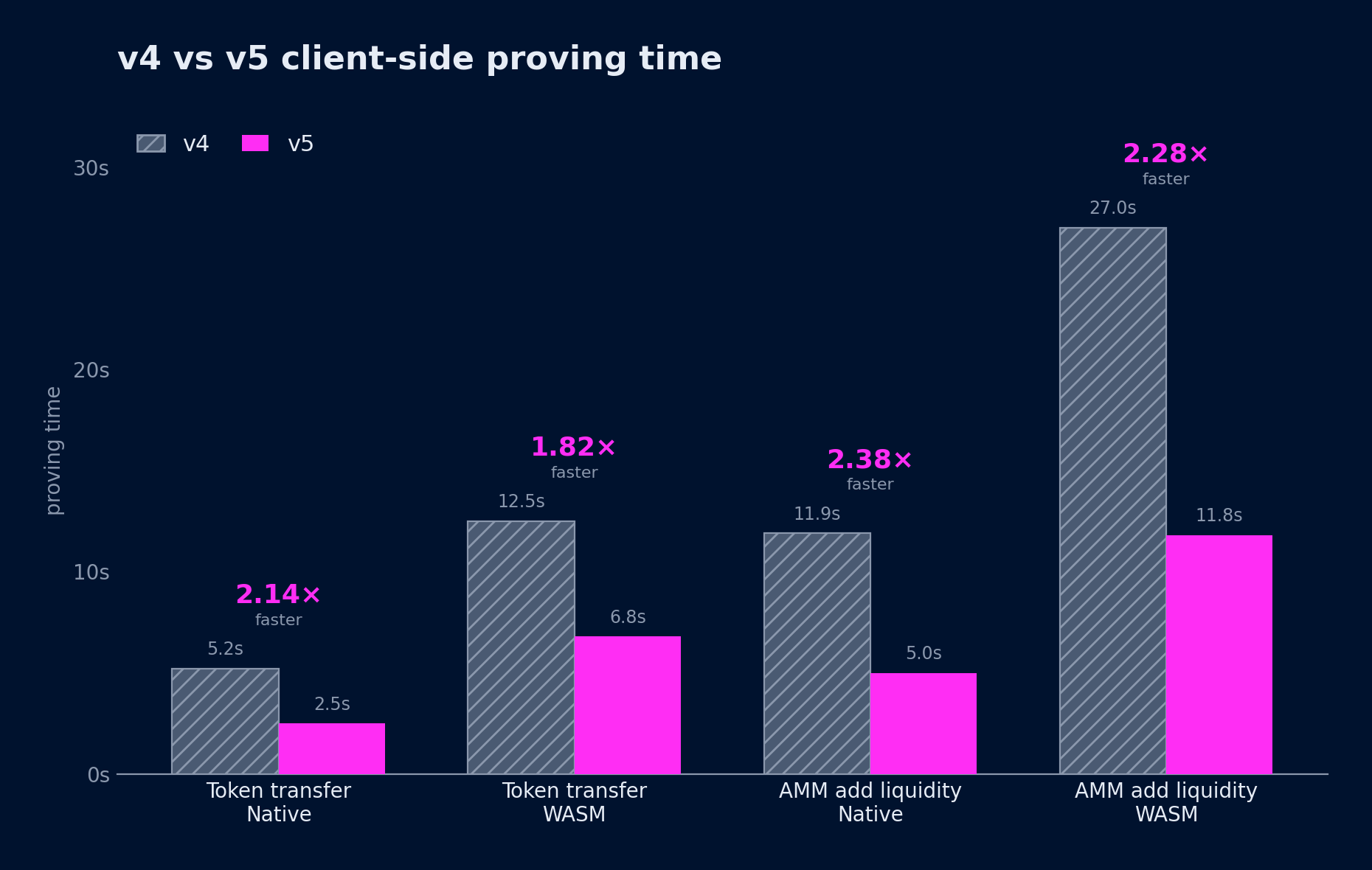
In 2019, Aztec's cofounder Zac Williamson and Chief Scientist Ariel Gabizon introduced PLONK, which became one of the most widely used proving systems in zero-knowledge cryptography. Since then, Aztec's cryptographic backend, Barretenberg, has evolved through multiple generations, each facilitating faster, lighter, and more efficient proving than the last. The latest innovation, CHONK (Client-side Highly Optimized ploNK), is purpose-built for proving on phones and browsers and is what powers proof generation for the Alpha Network.
CHONK is a major leap forward for the user experience, dramatically reducing the memory and time required to generate proofs on consumer devices. It leverages best-in-class circuit primitives, a HyperNova-style folding scheme for efficiently processing chains of private function calls, and Goblin, a hyper-efficient purpose-built recursion acceleration scheme. The result is that private transactions can be proven on the devices people actually use, not just powerful servers.
This matters because privacy on Aztec means proofs are generated on the user's own device, keeping private data private. If proving is too slow or too resource-intensive, privacy becomes impractical. CHONK makes it practical.
Decentralization
Decentralization is what makes Aztec's privacy guarantees credible. Without it, a central operator could censor transactions, introduce backdoors, or compromise user privacy at will.
Aztec addressed this by hardcoding decentralized sequencing, proving, and governance directly into the base protocol. The Ignition Chain has proven the stability of this consensus layer, maintaining zero downtime with over 3,500 sequencers and 50+ provers running across five continents. Aztec Labs and the Aztec Foundation run no sequencers and do not participate in governance.
Noir
Noir 1.0 is nearing completion, bringing a stable, production-grade language within reach. Aztec's own protocol circuits have been entirely rewritten in Noir, meaning the language is already battle-tested at the deepest layer of the stack.
Internal and external audits of the compiler and toolchain are progressing in parallel, and security tooling including fuzzers and bytecode parsers is nearly finished. A stable, audited language means application teams can build on Alpha with confidence that the foundation beneath them won't shift.
What Comes Next
The code for Alpha Network, a functionally complete and raw version of the network, is ready.
The Alpha Network brings fully programmable, privacy-preserving smart contracts to Ethereum for the first time. It's the culmination of years of parallel work across the four tracks in the Aztec Roadmap. Together, they enable efficient client-side proofs that power customizable smart contracts, letting users choose exactly what stays private and what goes public.
No other project in the space is close to shipping this.
The code is written. The network is running. All the pieces are in place. The governance proposal is now live on the forum and open for discussion. Read through it, ask questions, poke holes, and help shape the path forward.
Once the community is aligned, the proposal moves to a vote. This is how a decentralized network upgrades. Not by a team pushing a button, but by the people running it.
Programmable privacy will unlock a renaissance in onchain adoption. Real-world applications are coming and institutions are paying attention. Alpha represents the culmination of eight years of intense work to deliver privacy on Ethereum.
Now it needs to be battle-tested in the wild.
View the updated product roadmap here and join us on Thursday, March 5th, at 3 pm UTC on X to hear more about the most recent updates to our product roadmap.