Menu
Contributors identified a critical vulnerability in Aztec's V5 Alpha proving system, the kind of finding Alpha testing exists to surface, with the fix planned for V6.
Core contributors identified a critical vulnerability affecting the V5 Alpha proving system on 27 July 2026 through internal AI-assisted auditing.
V5 remains Alpha software. Critical findings can arise during this phase, and the audit process exists to identify them before broader deployment. This finding places V5 funds, applications, and contract state at risk.
Treat funds and applications on V5 as exposed to a protocol-level failure until contributors complete incident response work and operators carry out the required network actions.
An attacker may be able to exploit a flaw in the current V5 proving system by constructing a proof that passes verification for a transaction the network should reject. If accepted, that transaction could produce a state transition outside the rules V5 intends to enforce.
Contributors cannot determine whether anyone exploited the flaw before this finding. The affected system lacks the information needed to distinguish ordinary accepted transactions from transactions accepted through the flawed proving path. Historical chain activity cannot establish whether exploitation occurred or quantify its impact.
We expect application teams to prepare safeguards in the coming weeks.
Those safeguards may include changes to application controls, deployment procedures, user flows, and migration plans. We expect each team to assess its contracts and determine which protections fit its architecture and users.
We expect teams planning a V5 deployment to pause that work until contributors publish further guidance. We expect teams with live contracts to review their ability to limit user exposure, isolate affected functionality, and move users to fresh deployments if needed.
We expect applications that maintain administrative or emergency controls to assess whether those controls can reduce user risk during the incident timeframe.
Core contributors are working with operators, application teams, and bridge operators as applications add security guards around affected flows.
The findings from this incident will inform the V6 release, including circuit updates that prevent the network from accepting proofs tied to an affected proving system.
V5 launched as Alpha software, with V6 planned for later in 2026. Contributors will publish a security roadmap covering the remaining work and release path.
Reviewers have not identified other high-severity or critical V5 Alpha vulnerabilities at this time.
Internal and external human audits have completed, and contributors continue AI-assisted auditing. Alpha is the period for identifying faults before production deployment.
Dark Forest is a real-time strategy game played across a procedurally generated universe where most of the map is hidden. You cannot see rival players, their planets, or their fleets. You only know what you have explored. Everyone shares one universe, and nobody has the full picture.
In most onchain games, every position and every move is public, because the chain is public. Dark Forest used zero-knowledge proofs to break that assumption: players prove their moves are valid without revealing where those moves came from. The result is a game of hidden information running on a public network.
Dark Forest Aztec ports the original Dark Forest 0.6 to Aztec. It keeps the gameplay from the original and rebuilds the privacy layer on Aztec's programmable privacy.
A note before diving in: this is early, experimental software on Aztec Alpha V5. Treat it as an alpha and play accordingly.
You start on a single home planet with almost the entire map dark. To find anything you mine the universe, running a client that explores coordinates and reveals what sits there: unclaimed planets, resources, and eventually the edges of other players' territory.
You are never handed a view of the board. You earn it one region at a time, and everyone else works under the same fog.
Your home coordinates and your fleet movements are private state, expressed as first-class private notes on Aztec. Your location and where you send energy stay hidden, enforced in the contracts by zero-knowledge cryptography.
What sits onchain is a set of cryptographic commitments. Instead of storing every planet's full details in the open, the contracts store Poseidon2 hashes of entity state. When you make a move, your client supplies the full state, the contract checks it against the stored hash, applies the change under zero-knowledge constraints, and writes a new hash back. Full game state lives offchain and gets rebuilt from public logs by an indexer, which is what renders your map without exposing every player's position.
So you can prove you made a legal move from a planet you own without revealing where that planet is. Aztec applies the same principle to private payments and private contracts.
Four actions carry the game.
Explore. Your explorer sits in the bottom left. Set it running and it uncovers the map around you, surfacing planets, resources, and other players.
Send energy. Most planets produce energy. Click and drag from a planet you own toward a target to capture or weaken it.
Route silver. Asteroid fields produce silver. Move it to your planets and spend it on upgrades, or send it to a Spacetime Rip to convert it into score.
Hunt artifacts. Some planets hold artifacts. Your Gear ship discovers them. Once harvested, you deposit them on planets to boost stats.
Four stats drive most decisions.
Energy is the core resource. Planets generate it over time up to a capacity, and you spend it on everything: claiming planets, reinforcing your own, attacking rivals. Two details matter. Moves are taxed, so a flat percentage of a planet's total capacity burns every time you send energy, which discourages small frequent moves. And energy decays over distance, so send it too far and almost nothing arrives. A common rule of thumb is to let a planet fill to about 75%, then send it down to about 25%.
Defense reduces the damage incoming energy does when it lands. Higher-level planets often have lower defense, but they hold much more energy, so they still take more to capture. Defense matters most on front lines.
Range sets how far a planet can send energy. It governs how fast you expand and how efficiently you move energy inside your own empire, since shorter relative distances mean less decay. Good range also lets you strike deep into an opponent's territory.
Speed sets how quickly a move arrives. Usually secondary, though a fast strike can land before a rival reacts, and some playstyles reward capturing many nearby planets quickly.
Planets can also be upgraded with silver and enhanced with artifacts. Space types carry different multipliers, from mild Nebula to punishing Dead Space, so where a planet sits changes how it plays.
There is a scoreboard, and territory alone does not win it. This round scores two activities: discovering artifacts with your Gear ship, and withdrawing silver through Spacetime Rips.
Point values from the in-game help page:
Silver accrues one point at a time. A single Mythic artifact is worth twenty million of them, so artifact hunting decides rounds and silver withdrawal sets your floor.
Silver has two competing uses. Spend it on upgrades and your planets get stronger, extending range and hardening defense. Withdraw it through a Spacetime Rip and it becomes scored points, but it is gone. Every unit is a choice between building the empire and banking points.
Upgrades tend to win early, since a stronger empire reaches more asteroid fields and finds more artifacts. Late in a round that calculation flips, because a planet you never use is worth less than points already scored.
Artifacts do both jobs at once. They score on discovery, and once deposited they boost a planet's stats, which makes the next expedition easier.
Nothing happens until you find something to act on. Your explorer turns dark space into planets you can capture, asteroid fields you can mine, and artifact-bearing planets you can raid. Sitting still means no new energy, no silver, no score.
Exploring also buys information. The map you have uncovered is an advantage nobody else holds. Knowing where high-level planets sit, which asteroid fields are unclaimed, and where space types shift lets you plan further ahead than someone still working through their starting region.
You find other players as a byproduct. There is no player list. You explore outward until your revealed region touches territory someone already owns: a planet in another player's colors, sitting where you were about to expand. Their home coordinates stay private, so you learn something narrow. Someone is here, roughly this direction, holding this much. You infer the rest, and you have no way of knowing whether they found you first.
You have three broad options.
Stay quiet and keep growing. Nothing forces you to engage. Keep exploring elsewhere, keep routing silver, keep upgrading. Your positions stay private, so silence costs you only time, which is what you want if they are stronger. The risk is that they are doing the same thing faster.
Fortify the border. If the contact sits somewhere you cannot lose, spend energy hardening the planets facing them. Defense is worth most where an attack will actually land. This keeps the option to fight without committing to one.
Attack. Send enough energy to overwhelm the target's defense and the planet becomes yours, along with its production and its position as a staging post. Higher-level planets are the prize and take proportionally more to crack.
Attacking costs more than energy. A move that lands tells your rival where you strike from, and that you are close enough to be worth answering. Retaliation can then come from directions you have not explored, launched from planets you cannot see.
Everyone plays one shared universe in real time. No turns, no lobbies. Energy regenerates whether you are watching or not, moves stay in flight while you sleep, and rivals expand while you are away from the screen.
Most strategy games let you watch a threat approach. Here you tend to see the consequences: a planet you owned this morning in someone else's colors, an incoming move you notice once it is already close.
That produces a particular kind of paranoia. You are trying to find everyone else while avoiding being found, and every expansion is a strategic bet that the space ahead is empty.
Information becomes tradeable, because it is scarce. Players compare notes, warn each other about aggressive neighbors, and agree who expands where, then break those agreements when the scoreboard makes it worth breaking.
A fully onchain game where players cannot see each other's positions is hard to build, and building it well says something about the platform underneath.
Hidden state, private notes, and client-side proving are the same building blocks behind private applications across Aztec. Dark Forest is a way to watch them work.
Dark Forest Aztec is playable now as an alpha. Expect a learning curve; the original was famous for it. DFArchon maintains onboarding material and a community for new players. Round One is live. The universe is dark, and everyone else is out there somewhere. Go find them, quietly.
Gas on Aztec is known as Fee Juice and is used to pay for transaction costs. This is the same as $ETH on Ethereum. Some apps will handle transaction costs for you under the hood, but if you are using a browser extension wallet, you will not be able to send transactions without it. Fee Juice can be obtained by bridging the $AZTEC token on Ethereum to the Aztec Network L2. This means that under the hood, all activity that happens on Aztec is underpinned by the $AZTEC token bridged into the network. Some bridges like Shield (by human.tech) handle this for you, allowing you to allocate a portion of your bridged transaction to convert into Fee Juice and land in your wallet automatically.
Assets and transactions on the Aztec Network can be either public or private. If you bridge publicly, your tokens will arrive as public, traceable tokens visible to all. Privately bridging, on the other hand, will give you private assets that are visible only to you. These assets can then be sent privately to another user or wallet without ever revealing who you are, what tokens were sent, how many, or who the recipient is.
Like tokens on the Aztec Network, Fee Juice (gas) can also be public or private. The reason for this is that even if what you are sending is private, the gas you spend to execute that transaction could still be visible if you are using public Fee Juice, potentially revealing transaction patterns and activity. Private Fee Juice keeps your entire transaction footprint hidden. When you send a private transaction, you can use private Fee Juice, and when you send a public transaction, you can use public Fee Juice, which means your transaction costs are always aligned with the type of transaction you're making.
Aztec has native fee abstraction, which means apps could let you pay for transactions in any token you want, or cover your fees entirely. Apps like Nyx may choose to cover part or all of a user's transaction costs, or allow you to pay in tokens that are convenient for you. This means you will most likely never see Fee Juice in an app; instead, you'll pay in whatever makes sense for what you're doing, on your terms. Similarly, you might never even see an Aztec wallet at all, because the app itself becomes your interface that you connect to using your MetaMask wallet.
If you're using a browser extension like Azguard, you'll manage Fee Juice directly in your wallet alongside your private and public balances, converting between tokens as needed to cover transaction costs.
When you bridge tokens in, you'll need enough Fee Juice to cover the cost of your first transaction, then you'll need to monitor how much Fee Juice you have available to make transactions. Browser wallets will allow you to send either publicly or privately to other users and will default to using either public or private Fee Juice depending on the type of transaction. Both private Fee Juice and public Fee Juice will appear by default in your token list.
How you handle Fee Juice depends on where you're transacting: apps can abstract it away entirely and let you pay in any token, while a browser wallet like Azguard puts it in your hands to manage across public and private balances. Match your gas to your transaction, keep private activity private down to the fee, and you move on your terms.
The Aztec Network today activated Alpha V5, a major protocol upgrade passed by token-holder governance and executed onchain. Alpha V5 reduces private-transaction proving times by more than 2x compared to the previous version, lowers the cost of a fully private transaction by roughly 50%, resolves the critical issues found in V4, and sees the first wave of apps go live. Users can now send private transactions and earn yield on Aave simply by connecting their Ethereum wallets on Nyx, bridge from Ethereum to Aztec using Shield or TRAIN, privately collect NFTs on RavenHouse, or play Dark Forest Aztec, a hidden-information strategy game in a universe that lives entirely onchain.
"Alpha V5 continues Aztec's work at the frontier of client-side proving, with cryptographic breakthroughs that cut proving times by more than half this release," said Zac Williamson, Co-founder, Aztec Foundation. "We believe Aztec is now the fastest system in the world for proving a fully private transaction entirely on a user's own device, and every release moves the industry closer to private transactions at public transaction speeds."
As the only decentralized privacy L2, Aztec is the credibly neutral privacy layer for Ethereum. Aztec allows anyone to write smart contracts that include both private and public aspects – every private transaction is proven on the user's own device, so no operator, sequencer, or intermediary can see the data. The Alpha V5 proving improvements come from cryptographic advances that make this client-side proving faster than any prior release. The network remains in alpha, but with V5 it is ready for teams to begin building and deploying applications.
Making private transactions practical comes down to how quickly a proof can be generated on a user's own device, without offloading that work to a server that would learn what the user is doing. On Alpha V5, proving a private token transfer natively now takes approximately 2.5 seconds on a consumer laptop, down from 5.2 seconds on V4, and about 6.8 seconds in a browser, down from 12.5 seconds. Across every measured transaction flow, client-side proving times improved by approximately 2x compared with V4.

Alpha V5 lowers ECDSA signature-verification cost by approximately 2x, speeds up Poseidon2 hashing by approximately 3x, and reduces the protocol circuit gate count by approximately 50% (gate count is the number of individual operations a proving circuit must perform, and it is the main driver of how long a proof takes to generate). Each of these lowers the amount of work a device performs to prove a transaction, and the reduction in gate count in particular compounds across every proof the network generates.
Alpha V5 launches the first wave of apps on a network where privacy is built into the protocol rather than managed by an operator. On other networks that claim privacy, transactions still pass through an operator or node that reads them in plaintext, or depend on a viewing key that a third party holds, so users rely on someone else to protect their data and to decide when it gets disclosed. On Aztec, every private transaction is proven on the user's own device, so the app, the sequencer, and any operator never need to see the underlying data. Nyx is one of these apps, allowing users to privately send transactions and privately earn yield on Aave.
"On Ethereum, everything you do is public. That's why we built Nyx: a private account governed by your Ethereum wallet", said Nikhil, Co-founder of Nyx. "Now you can send, receive and earn in private. Nyx was the first app live on the Aztec Alpha, and we're excited to expand participation to more users with the added stability of Alpha V5."
Other apps on Alpha V5 include Azguard and Nethermind (wallets), Shield, TRAIN, and RavenHouse (bridges), and the Aztecscan block explorers. Also launching is Dark Forest Aztec, a game where users explore a universe, control planets, manage planetary energy, expand territory, and launch attacks through strategic play with private state and hidden actions.

Transaction fees on Aztec come from two main sources: the cost of proving a transaction and the cost of verifying the rollup proof on Ethereum. Alpha V5 reduces both. It lowers the network's proving-cost parameter by 50%, and it reduces the L1 gas required to verify a rollup proof by approximately 40%. Because rollup proofs are verified on Ethereum and that cost is shared across all transactions in a batch, the L1 reduction lowers fees for every user, while the lower proving-cost parameter reduces the per-transaction proving fee directly. Together, these bring the average cost of a fully private token transfer to under a $0.05 transaction cost.
Alpha V5 also hardens the network on several fronts. It resolves critical vulnerabilities found in Alpha V4 along with additional bugs discovered since launch. Aztec's bug bounty program on Cantina also drew more than 234 security researchers to participate. The network remains in alpha, and further bugs may surface as usage grows, but each release has closed the issues found in the last and strengthened the protocol against new ones. With the critical V4 issues resolved and these safeguards in place, Alpha V5 is stable enough for teams to begin building and deploying applications.
Alpha V5 is live now, view the Alpha V5 landing page for a full list of features, performance updates, and live apps to explore.
Aztec is the only decentralized, privacy-first Layer 2 on Ethereum. Developers write private and public logic in the same smart contract, and private functions are executed and proven on the user's own device, so no operator sees the underlying data. The protocol is upgraded through onchain governance, and the network settles to Ethereum. For more information, visit aztec.network.
On Ethereum today, each transaction reveals everything publicly. The token you moved, the size, the timing, the wallet it came from, every action you take. Given the limitations of this type of transparent network, the industry is now focusing on bringing privacy onchain as a top priority. The response to this has mostly been to enable private transactions that shield transfers in various ways. But when we look at how privacy works on Web2, it’s clear that users and developers need granular privacy controls: the ability to decide what is public or private and who is able to see different types of data.
Aztec was built so that one transaction can carry two halves. A private half that runs on your own device and never leaves it, and a public half that the network runs in the open. Apps can choose which aspects are private or public, and users can choose what they want to reveal and when.
This article will follow an example transaction on Aztec: a vote in an onchain election built on Aztec, where who you are and which candidate you chose stay private, while the running tally for each candidate stays public for anyone to verify.
Picture the vote you cast in our example as two aspects that seamlessly weave together. In the first step, you act in private: an app records your vote on your device and hands the network a proof that the vote is valid without revealing it. In the second, the network acts in public: it checks that proof, then adds one to the chosen candidate's public tally. It is one transaction: one part stays with you, one part goes to the network. Both parts end up recorded onchain, in two separate state trees, one private and one public. The walkthrough below follows how these two aspects work together and what this means for how your transaction lands onchain.
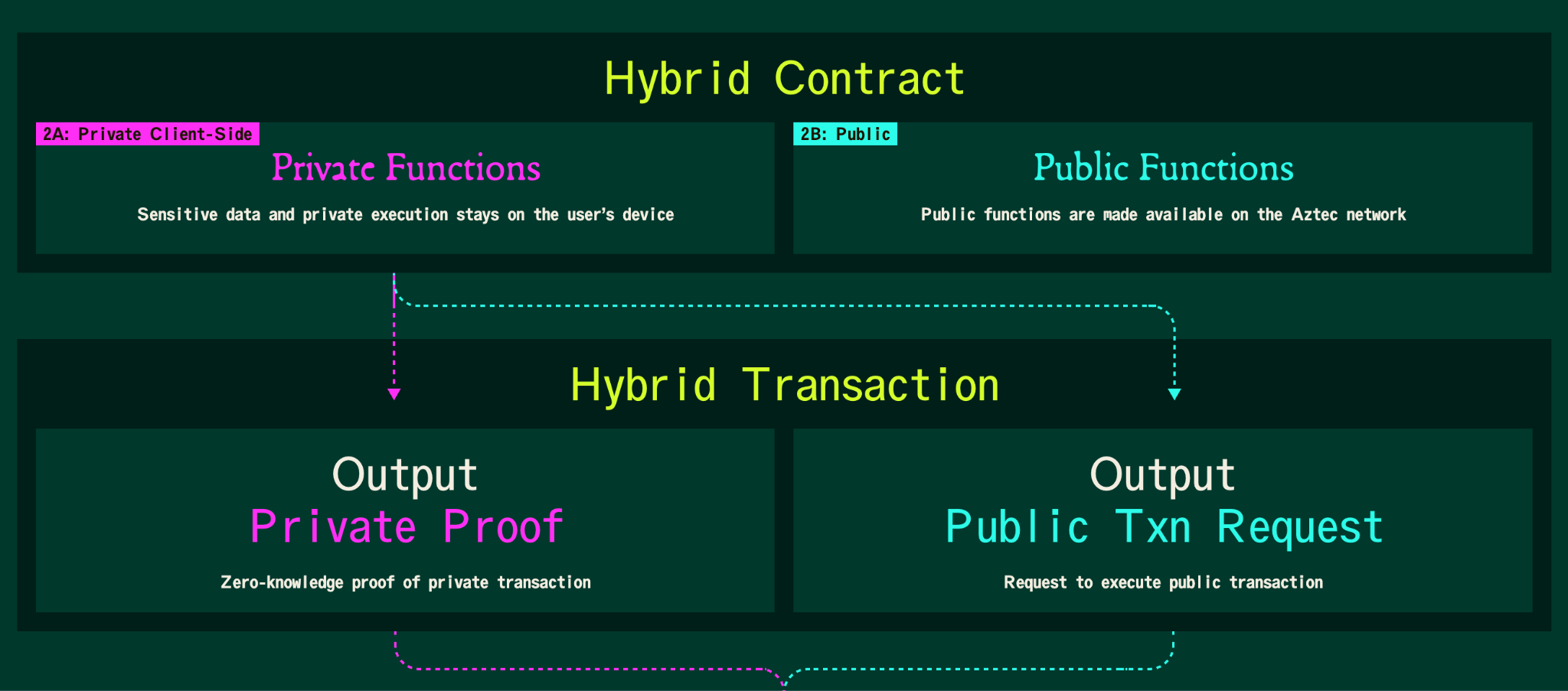
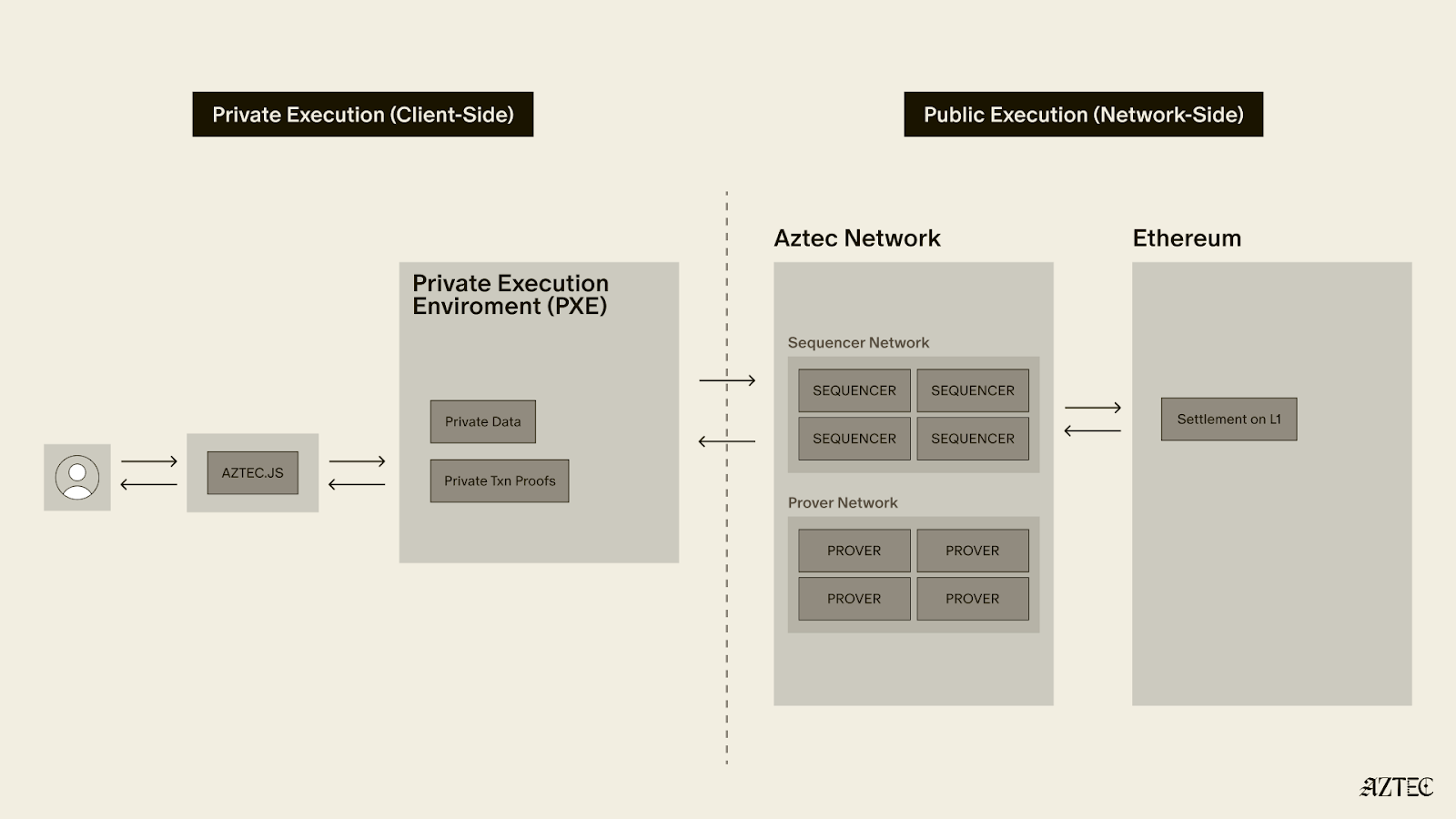
You open the voting app and connect an Aztec wallet. That first step looks like any onchain app. The difference is inside the wallet. An Aztec wallet carries a private execution environment, the PXE, pronounced "pixie", which runs on your phone or in your browser. The PXE is where the private half of your transaction executes, and where the proof of that work gets made, on your hardware, under your exclusive control.
Every account on Aztec is a smart contract rather than a bare key. That design, account abstraction, allows a wallet to authorize a transaction however its owner chooses without writing an identity onto the network for everyone to read. The wallet is the front door, and on Aztec you can decide if the door is open or closed, who you share your information with.
The voting app is a smart contract with two kinds of functions. The private functions run first, and they run inside your PXE. Your identity and the candidate you picked are the private inputs, and they stay on your device.
The only thing to leave your device is a proof confirming the legitimacy of your vote. Aztec's client-side proving system, Chonk, takes the private execution and produces a zero-knowledge proof: a compact cryptographic receipt that your vote followed the rules, that you are eligible, and have not voted before, while revealing nothing about who you are or who you voted for. Think of it as a sealed ballot the network can confirm is valid without opening it. The network learns only that a legitimate vote happened. It does not learn how you voted, or even which account voted.
This is the part that used to be too slow to be practical. Generating a proof on a phone was the bottleneck every privacy app hit. Aztec’s Chonk is purpose-built for fast proving on low-memory devices, both natively and in the browser, so the private half runs on the device in your hand instead of on someone else's server.
Some elements of a vote should be public. The tally is shared infrastructure, the number everyone relies on to trust the result. Thanks to programmable privacy on Aztec, the app marks that part public. Public functions live on the network and run in the open, the way functions do on Ethereum.
On Aztec, private and public logic live in the same contract, and the developer decides which is which, function by function and variable by variable. Programmable privacy is a dimmer, not a switch. The voting app turns it up on the individual ballot and turns it down on the running tally. That boundary is a design decision written into the contract, and it is the thing no transparent chain and no fixed-privacy chain can offer.
Your vote leaves your device as a bundle: the zero-knowledge proof of the private half, plus the call to the public function that updates the count. It goes to Aztec's sequencers, a decentralized set of thousands of independent operators, with more than 3,500 of them running the network today.
The sequencers do two jobs at once. They verify the proof of your private vote, confirming it is valid and eligible without seeing the choice behind it, and they run the public function that adds one to the chosen candidate and updates the public tally. Your ballot stays sealed. The count goes up by one for everyone to see. The same proof guarantees you cannot vote twice, even though no one learns which ballot is yours.
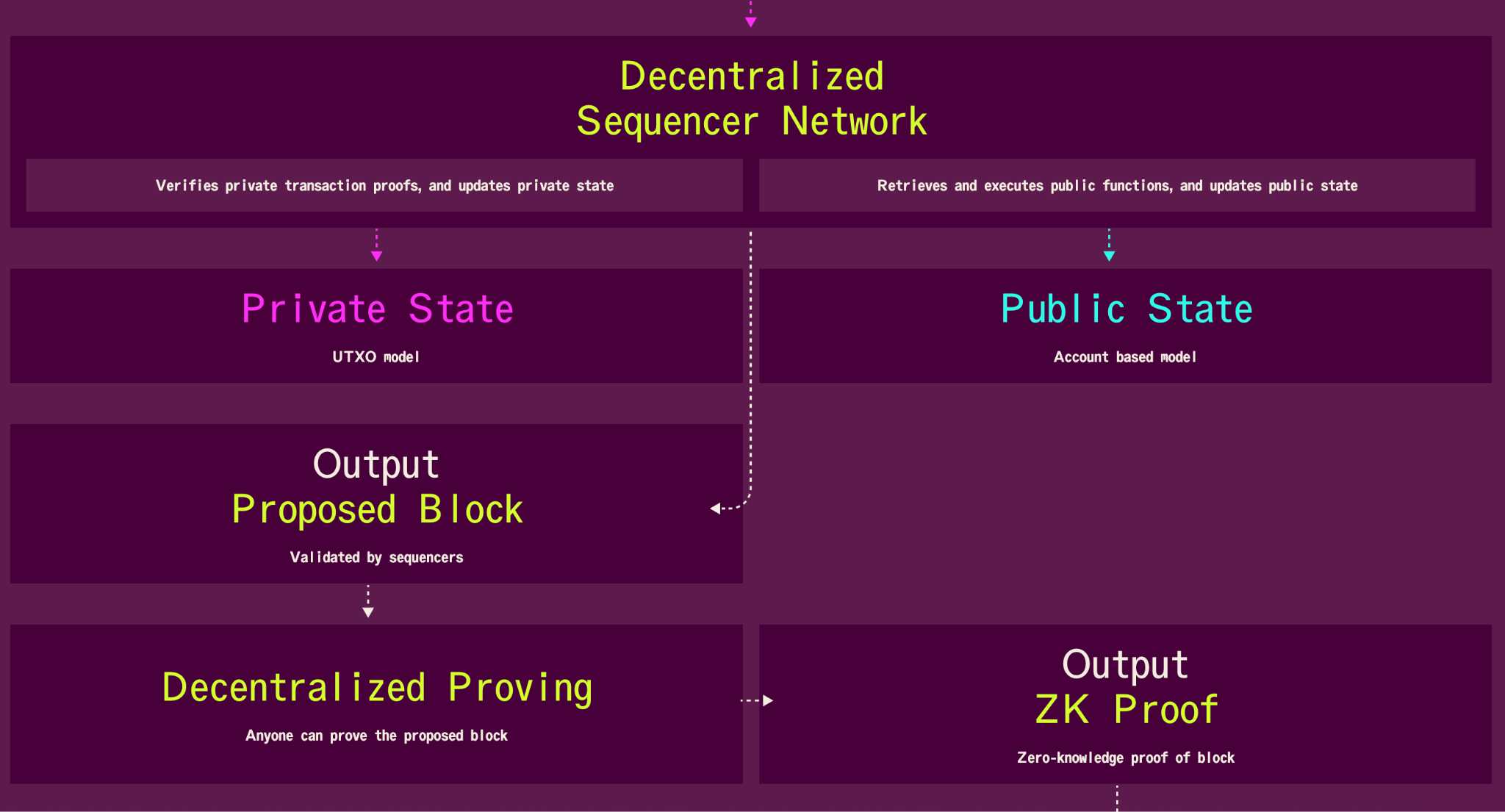
Aztec has two main state trees, and both live onchain. One holds private state, the other holds public state, so the full record of what happened sits on the network rather than on any one person's laptop. The two trees store each record in two different ways depending on if it needs to be private or public.
The private tree uses a UTXO model, the same note-based design used by Zcash. In this model, state is written as commitments: each entry is a sealed record that a valid vote was cast, with the voter and the choice kept private. Just like with Zcash or Bitcoin, you do not edit a private entry in place. You write a new one, and the design stops the same vote from being cast twice (old state is nullified). The vote stays private, and the record of a legitimate vote happening is onchain for the network to check.
The public tree uses an account-based model, the same shape Ethereum uses: values that update in place, readable by anyone. This is where each candidate's tally lives.
One transaction wrote information to both trees. The private tree recorded that you voted, sealed. The public tree recorded the new totals, in the open. Everything is onchain. The difference between the two trees is how much each one reveals.
Every private app on Aztec writes into that same private tree. A vote, a payment, and a payroll run all land in one shared record of activity, so each user's privacy grows stronger as the network grows, instead of splitting into a separate pool for every app.
Aztec is an L2 on Ethereum, so everything settles to Ethereum L1. A sequencer on Aztec gathers transactions into a proposed block. Other sequencers validate it before it goes to Ethereum's pending chain. At that point the block sits on Ethereum, ordered and recorded, waiting for its proof. The network has agreed on what happened and the proposed block is just waiting a final proof.
Proving a block is its own job, and on Aztec, it belongs to no one in particular. A decentralized, permissionless set of provers competes to take a full epoch, a 32-block stretch of the chain, and compresses it into a single zero-knowledge proof of the entire epoch. Anyone with the hardware can run a prover and bid for the work. There is no privileged operator, no committee you have to trust, no outside network holding a key.
That openness is the whole point of a privacy layer. A system that protects your data but routes it through one trusted server has only moved the exposure rather than removed it. Aztec keeps proving permissionless and your private inputs on your device, thereby avoiding any exposure.
The economics land in the voter's favor too. As an L2 network, Aztec spreads the cost of that one L1 proof across thousands of transactions in the rollup, so a vote costs pennies, not the millions of gas a private proof would cost verified alone on Ethereum.
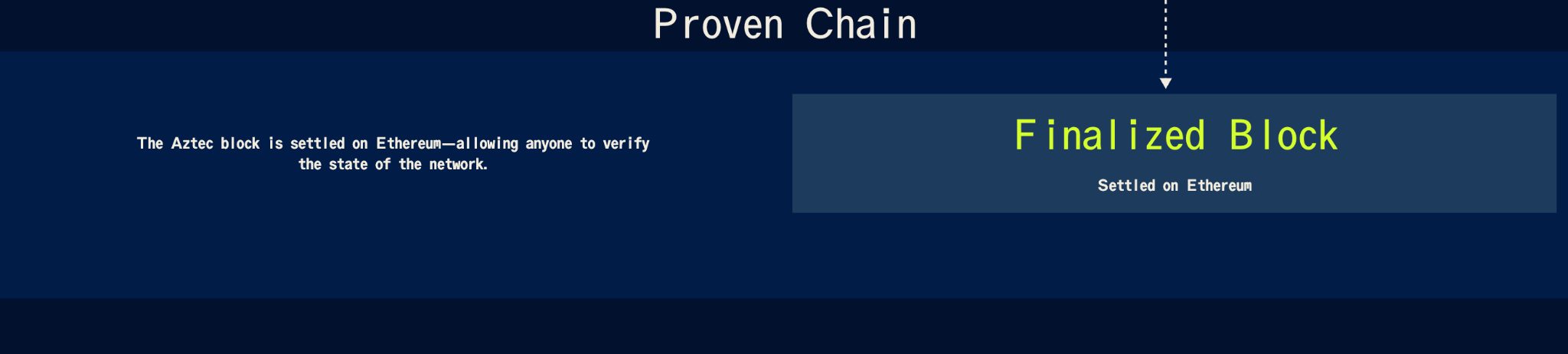
A prover then posts the epoch proof to Ethereum's proven chain, and the Aztec state is final. Ethereum verifies one proof and inherits the correctness of everything inside it. Aztec extends Ethereum and settles to Ethereum, so your hybrid transaction carries Ethereum's security without carrying Ethereum's enforced transparency.
Anyone can now verify that the result is valid and that every counted vote was legitimate. No one can see how any individual voted. The tally is on the shared ledger where it belongs, and your ballot stayed yours the whole way through.
For the voter, their ballot was never a broadcast. The candidate you chose stayed yours, with no record tying your wallet to a name for anyone to read later, and you can still check that your vote was counted and the result is honest. You took part without your choice becoming data for systems built to act on it.
For a founder, the election app in this walkthrough is easy to implement without needing to build extensive custom code. Secret ballots with a public, verifiable count, in one contract, is a product category that opens up only because the boundary is programmable. You can build governance, elections, and polls where people vote without fear and the result still proves itself. And of course you can build anything that requires both public and private state to work seamlessly together.
For an infrastructure provider, the same machinery serves clients who need a result they can stand behind without exposing the people who produced it. Selective disclosure lets a client prove exactly what a counterparty needs to see, the count and the integrity of the process, and protect everything else, on their own terms. That is a guarantee a transparent chain cannot make.
A real vote needs two things at once: a secret ballot and a count anyone can check. A transparent chain makes you give up the first to get the second. On Aztec, you get both. The tally settled on Ethereum for anyone to verify, and how you voted stayed yours. The infrastructure is in place, what will you create with it?
The Aztec Network today activated Alpha V5, a major protocol upgrade passed by token-holder governance and executed onchain. Alpha V5 reduces private-transaction proving times by more than 2x compared to the previous version, lowers the cost of a fully private transaction by roughly 50%, resolves the critical issues found in V4, and sees the first wave of apps go live. Users can now send private transactions and earn yield on Aave simply by connecting their Ethereum wallets on Nyx, bridge from Ethereum to Aztec using Shield or TRAIN, privately collect NFTs on RavenHouse, or play Dark Forest Aztec, a hidden-information strategy game in a universe that lives entirely onchain.
"Alpha V5 continues Aztec's work at the frontier of client-side proving, with cryptographic breakthroughs that cut proving times by more than half this release," said Zac Williamson, Co-founder, Aztec Foundation. "We believe Aztec is now the fastest system in the world for proving a fully private transaction entirely on a user's own device, and every release moves the industry closer to private transactions at public transaction speeds."
As the only decentralized privacy L2, Aztec is the credibly neutral privacy layer for Ethereum. Aztec allows anyone to write smart contracts that include both private and public aspects – every private transaction is proven on the user's own device, so no operator, sequencer, or intermediary can see the data. The Alpha V5 proving improvements come from cryptographic advances that make this client-side proving faster than any prior release. The network remains in alpha, but with V5 it is ready for teams to begin building and deploying applications.
Making private transactions practical comes down to how quickly a proof can be generated on a user's own device, without offloading that work to a server that would learn what the user is doing. On Alpha V5, proving a private token transfer natively now takes approximately 2.5 seconds on a consumer laptop, down from 5.2 seconds on V4, and about 6.8 seconds in a browser, down from 12.5 seconds. Across every measured transaction flow, client-side proving times improved by approximately 2x compared with V4.
Alpha V5 lowers ECDSA signature-verification cost by approximately 2x, speeds up Poseidon2 hashing by approximately 3x, and reduces the protocol circuit gate count by approximately 50% (gate count is the number of individual operations a proving circuit must perform, and it is the main driver of how long a proof takes to generate). Each of these lowers the amount of work a device performs to prove a transaction, and the reduction in gate count in particular compounds across every proof the network generates.
Alpha V5 launches the first wave of apps on a network where privacy is built into the protocol rather than managed by an operator. On other networks that claim privacy, transactions still pass through an operator or node that reads them in plaintext, or depend on a viewing key that a third party holds, so users rely on someone else to protect their data and to decide when it gets disclosed. On Aztec, every private transaction is proven on the user's own device, so the app, the sequencer, and any operator never need to see the underlying data. Nyx is one of these apps, allowing users to privately send transactions and privately earn yield on Aave.
"On Ethereum, everything you do is public. That's why we built Nyx: a private account governed by your Ethereum wallet", said Nikhil, Co-founder of Nyx. "Now you can send, receive and earn in private. Nyx was the first app live on the Aztec Alpha, and we're excited to expand participation to more users with the added stability of Alpha V5."
Other apps on Alpha V5 include Azguard and Nethermind (wallets), Shield, TRAIN, and RavenHouse (bridges), and the Aztecscan block explorers. Also launching is Dark Forest Aztec, a game where users explore a universe, control planets, manage planetary energy, expand territory, and launch attacks through strategic play with private state and hidden actions.
Transaction fees on Aztec come from two main sources: the cost of proving a transaction and the cost of verifying the rollup proof on Ethereum. Alpha V5 reduces both. It lowers the network's proving-cost parameter by 50%, and it reduces the L1 gas required to verify a rollup proof by approximately 40%. Because rollup proofs are verified on Ethereum and that cost is shared across all transactions in a batch, the L1 reduction lowers fees for every user, while the lower proving-cost parameter reduces the per-transaction proving fee directly. Together, these bring the average cost of a fully private token transfer to under a $0.05 transaction cost.
Alpha V5 also hardens the network on several fronts. It resolves critical vulnerabilities found in Alpha V4 along with additional bugs discovered since launch. Aztec's bug bounty program on Cantina also drew more than 234 security researchers to participate. The network remains in alpha, and further bugs may surface as usage grows, but each release has closed the issues found in the last and strengthened the protocol against new ones. With the critical V4 issues resolved and these safeguards in place, Alpha V5 is stable enough for teams to begin building and deploying applications.
Alpha V5 is live now, view the Alpha V5 landing page for a full list of features, performance updates, and live apps to explore.
Aztec is the only decentralized, privacy-first Layer 2 on Ethereum. Developers write private and public logic in the same smart contract, and private functions are executed and proven on the user's own device, so no operator sees the underlying data. The protocol is upgraded through onchain governance, and the network settles to Ethereum. For more information, visit aztec.network.
Crypto is in a long night. It is no secret that the industry is facing challenging circumstances and there has been a clear consolidation of the industry. Right now we are seeing a focus on real traction, demonstrable value projects shipping practical solutions that will meaningfully reach users.
Some of that discipline is overdue. However, in times like these the properties that made crypto structurally different begin to look expendable. Decentralization slows you down. It makes upgrades harder. It makes institutional sales harder. It removes the control surfaces that the existing financial world knows how to buy.
We used to accept those costs as the price of building something durable. But, in a famine, they look like unaffordable affectations. Discarding them wholesale, however, is like selling the land out from under our feet.
Permissionless, uncensorable transaction networks with rich composability - this is the clay from which our industry was grown. The long term commercial health of our industry depends on preserving these properties in an age of privacy and institutional adoption.
These trade-offs become more challenging and pernicious when privacy is involved. Privacy is the narrative for crypto in 2026, and for good reason. It’s the missing piece that will deliver the traction and real use-cases that the industry so desperately needs.
The challenges of decentralization multiply under the constraints of privacy and what we are seeing in the industry is not a pivot, but a complete capitulation of all of the differentiable value that made crypto valuable.
I have spent nearly a decade building a network that marries programmable privacy with decentralization. A network where users keep their data, where applications are composable with one another, where transactions can settle without a privileged party learning everyone’s business or deciding which products are allowed to exist. That required new cryptography, new programming models, new state architecture, new wallets, and a fairly insane number of tradeoffs that are invisible until you try to build the thing yourself. There are easier products to ship.
A centralized privacy service can give institutions something legible quickly, replicating how the existing financial sector works: a responsible operator, a viewing key, a way to block transactions, a way to explain the whole thing to a risk committee. Some of these products will be useful. Some will be good businesses. But they are not the thing we came here to build.
Institutional and enterprise adoption is one of the core growth areas in this crypto-winter and the playbook is simple: use the language of crypto as a skin-suit to sell products and services that pattern match onto existing financial rails, with their need for complete visibility, censorship, centralized network operators and all of the liabilities this incurs.
This is a tempting bargain because it shortens the path to adoption. It gives buyers and regulators a shape they understand. A company. A contract. A switch. But the moment you accept that bargain, the system changes character. It may still be encrypted. It may still contain proofs. It may still call itself private. But, it now behaves like and is an operated service.
There is a party with privileged knowledge and privileged control. Builders must shape themselves around it. Institutions negotiate with it. Regulators may pressure it. Attackers target it. Users ultimately depend on it. By a backdoor I mean something specific: a network or protocol-level viewing key where the product developer does not control who can see their users’ data, especially when paired with network-level controls that can block transactions or ban smart contracts entirely. I do not mean application-level controls. I do not mean user-authorised disclosure. I do not mean a dapp deciding that users must prove something before using it. Regulated applications will need rules. The issue is that the disclosure boundary of your application belongs to somebody else, and the same layer that sees can also decide whether your users are allowed to transact. In short, users lack a platform that has credible neutrality.
Privacy on top of centralized rails is fatal. If one party can see everything and stop anything, that party may be treated as responsible for seeing and stopping.
This compounds into substantial platform risk. If an entity builds on top of such a system they must surrender visibility and control to the network operator to satisfy their liabilities without consideration for yours. Decentralization and ultimately credible neutrality is the difference between whether you own durable infrastructure or are renting a service whose rules can change on a whim. Worse, you cannot “just build things”. For novel transaction flows approval must be sought and granted. Tell me, would Ethereum have grown if every smart contract deployment required approval from the Ethereum Foundation?
Privacy needs the same freedom. A private credit market, for example, touches identity, collateral, repayment history, payment flows, liquidation logic, lender disclosures, auditor access and borrower privacy. If every component lives inside a different permissioned service, each with its own operator and viewing assumptions, that is a bureaucratic friction that negates blockchain’s core value proposition; composability.
A decentralized and credibly neutral privacy network prevents the settlement layer from becoming the single place where all surveillance and censorship obligations naturally accumulate. It allows product developers to scope their code to satisfy their own narrow requirements without consideration for the obligations of a centralized operator.
A lot of today’s privacy narrative treats architecture as if it were a detail. It is not. You cannot take a transparent ledger, staple confidentiality onto the edge, add a viewing key for comfort, and expect to get programmable private infrastructure.
If the state model is not private from the ground up you get wrappers, third party tools, data custodians, ad hoc disclosure paths and a pile of assumptions that every application drags into the next. Developers do not get a normal programming model where private contracts can call private contracts and users keep state on their own devices. They do not get composability.
The difference matters. In a real private execution environment, users generate transactions locally. They do not outsource their intent to a third party who learns what they are doing. Private contracts interact through a state model designed for privacy. The network settles proofs without becoming the party that knows everyone’s business. Privacy is part of the architecture.
This is why Aztec has taken so long. We built something that makes programmable private state and decentralised settlement live inside the same system. That means proving systems that run on consumer hardware, a transaction architecture built around local private execution, and a programming model where privacy is idiomatic and just works out of the box.
A centralized service can skip much of this. It can hold the key, run the prover, approve the flow and call the result privacy. It gets to market faster because it is not trying to arrive at the same place.
Adding decentralization does not make obligations disappear. Applications, issuers, frontends, custodians and regulated businesses will continue to exist in a web of obligations and responsibilities. Anyone pretending otherwise is unserious.
The question is where those obligations live. If they are pushed into the settlement layer, the settlement layer is no longer credibly neutral. It needs visibility into everyone and controls over everyone.
The better answer is selective disclosure. Users and applications should prove specific facts to specific parties for specific purposes. A regulated application may need to know that a user passed a check, that a transaction satisfies a policy, or that an auditor can inspect a particular flow. None of that requires the base network to hold a permanent key into everyone’s activity.
This will be harder to explain to the existing world. New infrastructure always fails to fit the categories built for the old infrastructure. Bitcoin did not arrive as a neatly regulated bank product. Ethereum did not wait for every lawyer to understand smart contracts. Stablecoins and DeFi forced institutions, regulators and users to develop new language around rails that kept existing.
If the standard for privacy infrastructure is to plug into the old world without changing anything, the answer will always be a service with a backdoor. And the result will be to catch crumbs falling from the tables of the old world.
The market we should be building is, well, a market. A private financial system that compounds: assets, liquidity, identity, credentials, credit and applications interacting through a shared settlement layer without forcing users to surrender their data to whoever sits in the middle.
Traditional finance is built out of vertically integrated information silos. Those silos are its moat. Banks, exchanges, custodians, payment processors and data brokers all benefit from controlling the information that flows through them. A global private settlement layer attacks that advantage directly. It lets liquidity and credentials move while outsourcing information custody to neutral cryptographic infrastructure.
A company wants a moat. A settlement layer wants surface area. A permissioned privacy provider can ration access, raise fees, exclude applications, shape disclosure rules and define acceptable use around its own risk tolerance. These are products pretending to be networks, and not durable financial infrastructure. What bothers me is this compounding category confusion. Networks adding protocol-level viewing keys and transaction controls are using the same language as decentralised programmable privacy, and commentators are treating them as variations of the same thing. They are not.
We have spent nine years walking the hard road. Now, just as we are close, the market has lost faith. Everyone is reaching for whatever lifeline looks immediate. Some of those lifelines will be real. Some will make money. But if crypto responds to its long night by rebuilding financial privacy as permissioned services, then we will have survived by surrendering the property that made the industry worth building.
Markets can grow when the platform is removed from the position where it can dictate the rules. It would be perverse to forget that lesson while building privacy, the domain where control over information matters most.
Crypto is in a famine. The land is struggling. We could sell our land for a pittance and survive the season. But the famine will pass, and when it does the land will blossom again. Without the land we are nothing.
We have struggled immensely to create a permissionless network that can marry privacy with decentralisation: an indestructible network whose users cannot be surveilled and whose transactions cannot be censored. This is the soil we have to grow our crops. To surrender a backdoor or a centralized operator for temporary relief is to sell our land for the price of a stablecoin. And we cannot sell the land.
Follow Zac on X to get more insights
Follow Aztec on X for updates & breaking news
Privacy has become a baseline requirement for L1s and L2s who care about bringing real-world users onchain. Users don't want their activity broadcast to competitors or the general public, but applications operating at scale also need some form of auditability, whether for regulators, compliance requirements, or tax reporting. Selective disclosure resolves that tension: privacy by default, with the ability to prove specific facts when required. What separates these networks is not whether they offer that switch, but who gets to hold it.
Aztec, Canton, Starknet, Tempo, and zkSync all offer some form of privacy with selective disclosure, but under the hood they make fundamentally different architectural decisions about who can see your data and who can turn your privacy off. Those decisions determine whether your privacy stays under your own control or sits behind a switch that someone else operates.
Three questions reveal where these networks actually diverge:
The answers determine whether your privacy off-switch is held by a policy, by an operator's good behavior, or by you alone through a cryptographic proof. As you'll see in this post, there are legitimate reasons to use each one with different tradeoffs. Aztec is the only network, however, where that switch stays in the user's hands, answering all three questions without putting a permissioned set of operators or a standing viewing key in control of your privacy. That gives developers the flexibility to build apps that comply with applicable laws while still keeping full privacy under the user's control.
This article will compare the privacy approaches of Aztec, Canton, Starknet, Tempo, and zkSync to give developers insight into the privacy tradeoffs of each network.
Here’s how each network handles the selective disclosure privacy off-switch, and who has control over your privacy:
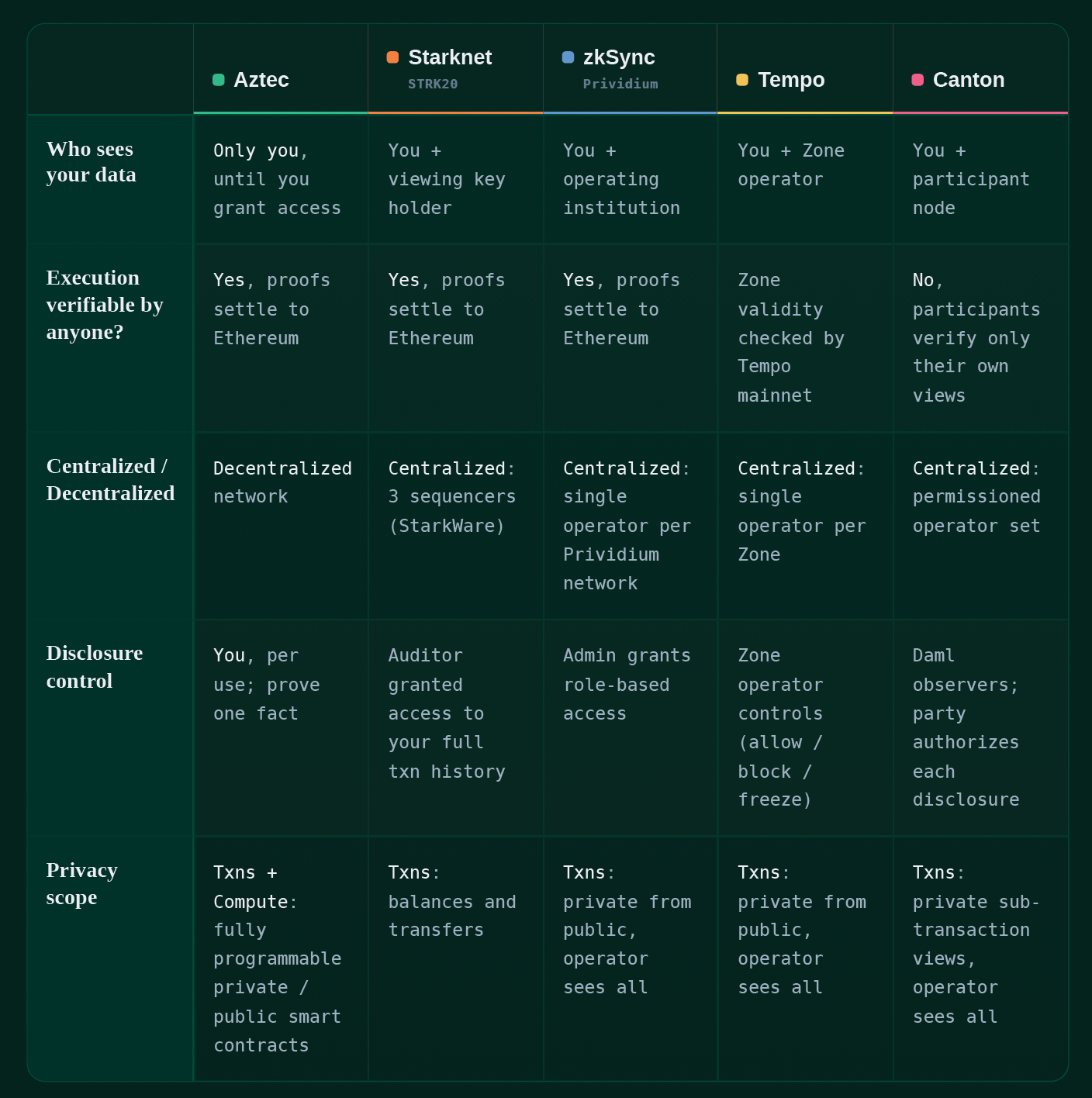
Each of these networks offers privacy with selective disclosure, but each rests on a different network design with its own tradeoffs. We have ordered them by who holds your privacy off-switch, starting with designs where a third party controls access to your data and ending with designs where that control stays with you. At the top, the switch sits behind a policy promise and an honest operator, and further down it is replaced by proofs that the user generates and controls.
Canton keeps data private by controlling viewing permissions for the various actors on its network. A transaction splits into per-participant views, so each party receives only the sub-transactions that name it, and the parts it is not entitled to never reach it. The sequencer and mediator move those views without reading them, which is real privacy against those roles.
However, the data is still read in plaintext by the participant nodes that host the relevant parties, and in the common regulated-asset pattern where the issuer is a signatory on its own token, the issuer's node sees every transfer. The harder gap is verification, because no third party can reconstruct the global ledger, so correctness rests on the confirming nodes staying honest and their keys staying safe. In practice the off-switch sits with those nodes rather than with you, since you cannot see when your data is read and cannot stop it.
Tempo is designed for payments and uses validity proofs to verify that each zone is executing correctly, while still giving the zone operator full plaintext visibility into every transaction within that zone. Privacy comes from Tempo Zones, which are parallel execution environments connected to the Tempo mainnet.
By design, the zone operator has visibility into all transactions within the zone, while users see only their own and the public sees only a proof that the zone is valid. Token issuers set compliance controls, allowlists, blocklists, and freezes, enforced across zones. The mainnet checks each zone's validity, so execution is verified, while the operator still reads every transaction in plaintext and holds the off-switch over what is revealed. Your privacy is from the public, not from the operator.
zkSync Prividium adds the verifiability piece that Canton lacks. Every batch produces a validity proof settled to Ethereum, so a compromised operator cannot forge state or mint tokens from nothing without also forging a proof, which it cannot do. The tradeoff is that the operator processes every transaction in plaintext and decides who sees what, which means the off-switch stays with the operator and your privacy is from the outside world rather than from the operator itself.
This tradeoff has legitimate uses in high-trust institutional environments. If Bank of America, JPMorgan, and Wells Fargo are transacting on a shared network, a zone where BofA's infrastructure processes BofA-originated transactions satisfies internal control requirements while still delivering genuine ZK privacy from the other banks and the rest of the world. Where this model breaks down is in lower-trust environments where giving an operator full plaintext access and the switch that comes with it holds back product design possibilities.
Starknet's STRK20 breaks from relying on an operator for privacy. It shields ERC-20 balances and transfers in a privacy pool, and every private transaction carries a zero-knowledge proof generated client-side, so no operator sees your plaintext in order to build it.
Disclosure is where STRK20 diverges from Aztec. To join the Starknet Privacy Pool, you register an encrypted viewing key onchain, and it sits there for the life of your participation. On a regulatory request, a designated auditing entity can decrypt that key and trace your complete transaction history, forwards and backwards. StarkWare calls this ‘not a backdoor’ but a carefully scoped access mechanism, and the safeguard is a policy promise that the auditor decrypts only when required. The privacy is cryptographic, but the off-switch is a standing key that someone else holds and can flip whether or not you are watching.
On Aztec your private state lives as encrypted private data that only you can decrypt. The contract developer can choose what state is public and what is private, and whether your encrypted private data is emitted onchain as a private log or shared off-chain instead.
Your transactions get proven client-side on your own device, so no sequencer or operator sees your unencrypted private data. Those proofs settle to Ethereum, which gives the same integrity anchor marketed by Prividium, with every transaction verified and no forged state, but without a single operator who reads your data. The base protocol decentralizes sequencing, proving, and governance, so there is no operator to choose and trust in the first place.
Disclosure is your choice too: you decide who learns your private data, and whether they learn it in encrypted or decrypted form. To grant discovery without readability, you share an app-specific tagging secret that lets an auditor find your data in encrypted form without being able to decrypt and read it. This is enough to prove things calculated from that data, such as a tax basis or a profit and loss figure. Granting permission to actually read the data works differently. There's no per-contract read key you can hand out, because decryption uses your master viewing key, which would unlock all your data across every contract. So instead of sharing a key, you share the data itself, plus a proof that your plaintext is what encrypts to the on-chain ciphertext.
Aztec has true selective disclosure in that you can selectively share it, and nothing else you don’t need to. This is app specific, meaning that private data discoverability access on one app does not grant access on another. Most importantly, the off-switch stays in your hands, and you never need to trust the network to handle access to any of your private data and activity.
This is not just conceptual: here is a working proof-of-concept of this model on Aztec. PrivPNL takes you from private DEX trades through a tagging-key disclosure to a browser-generated ZK proof of your PnL. The auditor verifies a proof while the prover only has to reveal the amount they owe, and your portfolio stays private.
Canton keeps the switch with the participant nodes that read your data in plaintext, so disclosure rests on those nodes staying honest rather than on anything you control. Tempo similarly gives the off-switch to a zone-based node operator, but allows you to verify the correctness of transactions using validity proofs. Prividium hardens that promise with a proof settled to Ethereum, a real improvement, but the operator still reads every transaction and still decides who sees what. This can work well for large institutions, but small to medium sized enterprises are left with the same privacy as their current banks unless they run their own Prividium nodes. STRK20 moves the switch into a standing viewing key and asks you to trust that a designated auditor reaches for it only when needed. In each of these models the real question is not whether your privacy can be switched off, but who gets to do the switching, and whether you would even know it happened.
Aztec takes the operator and the standing key out of the question entirely. You keep the data, you generate the proof, and you disclose the result, one fact at a time and only when you choose to. The off-switch never leaves your hands, and no operator, auditor, or node can reach it on your behalf. This is one of the benefits of a network that offers fully programmable, privacy-preserving smart contracts that put you in control.
Selective disclosure is how privacy survives contact with a regulator, and the model you pick decides who can open your history when you are not looking. On Aztec, that answer is no one but you.
Dive into the technical details: Try a live demo of selective disclosure on Aztec and read the technical article on how it was built.
Integrate with Aztec: Reach out if you are interested in integrating privacy into your project.
Alpha is live: a fully feature-complete, privacy-first network. The infrastructure is in place, privacy is native to the protocol, and developers can now build truly private applications.
Nine years ago, we set out to redesign blockchain for privacy. The goal: create a system institutions can adopt while giving users true control of their digital lives. Privacy band-aids are coming to Ethereum (someday), but it’s clear we need privacy now, and there’s an arms race underway to build it. Privacy is complex, it’s not a feature you can bolt-on as an afterthought. It demands a ground-up approach, deep tech stack integration, and complete decentralization.
In November 2025, the Aztec Ignition Chain went live as the first decentralized L2 on Ethereum, it’s the coordination layer that the execution layer sits on top of. The network is not operated by the Aztec Labs or the Aztec Foundation, it’s run by the community, making it the true backbone of Aztec.
With the infrastructure in place and a unanimous community vote, the network enters Alpha.
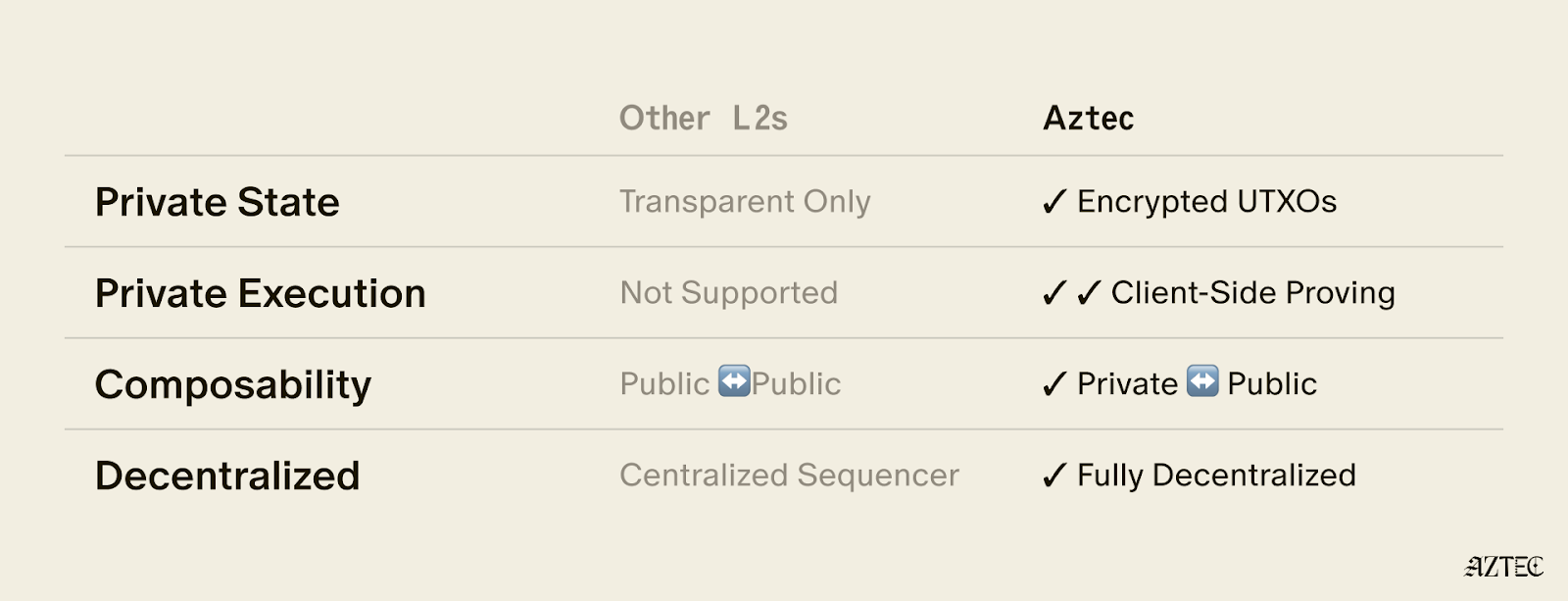
Alpha is the first Layer 2 with a full execution environment for private smart contracts. All accounts, transactions, and the execution itself can be completely private. Developers can now choose what they want public and what they want to keep private while building with the three privacy pillars we have in place across data, identity, and compute.
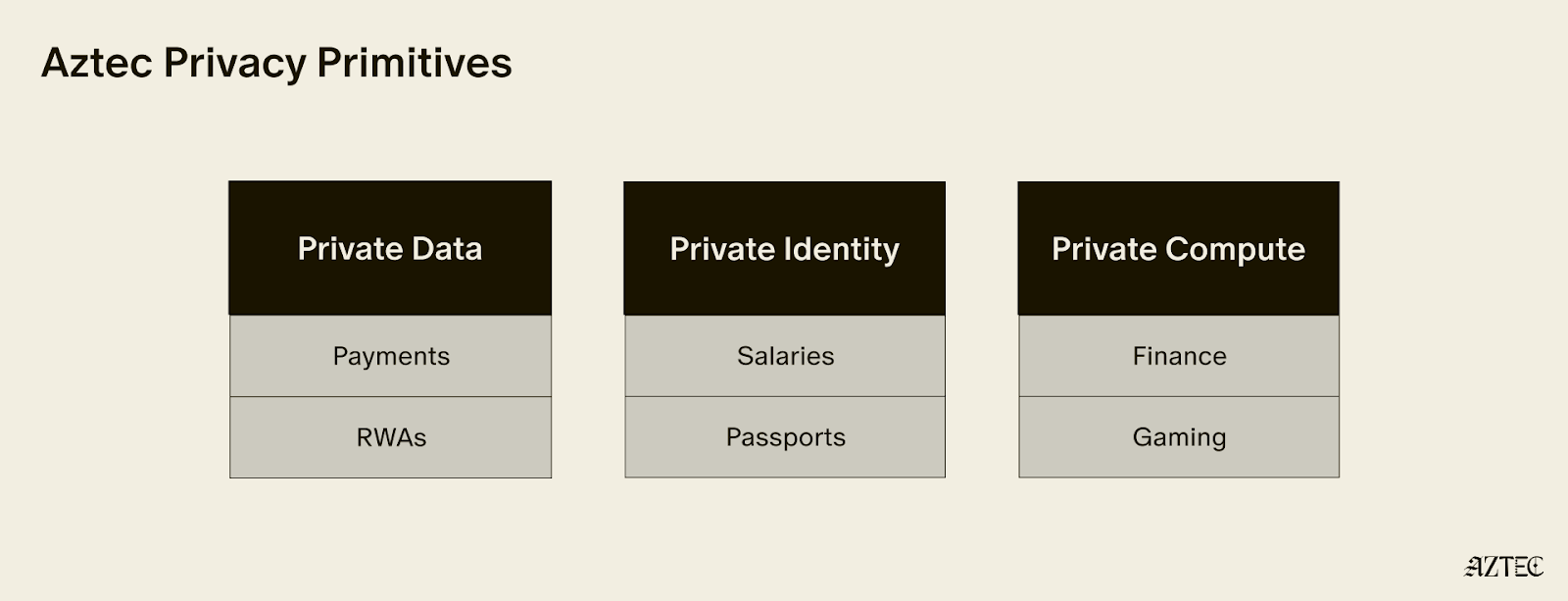
These privacy pillars, which can be used individually or combined, break down into three core layers:
Alpha is feature complete–meaning this is the only full-stack solution for adding privacy to your business or application. You build, and Aztec handles the cryptography under the hood.
It’s Composable. Private-preserving contracts are not isolated; they can talk to each other and seamlessly blend both private and public state across contracts. Privacy can be preserved across contract calls for full callstack privacy.
No backdoor access. Aztec is the only decentralized L2, and is launching as a fully decentralized rollup with a Layer 1 escape hatch.
It’s Compliant. Companies are missing out on the benefits of blockchains because transparent chains expose user data, while private networks protect it, but still offer fully customizable controls. Now they can build compliant apps that move value around the world instantly.
Developers can explore our privacy primitives across data, identity, and compute and start building with them using the documentation here. Note that this is an early version of the network with known vulnerabilities, see this post for details. While this is the first iteration of the network, there will be several upgrades that secure and harden the network on our path to Beta. If you’d like to learn more about how you can integrate privacy into your project, reach out here.
To hear directly from our Cofounders, join our live from Cannes Q&A on Tuesday, March 31st at 9:30 am ET. Follow us on X to get the latest updates from the Aztec Network.
Privacy has emerged as a major driver for the crypto industry in 2025. We’ve seen the explosion of Zcash, the Ethereum Foundation’s refocusing of PSE, and the launch of Aztec’s testnet with over 24,000 validators powering the network. Many apps have also emerged to bring private transactions to Ethereum and Solana in various ways, and exciting technologies like ZKPassport that privately bring identity on-chain using Noir have become some of the most talked about developments for ushering in the next big movements to the space.
Underpinning all of these developments is the emerging consensus that without privacy, blockchains will struggle to gain real-world adoption.
Without privacy, institutions can’t bring assets on-chain in a compliant way or conduct complex swaps and trades without revealing their strategies. Without privacy, DeFi remains dominated and controlled by advanced traders who can see all upcoming transactions and manipulate the market. Without privacy, regular people will not want to move their lives on-chain for the entire world to see every detail about their every move.
While there's been lots of talk about privacy, few can define it. In this piece we’ll outline the three pillars of privacy and gives you a framework for evaluating the privacy claims of any project.
True privacy rests on three essential pillars: transaction privacy, identity privacy, and computational privacy. It is only when we have all three pillars that we see the emergence of a private world computer.
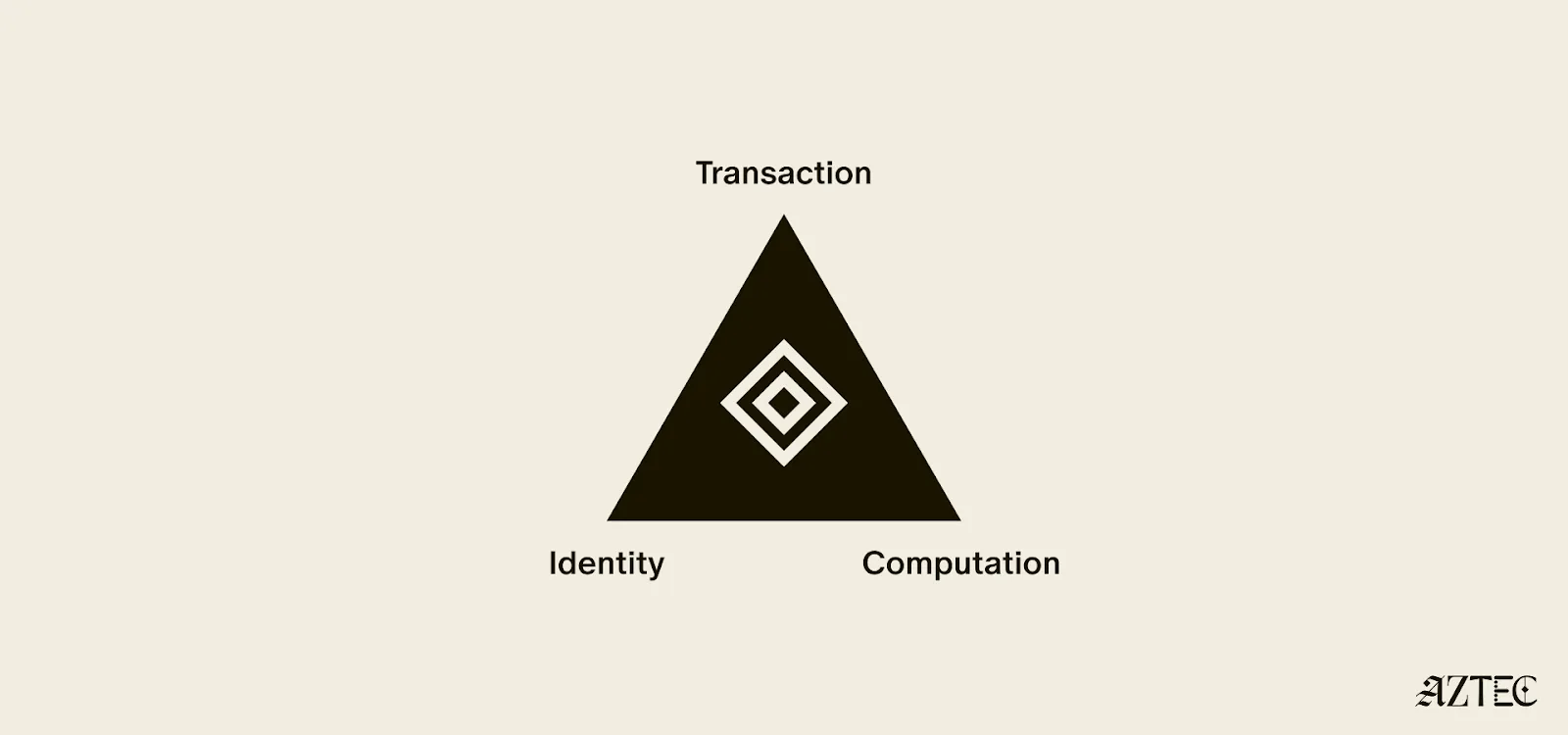
Transaction privacy means that both inputs and outputs are not viewable by anyone other than the intended participants. Inputs include any asset, value, message, or function calldata that is being sent. Outputs include any state changes or transaction effects, or any transaction metadata caused by the transaction. Transaction privacy is often primarily achieved using a UTXO model (like Zcash or Aztec’s private state tree). If a project has only the option for this pillar, it can be said to be confidential, but not private.
Identity privacy means that the identities of those involved are not viewable by anyone other than the intended participants. This includes addresses or accounts and any information about the identity of the participants, such as tx.origin, msg.sender, or linking one’s private account to public accounts. Identity privacy can be achieved in several ways, including client-side proof generation that keeps all user info on the users’ devices. If a project has only the option for this pillar, it can be said to be anonymous, but not private.
Computation privacy means that any activity that happens is not viewable by anyone other than the intended participants. This includes the contract code itself, function execution, contract address, and full callstack privacy. Additionally, any metadata generated by the transaction is able to be appropriately obfuscated (such as transaction effects, events are appropriately padded, inclusion block number are in appropriate sets). Callstack privacy includes which contracts you call, what functions in those contracts you’ve called, what the results of those functions were, any subsequent functions that will be called after, and what the inputs to the function were. A project must have the option for this pillar to do anything privately other than basic transactions.
Bitcoin ushered in a new paradigm of digital money. As a permissionless, peer-to-peer currency and store of value, it changed the way value could be sent around the world and who could participate. Ethereum expanded this vision to bring us the world computer, a decentralized, general-purpose blockchain with programmable smart contracts.
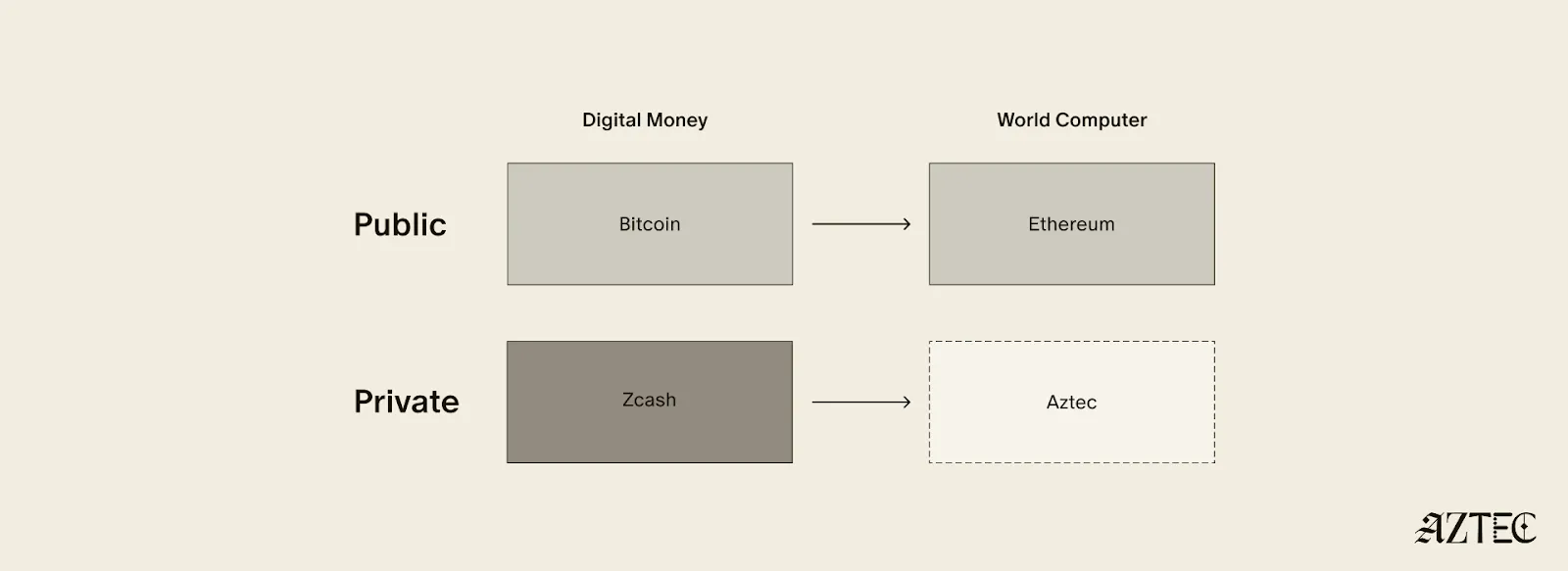
Given the limitations of running a transparent blockchain that exposes all user activity, accounts, and assets, it was clear that adding the option to preserve privacy would unlock many benefits (and more closely resemble real cash). But this was a very challenging problem. Zcash was one of the first to extend Bitcoin’s functionality with optional privacy, unlocking a new privacy-preserving UTXO model for transacting privately. As we’ll see below, many of the current privacy-focused projects are working on similar kinds of private digital money for Ethereum or other chains.
Now, Aztec is bringing us the final missing piece: a private world computer.
A private world computer is fully decentralized, programmable, and permissionless like Ethereum and has optional privacy at every level. In other words, Aztec is extending all the functionality of Ethereum with optional transaction, identity, and computational privacy. This is the only approach that enables fully compliant, decentralized applications to be built that preserve user privacy, a new design space that we see as ushering in the next Renaissance for the space.
Private digital money emerges when you have the first two privacy pillars covered - transactions and identity - but you don’t have the third - computation. Almost all projects today that claim some level of privacy are working on private digital money. This includes everything from privacy pools on Ethereum and L2s to newly emerging payment L1s like Tempo and Arc that are developing various degrees of transaction privacy
When it comes to digital money, privacy exists on a spectrum. If your identity is hidden but your transactions are visible, that's what we call anonymous. If your transactions are hidden but your identity is known, that's confidential. And when both your identity and transactions are protected, that's true privacy. Projects are working on many different approaches to implement this, from PSE to Payy using Noir, the zkDSL built to make it intuitive to build zk applications using familiar Rust-like syntax.
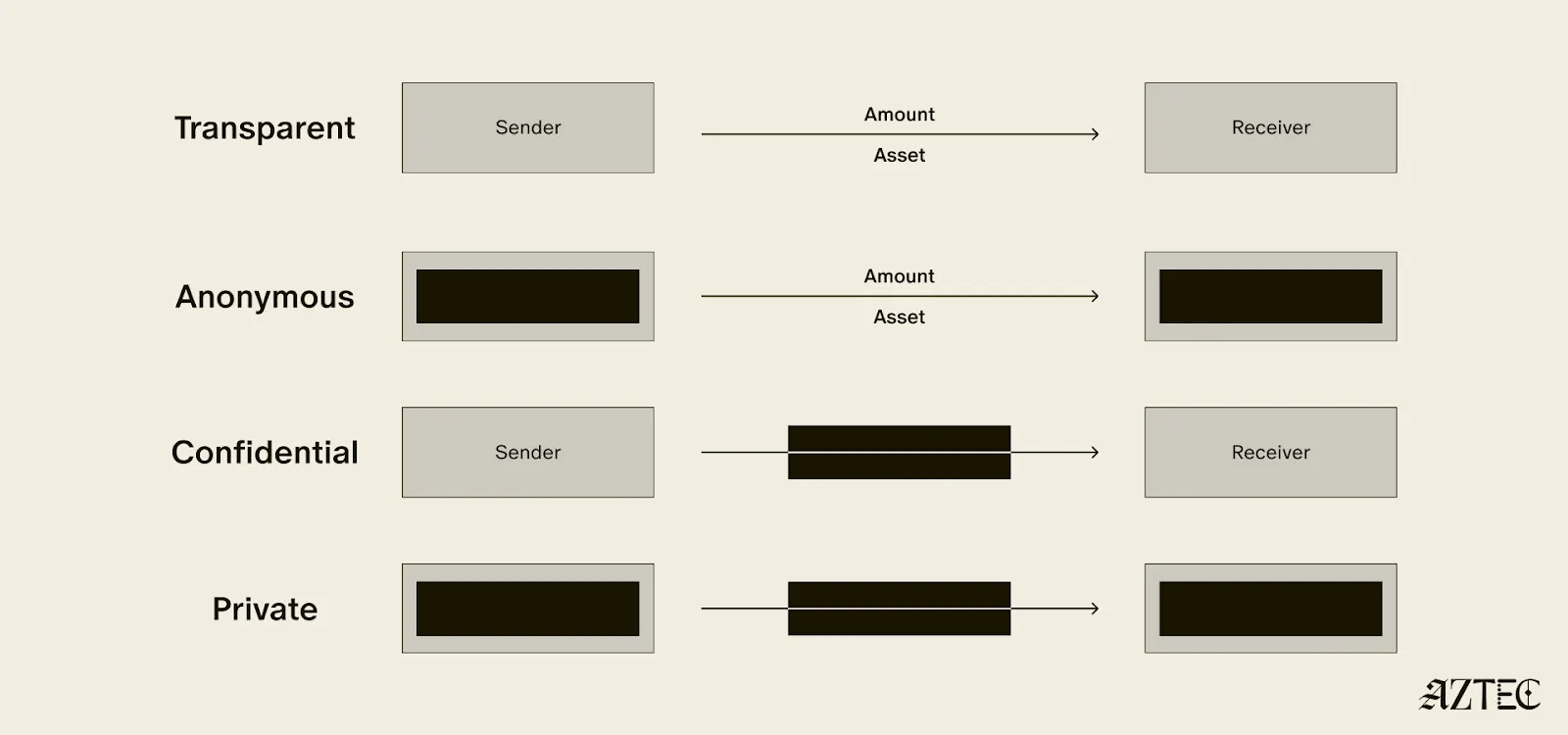
Private digital money is designed to make payments private, but any interaction with more complex smart contracts than a straightforward payment transaction is fully exposed.
What if we also want to build decentralized private apps using smart contracts (usually multiple that talk to each other)? For this, you need all three privacy pillars: transaction, identity, and compute.
If you have these three pillars covered and you have decentralization, you have built a private world computer. Without decentralization, you are vulnerable to censorship, privileged backdoors and inevitable centralized control that can compromise privacy guarantees.
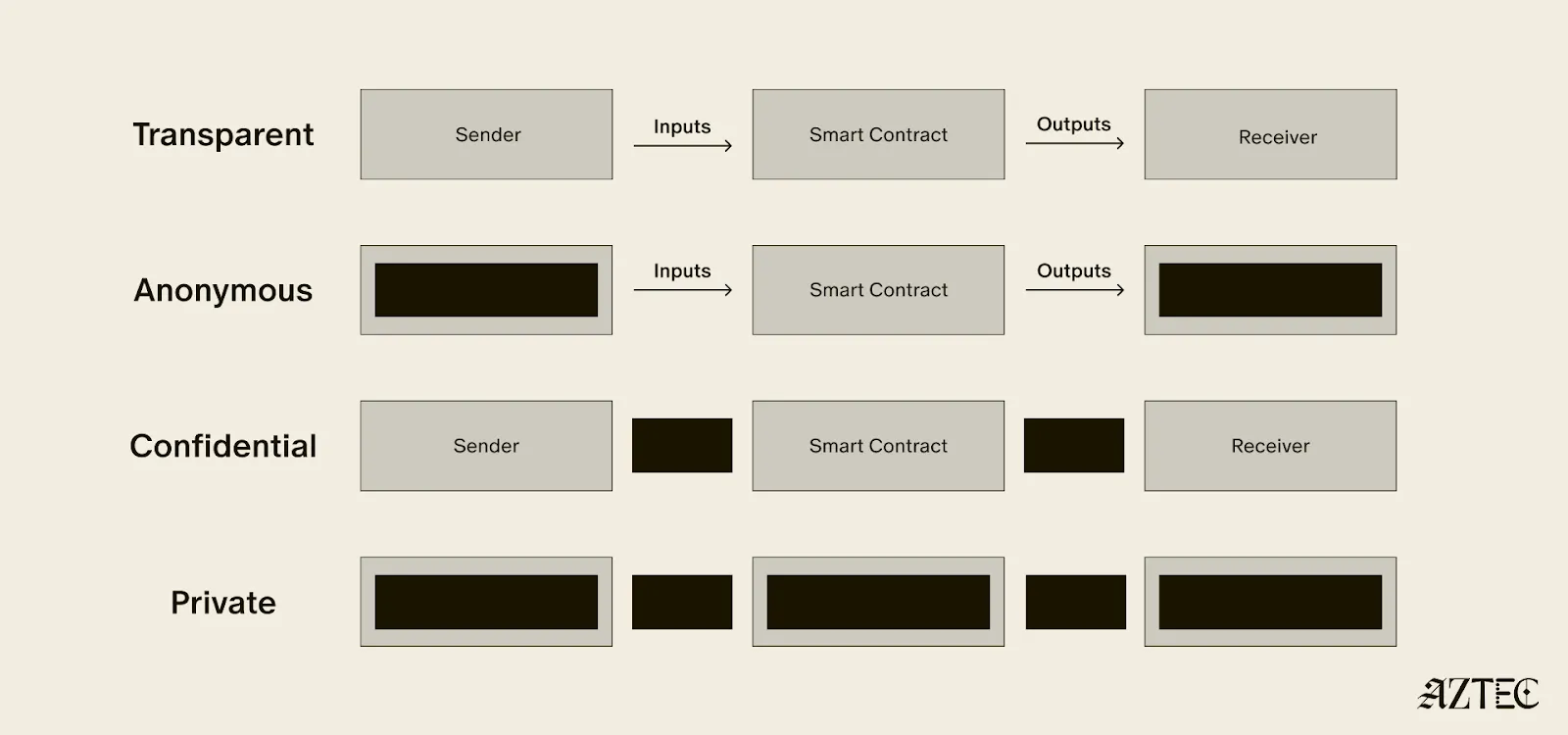
What exactly is a private world computer? A private world computer extends all the functionality of Ethereum with optional privacy at every level, so developers can easily control which aspects they want public or private and users can selectively disclose information. With Aztec, developers can build apps with optional transaction, identity, and compute privacy on a fully decentralized network. Below, we’ll break down the main components of a private world computer.
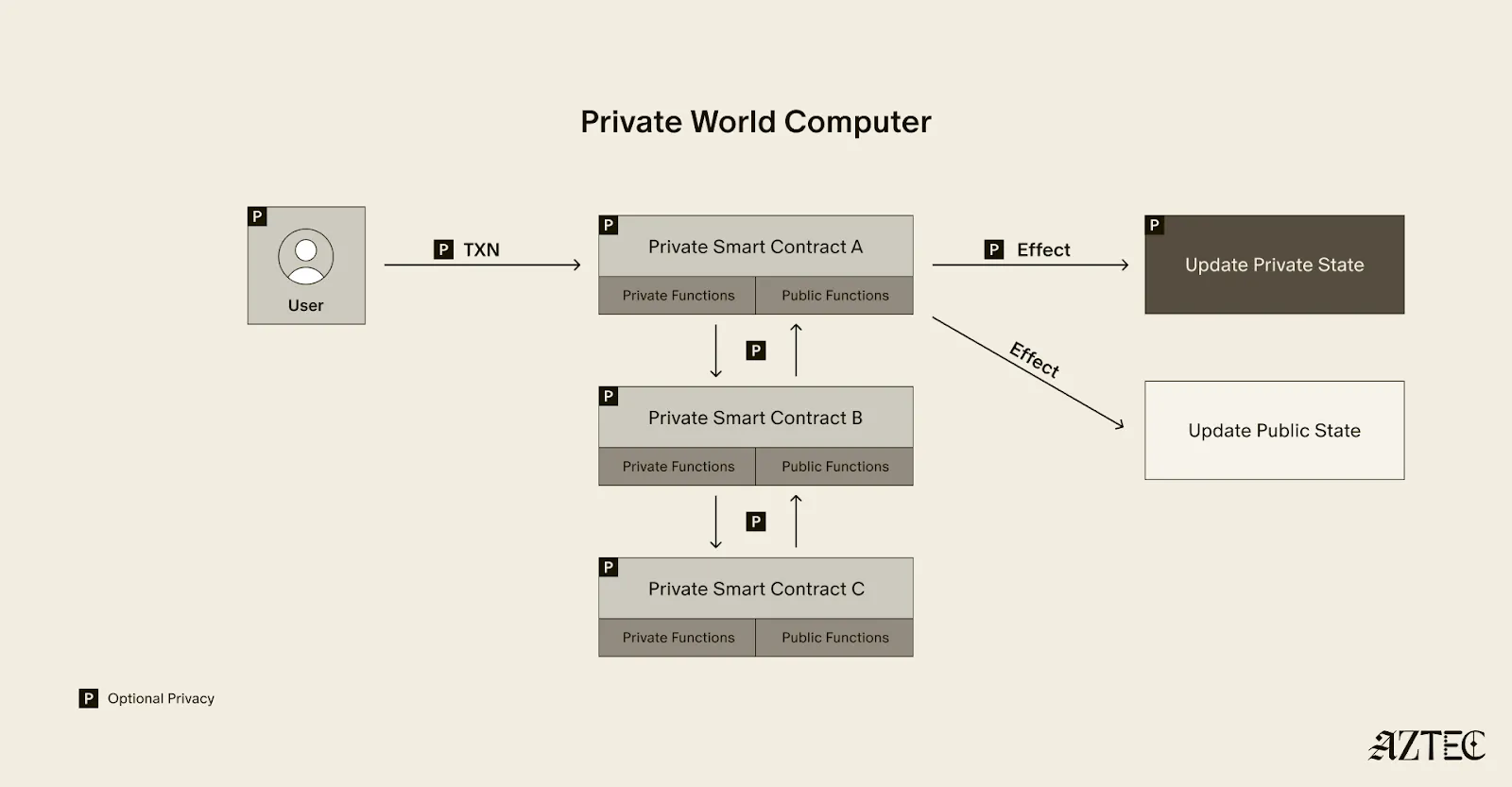
A private world computer is powered by private smart contracts. Private smart contracts have fully optional privacy and also enable seamless public and private function interaction.
Private smart contracts simply extend the functionality of regular smart contracts with added privacy.
As a developer, you can easily designate which functions you want to keep private and which you want to make public. For example, a voting app might allow users to privately cast votes and publicly display the result. Private smart contracts can also interact privately with other smart contracts, without needing to make it public which contracts have interacted.
Transaction: Aztec supports the optionality for fully private inputs, including messages, state, and function calldata. Private state is updated via a private UTXO state tree.
Identity: Using client-side proofs and function execution, Aztec can optionally keep all user info private, including tx.origin and msg.sender for transactions.
Computation: The contract code itself, function execution, and call stack can all be kept private. This includes which contracts you call, what functions in those contracts you’ve called, what the results of those functions were, and what the inputs to the function were.
A decentralized network must be made up of a permissionless network of operators who run the network and decide on upgrades. Aztec is run by a decentralized network of node operators who propose and attest to transactions. Rollup proofs on Aztec are also run by a decentralized prover network that can permissionlessly submit proofs and participate in block rewards. Finally, the Aztec network is governed by the sequencers, who propose, signal, vote, and execute network upgrades.
A private world computer enables the creation of DeFi applications where accounts, transactions, order books, and swaps remain private. Users can protect their trading strategies and positions from public view, preventing front-running and maintaining competitive advantages. Additionally, users can bridge privately into cross-chain DeFi applications, allowing them to participate in DeFi across multiple blockchains while keeping their identity private despite being on an existing transparent blockchain.
This technology makes it possible to bring institutional trading activity on-chain while maintaining the privacy that traditional finance requires. Institutions can privately trade with other institutions globally, without having to touch public markets, enjoying the benefits of blockchain technology such as fast settlement and reduced counterparty risk, without exposing their trading intentions or volumes to the broader market.
Organizations can bring client accounts and assets on-chain while maintaining full compliance. This infrastructure protects on-chain asset trading and settlement strategies, ensuring that sophisticated financial operations remain private. A private world computer also supports private stablecoin issuance and redemption, allowing financial institutions to manage digital currency operations without revealing sensitive business information.
Users have granular control over their privacy settings, allowing them to fine-tune privacy levels for their on-chain identity according to their specific needs. The system enables selective disclosure of on-chain activity, meaning users can choose to reveal certain transactions or holdings to regulators, auditors, or business partners while keeping other information private, meeting compliance requirements.
The shift from transparent blockchains to privacy-preserving infrastructure is the foundation for bringing the next billion users on-chain. Whether you're a developer building the future of private DeFi, an institution exploring compliant on-chain solutions, or simply someone who believes privacy is a fundamental right, now is the time to get involved.
Follow Aztec on X to stay updated on the latest developments in private smart contracts and decentralized privacy technology. Ready to contribute to the network? Run a node and help power the private world computer.
The next Renaissance is here, and it’s being powered by the private world computer.
Special thanks to Santiago Palladino, Phil Windle, Alex Gherghisan, and Mitch Tracy for technical updates and review.
On September 17th, 2025, a new network upgrade was deployed, making Aztec more secure and flexible for home stakers. This upgrade, shipped with all the features needed for a fully decentralized network launch, includes a completely redesigned slashing system that allows inactive or malicious operators to be removed, and does not penalize home stakers for short outages.
With over 23,000 operators running validators across 6 continents (in a variety of conditions), it is critical not to penalize nodes that temporarily drop due to internet connectivity issues. This is because users of the network are also found across the globe, some of whom might have older phones. A significant effort was put into shipping a low-memory proving mode that allows older mobile devices to send transactions and use privacy-preserving apps.
The network was successfully deployed, and all active validators on the old testnet were added to the queue of the new testnet. This manual migration was only necessary because major upgrades to the governance contracts had gone in since the last testnet was deployed. The new testnet started producing blocks after the queue started to be “flushed,” moving validators into the rollup. Because the network is fully decentralized, the initial flush could have been called by anyone. The network produced ~2k blocks before an invalid block made it to the chain and temporarily stalled block production. Block production is now restored and the network is healthy. This post explains what caused the issue and provides an update on the current status of the network.
Note: if you are a network operator, you must upgrade to version 2.0.3 and restart your node to participate in the latest testnet. If you want to run a node, it’s easy to get started.
This upgrade was a team-wide effort that optimized performance and implemented all the mechanisms needed to launch Aztec as a fully decentralized network from day 1.
With these updates in place, we’re ready to test a feature-complete network.
As mentioned above, block production started when someone called the flush function and a minimum number of operators from the queue were let into the validator set.
Shortly thereafter, while testing the network, a member of the Aztec Labs team spun up a “bad” sequencer that produced an invalid block proposal. Specifically, one of the state trees in the proposal was tampered with.
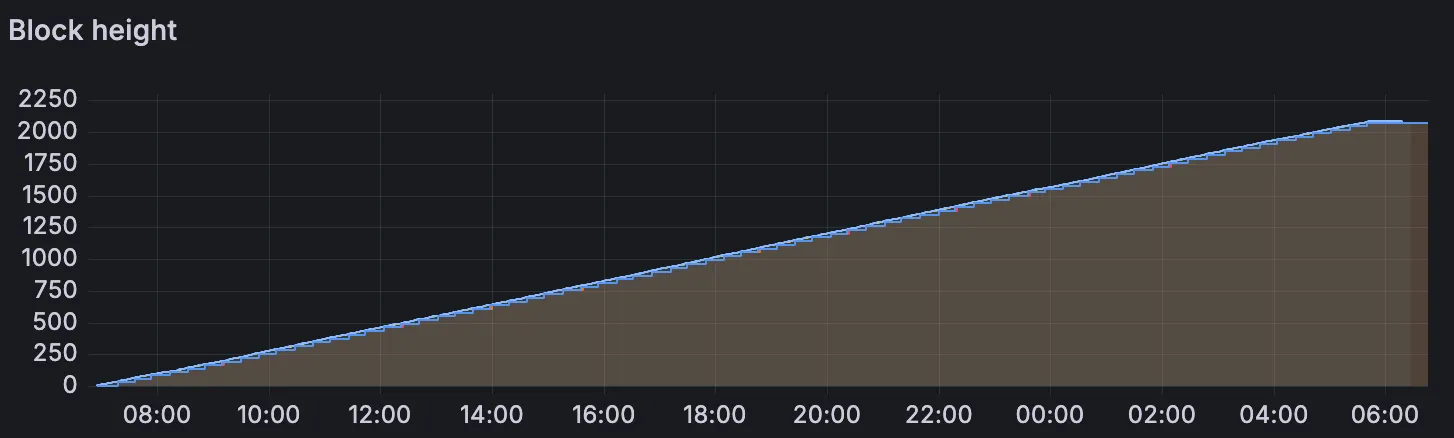
The expectation was that this would be detected immediately and the block rejected. Instead, a bug was discovered in the validator code where the invalid block proposal wasn't checked thoroughly enough. In effect, the proposal got enough attestations, so it was posted to the rollup. Due to extra checks in the nodes, when the nodes pulled the invalid block from Ethereum, they detected the tampered tree and refused to sync it. This is a good outcome as it prevented the attack. Additionally, prover nodes refused to prove the epoch containing the invalid block. This allowed the rollup to prune the entire bad epoch away. After the prune, the invalid state was reset to the last known good block.
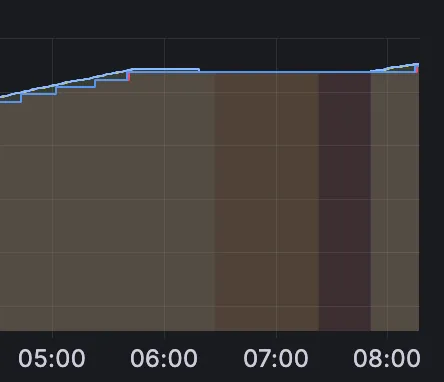
The prune revealed another, smaller bug, where, after a failed block sync, a prune does not get processed correctly, requiring a node restart to clear up. This led to a 90-minute outage from the moment the block proposal was posted until the testnet recovered. The time was equally split between waiting for pruning to happen and for the nodes to restart in order to process the prune.
Validators were correctly re-executing all transactions in the block proposals and verifying that the world state root matched the one in the block proposal, but they failed to check that intermediate tree roots, which are included in the proposal and posted to the rollup contract on L1, were also correct. The attack tweaked one of these intermediate roots while proposing a correct world state root, so it went unnoticed by the attestors.
As mentioned above, even though the block made it through the initial attestation and was posted to L1, the invalid block was caught by the validators, and the entire epoch was never proven as provers refused to generate a proof for the inconsistent state.
A fix was pushed that resolved this issue and ensured that invalid block proposals would be caught and rejected. A second fix was pushed that ensures inconsistent state is removed from the uncommitted cache of the world state.
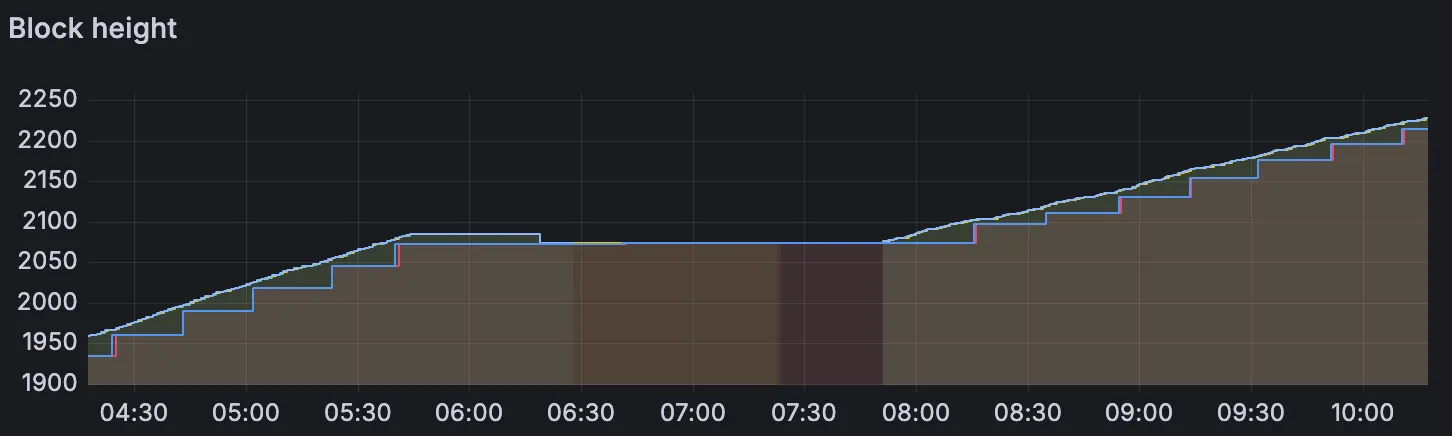
Block production is currently running smoothly, and the network health has been restored.
Operators who had previously upgraded to version 2.0.3 will need to restart their nodes. Any operator who has not upgraded to 2.0.3 should do so immediately.

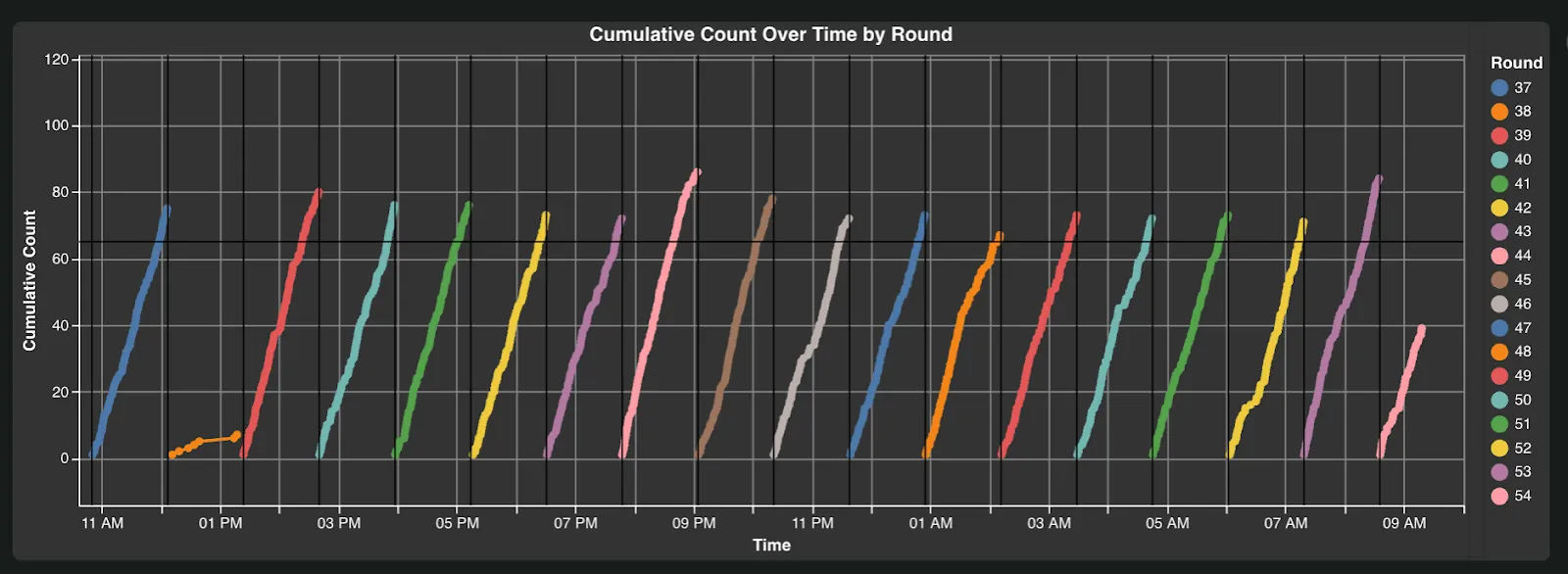
Slashing has also been functioning as expected. Below you can see the slashing signals for each round. A single signal can contain votes for multiple validators, but a validator's attester needs to receive 65 votes to be slashed.
Join us this Thursday, September 25, 2025, at 4 PM CET on the Discord Town Hall to hear more about the 2.0.3 upgrade. To stay up to date with the latest updates for network operators, join the Aztec Discord and follow Aztec on X.
Payy, a privacy-focused payment network, just rewrote its entire ZK architecture from Halo2 to Noir while keeping its network live, funds safe, and users happy.
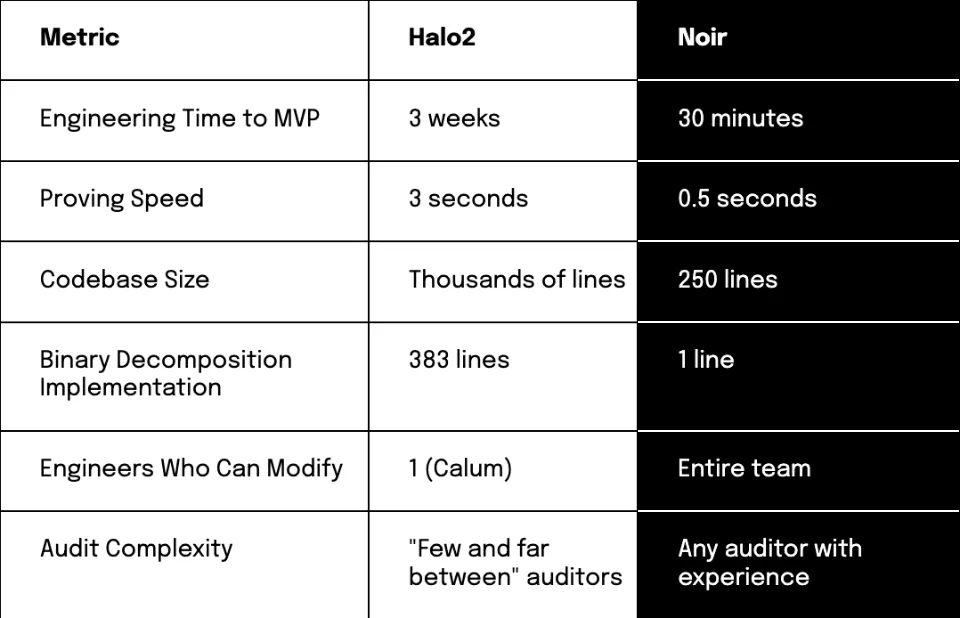
Code that took months to write now takes weeks (with MVPs built in as little as 30 minutes). Payy’s codebase shrank from thousands of lines to 250, and now their entire engineering team can actually work on its privacy infra.
This is the story of how they transformed their ZK ecosystem from one bottlenecked by a single developer to a system their entire team can modify and maintain.
Eighteen months ago, Payy faced a deceptively simple requirement: build a privacy-preserving payment network that actually works on phones. That requires client-side proving.
"Anyone who tells you they can give you privacy without the proof being on the phone is lying to you," Calum Moore - Payy's Technical Lead - states bluntly.
To make a private, mobile network work, they needed:
To start, the team evaluated available ZK stacks through their zkbench framework:
STARKs (e.g., RISC Zero): Memory requirements made them a non-starter on mobile. Large proof sizes are unsuitable for mobile data transmission.
Circom with Groth16: Required trusted setup ceremonies for each circuit update. It had “abstracted a bit too early” and, as a result, is not high-level enough to develop comfortably, but not low-level enough for controls and optimizations, said Calum.
Halo2: Selected based on existing production deployments (ZCash, Scroll), small proof sizes, and an existing Ethereum verifier. As Calum admitted with the wisdom of hindsight: “Back a year and a half ago, there weren’t any other real options.”
Halo2 delivered on its promises: Payy successfully launched its network. But cracks started showing almost immediately.
First, they had to write their own chips from scratch. Then came the real fun: if statements.
"With Halo2, I'm building a chip, I'm passing this chip in... It's basically a container chip, so you'd set the value to zero or one depending on which way you want it to go. And, you'd zero out the previous value if you didn't want it to make a difference to the calculation," Calum explained, “when I’m writing in Noir, I just write ‘if’. "
With Halo2, writing an if statement (programming 101) required building custom chip infra.
Binary decomposition, another fundamental operation for rollups, meant more custom chips. The Halo2 implementation quickly grew to thousands of lines of incomprehensible code.
And only Calum could touch any of it.
The Bottleneck
"It became this black box that no one could touch, no one could reason about, no one could verify," he recalls. "Obviously, we had it audited, and we were confident in that. But any changes could only be done by me, could only be verified by me or an auditor."
In engineering terms, this is called a bus factor of one: if Calum got hit by a bus (or took a vacation to Argentina), Payy's entire proving system would be frozen. "Those circuits are open source," Calum notes wryly, "but who's gonna be able to read the Halo2 circuits? Nobody."
During a launch event in Argentina, "I was like, oh, I'll check out Noir again. See how it's going," Calum remembers. He'd been tracking Noir's progress for months, occasionally testing it out, waiting for it to be reliable.
"I wrote basically our entire client-side proof in about half an hour in Noir. And it probably took me - I don't know, three weeks to write that proof originally in Halo2."
Calum recreated Payy's client-side proof in Noir in 30 minutes. And when he tested the proving speed, without any optimization, they were seeing 2x speed improvements.
"I kind of internally… didn't want to tell my cofounder Sid that I'd already made my decision to move to Noir," Calum admits. "I hadn't broken it to him yet because it's hard to justify rewriting your proof system when you have a deployed network with a bunch of money already on the network and a bunch of users."
Convincing a team to rewrite the core of a live financial network takes some evidence. The technical evaluation of Noir revealed improvements across every metric:
Proof Generation Time: Sub-0.5 second proof generation on iPhones. "We're obsessive about performance," Calum notes (they’re confident they can push it even further).
Code Complexity: Their entire ZK implementation compressed from thousands of lines of Halo2 to just 250 lines of Noir code. "With rollups, the logic isn't complex—it's more about the preciseness of the logic," Calum explains.
Composability: In Halo2, proof aggregation required hardwiring specific verifiers for each proof type. Noir offers a general-purpose verifier that accepts any proof of consistent size.
"We can have 100 different proving systems, which are hyper-efficient for the kind of application that we're doing," Calum explains. "Have them all aggregated by the same aggregation proof, and reason about whatever needs to be."
Initially, the goal was to "completely mirror our Halo2 proofs": no new features. This conservative approach meant they could verify correctness while maintaining a live network.
The migration preserved Payy's production architecture:
"If you have your proofs in Noir, any person who understands even a little bit about logic or computers can go in and say, 'okay, I can kinda see what's happening here'," Calum notes.
The audit process completely transformed. With Halo2: "The auditors that are available to audit Halo2 are few and far between."
With Noir: "You could have an auditor that had no Noir experience do at least a 95% job."
Why? Most audit issues are logic errors, not ZK-specific bugs. When auditors can read your code, they find real problems instead of getting lost in implementation details.
Halo2: Binary decomposition
Payy’s previous 383 line implementation of binary decomposition can be viewed here (pkg/zk-circuits/src/chips/binary_decomposition.rs).
Payy’s previous binary decomposition implementation
Meanwhile, binary decomposition is handled in Noir with the following single line.
pub fn to_le_bits<let N: u32>(self: Self) -> [u1; N]
(Source)
With Noir's composable proof system, Payy can now build specialized provers for different operations, each optimized for its specific task.
"If statements are horrendous in SNARKs because you pay the cost of the if statement regardless of its run," Calum explains. But with Noir's approach, "you can split your application logic into separate proofs, and run whichever proof is for the specific application you're looking for."
Instead of one monolithic proof trying to handle every case, you can have specialized proofs, each perfect for its purpose.
"I fell a little bit in love with Halo2," Calum admits, "maybe it's Stockholm syndrome where you're like, you know, it's a love-hate relationship, and it's really hard. But at the same time, when you get a breakthrough with it, you're like, yes, I feel really good because I'm basically writing assembly-level ZK proofs."
“But now? I just write ‘if’.”
Technical Note: While "migrating from Halo2 to Noir" is shorthand that works for this article, technically Halo2 is an integrated proving system where circuits must be written directly in Rust using its constraint APIs, while Noir is a high-level language that compiles to an intermediate representation and can use various proving backends. Payy specifically moved from writing circuits in Halo2's low-level constraint system to writing them in Noir's high-level language, with Barretenberg (UltraHonk) as their proving backend.
Both tools ultimately enable developers to write circuits and generate proofs, but Noir's modular architecture separates circuit logic from the proving system - which is what made Payy's circuits so much more accessible to their entire team, and now allows them to swap out their proving system with minimal effort as proving systems improve.
Payy's code is open source and available for developers looking to learn from their implementation.
Aztec’s Public Testnet launched in May 2025.
Since then, we’ve been obsessively working toward our ultimate goal: launching the first fully decentralized privacy-preserving layer-2 (L2) network on Ethereum. This effort has involved a team of over 70 people, including world-renowned cryptographers and builders, with extensive collaboration from the Aztec community.
To make something private is one thing, but to also make it decentralized is another. Privacy is only half of the story. Every component of the Aztec Network will be decentralized from day one because decentralization is the foundation that allows privacy to be enforced by code, not by trust. This includes sequencers, which order and validate transactions, provers, which create privacy-preserving cryptographic proofs, and settlement on Ethereum, which finalizes transactions on the secure Ethereum mainnet to ensure trust and immutability.
Strong progress is being made by the community toward full decentralization. The Aztec Network now includes nearly 1,000 sequencers in its validator set, with 15,000 nodes spread across more than 50 countries on six continents. With this globally distributed network in place, the Aztec Network is ready for users to stress test and challenge its resilience.
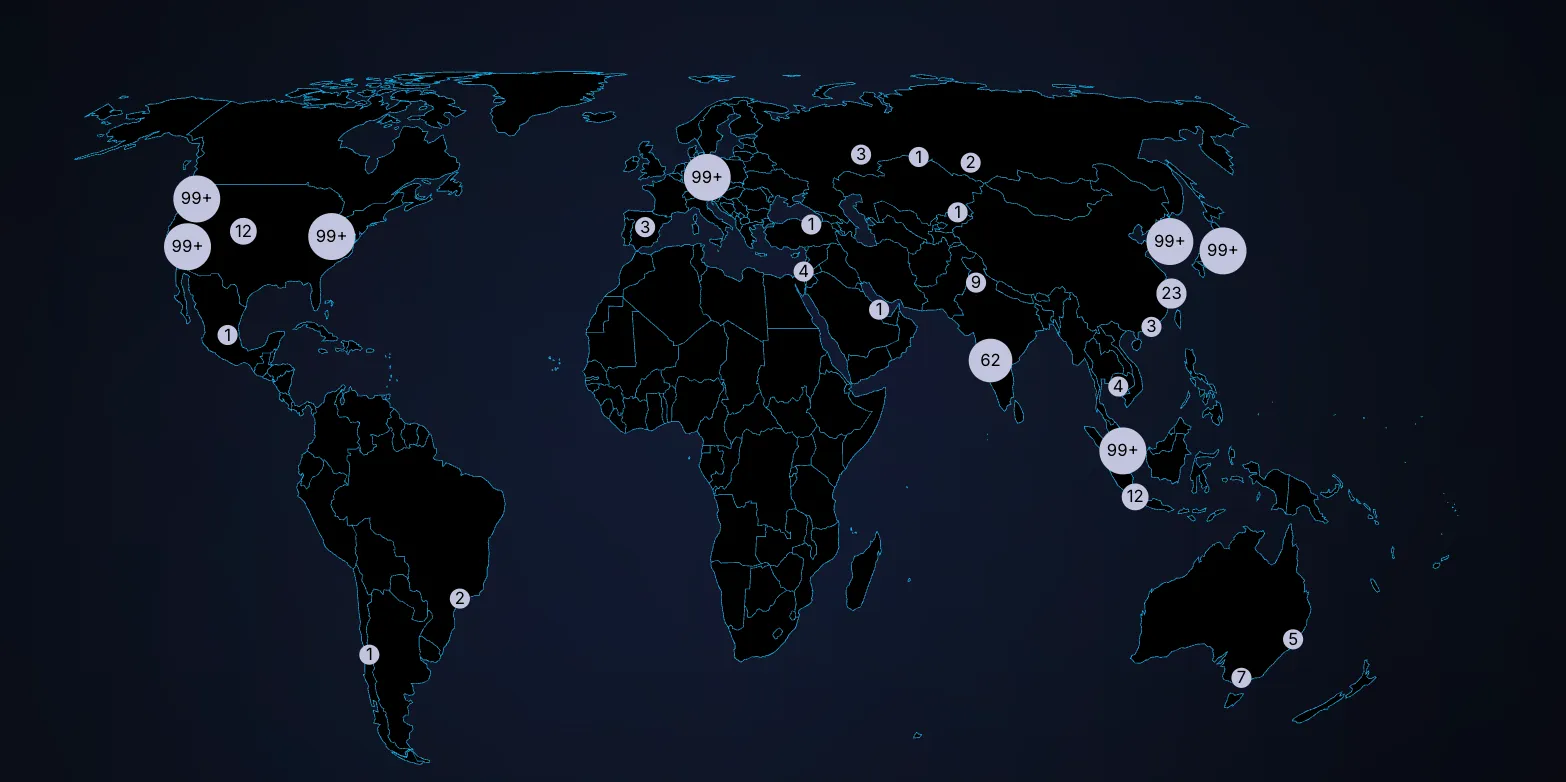
We're now entering a new phase: the Adversarial Testnet. This stage will test the resilience of the Aztec Testnet and its decentralization mechanisms.
The Adversarial Testnet introduces two key features: slashing, which penalizes validators for malicious or negligent behavior in Proof-of-Stake (PoS) networks, and a fully decentralized governance mechanism for protocol upgrades.
This phase will also simulate network attacks to test its ability to recover independently, ensuring it could continue to operate even if the core team and servers disappeared (see more on Vitalik’s “walkaway test” here). It also opens the validator set to more people using ZKPassport, a private identity verification app, to verify their identity online.
The Aztec Network testnet is decentralized, run by a permissionless network of sequencers.
The slashing upgrade tests one of the most fundamental mechanisms for removing inactive or malicious sequencers from the validator set, an essential step toward strengthening decentralization.
Similar to Ethereum, on the Aztec Network, any inactive or malicious sequencers will be slashed and removed from the validator set. Sequencers will be able to slash any validator that makes no attestations for an entire epoch or proposes an invalid block.
Three slashes will result in being removed from the validator set. Sequencers may rejoin the validator set at any time after getting slashed; they just need to rejoin the queue.
In addition to testing network resilience when validators go offline and evaluating the slashing mechanisms, the Adversarial Testnet will also assess the robustness of the network’s decentralized governance during protocol upgrades.
Adversarial Testnet introduces changes to Aztec Network’s governance system.
Sequencers now have an even more central role, as they are the sole actors permitted to deposit assets into the Governance contract.
After the upgrade is defined and the proposed contracts are deployed, sequencers will vote on and implement the upgrade independently, without any involvement from Aztec Labs and/or the Aztec Foundation.
Starting today, you can join the Adversarial Testnet to help battle-test Aztec’s decentralization and security. Anyone can compete in six categories for a chance to win exclusive Aztec swag, be featured on the Aztec X account, and earn a DappNode. The six challenge categories include:
Performance will be tracked using Dashtec, a community-built dashboard that pulls data from publicly available sources. Dashtec displays a weighted score of your validator performance, which may be used to evaluate challenges and award prizes.
The dashboard offers detailed insights into sequencer performance through a stunning UI, allowing users to see exactly who is in the current validator set and providing a block-by-block view of every action taken by sequencers.
To join the validator set and start tracking your performance, click here. Join us on Thursday, July 31, 2025, at 4 pm CET on Discord for a Town Hall to hear more about the challenges and prizes. Who knows, we might even drop some alpha.
To stay up-to-date on all things Noir and Aztec, make sure you’re following along on X.