
Aztec Network
16 May
## min read

An introduction to AZTEC

This is the first in a series of articles designed to help developers understand the core concepts of AZTEC.

Share
Written by
Joe Andrews
Edited by

An Introduction to AZTEC

This article is in English, you can read a Mandarin(中文) translation here.

This is the first in a series of articles designed to help developers understand the core concepts of AZTEC and walk through the steps required to build a confidential loan dApp using AZTEC. It is assumed the reader has a good knowledge of web development and a working knowledge of solidity.

This series is split into 4 parts:

  • Part 1 — An introduction to AZTEC
  • Part 2 — Deploying AZTEC on Ganache
  • Part 3 — Constructing Proofs, Signing Flows and Key Management.
  • Part 4 — Creating, Settling, & Streaming Confidential Assets

{{blog_divider}}

Before explaining what AZTEC is and how it works, it is important to first understand why it exists.

One of the much heralded uses of a blockchain is encompassed by the phrase “programmable money” — a smart contract controlling the movement of capital inside a financial application. e.g. A bond transfer will only process if the buyers total position is less than a 4% regulatory limit. If this can be achieved, large swathes of the financial system can be rebuilt on top of public blockchains and in the process remove intermediaries, end reconciliation and delete counter-party risk. Using the Ethereum blockchain today, it is straightforward to create “programmable money”. However there is a problem — privacy.

The inputs and outputs of any blockchain transaction are publicly broadcast inside the transaction payload.

In the bond transfer example, the notional being traded and a traders current position would have to be broadcast, in order for a smart contract to validate the trade complies with the the 4% regulatory limit. This is a non-starter for real world financial applications in where transaction privacy is a pre-requisite.

The AZTEC protocol was created to enable privacy on public blockchains. It enables logical checks to be performed on encrypted values without the underlying values being revealed to the blockchain. The inputs and outputs of a transaction are encrypted using a series of zero-knowledge proofs and homomorphic encryption, yet the blockchain can still test the logical correctness of these encrypted statements.

{{blog_divider}}

Under the hood

The validation of traditional Zero-knowledge systems on Ethereum is unworkable. This is due to a combination of on-chain verification gas costs, slow proof construction, and a lack of interoperability between assets. The lack of interoperability and inability for proof construction to run on a clients browser make these systems unsuitable for use in real world financial applications. One of the largest costs inside a Zero-knowledge system is the range proof. A range proof allows the prover to prove to a verifier, that a number is within a specific range. This is critically important when dealing with addition of elliptic curve points. On an elliptic curve, a negative number is in fact a very large positive number and a range proof is used to ensure that any point is within a usable range and to prevent double spend attacks by wrapping around the modulo. AZTEC’s range proof utilises a trusted setup to drastically reduce the cost of this check.

Once an encrypted number is proven to be inside the usable range the additive properties of an elliptic curve allow logical checks to be performed on it. This concept known as homomorphic encryption allows logical checks to be carried out on encrypted numbers as if they had not been encrypted. i.e the same checks can be performed as in a public transaction but without ever revealing the underlying values of the encrypted numbers.

These two cryptographic methods are combined into a set of sigma protocols that allow specific logical statements to be validated on chain. If you would like to find out more about the cryptography underpinning the protocol, please read the white-paper.

{{blog_divider}}

AZTEC’s Mental Model

AZTEC follows a UTXO model similar to that of Bitcoin. The core of any AZTEC transaction is a Note. The state of notes are managed by a Note Registry for any given asset.

The user’s balance of any AZTEC asset is made up of the sum of all of the valid notes their address owns in a given Note Registry.
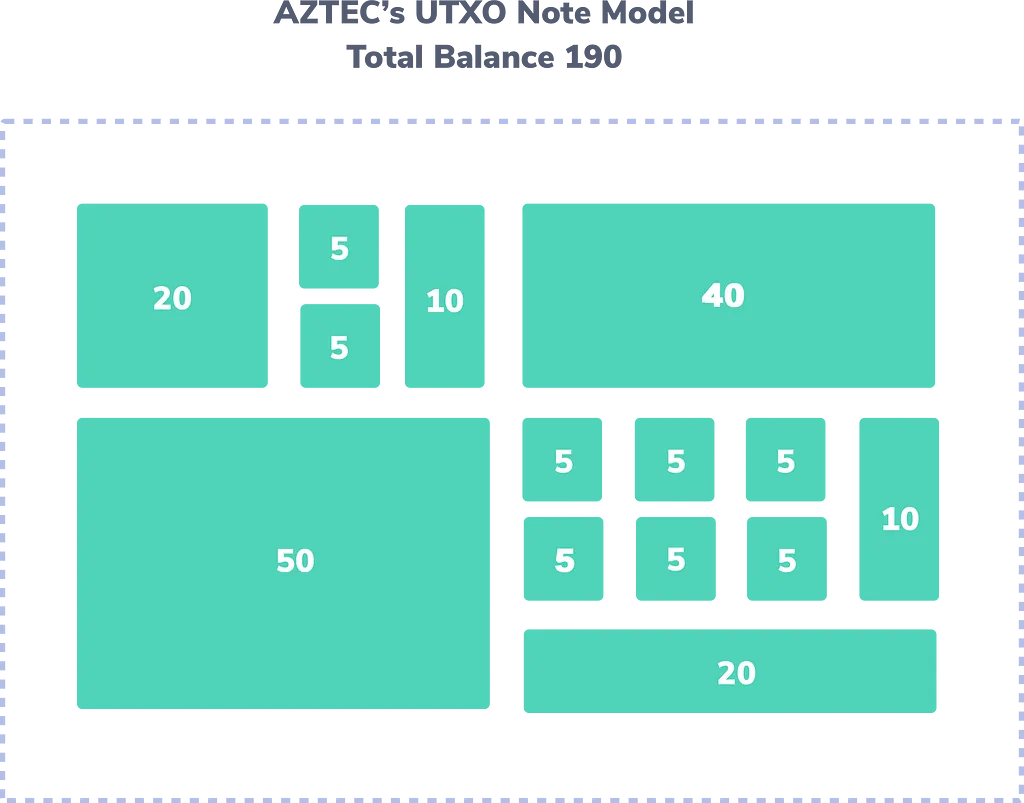
AZTEC's UTXO model

Public blockchains offer two main benefits, an independent economic guarantee around the correctness of state and interoperability of capital. (The capital received as an interest payment for a loan can also be used to settle a trade for a different asset). Most Zero Knowledge systems lack this interoperability. They create siloed pools of private capital. AZTEC is designed to solve this. It allows interoperability between dApps interacting in zero knowledge.

To achieve this interoperability, all AZTEC assets share a common trusted setup and their state is managed by a single smart contract, the AZTEC Cryptography Engine or ACE. ACE has two primary functions; first to delegate the validation of proofs to specific validation contracts and secondly to process state update instructions inside note registries that result from the successful validated proofs.
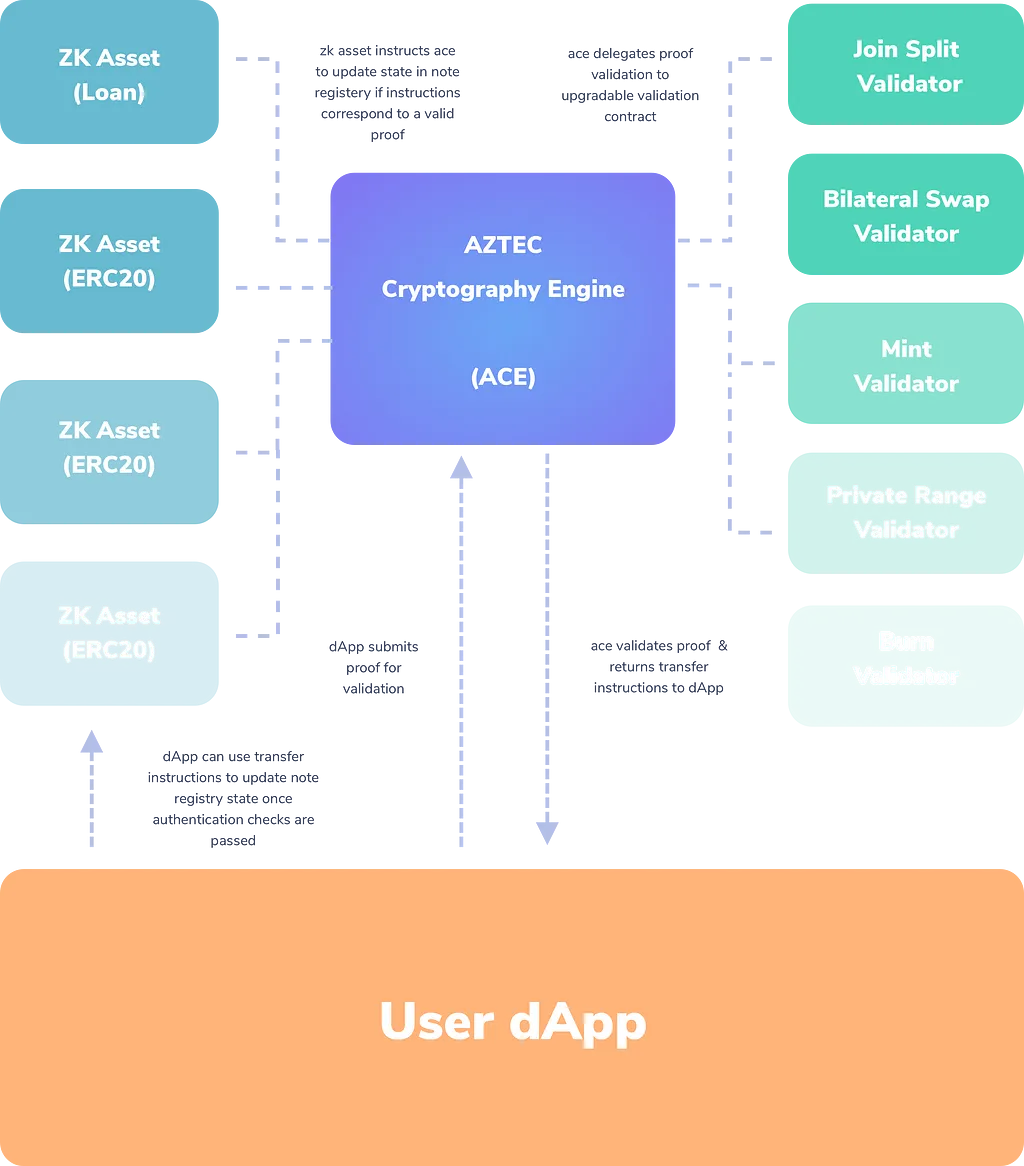
AZTEC architecture

{{blog_divider}}

A set of building blocks to enable privacy

The AZTEC protocol is designed to offer dApp builders a set of modular building blocks, each enabling a specific piece of functionality. A developer can compose together these building blocks to build a private dApp, without the need for a cryptographer. Under the hood these toolkits are Sigma protocols that prove a relationship between the supplied input and output notes. Currently AZTEC supports 7 of these toolkits:

Join Split (Transfer)
The Join Split proof allows a set of input notes to be joined or split into a set of output notes. Usually this is used to combine note values into a larger note, or split a note into multiple notes with different owners. This proof ensures that the sum of the input notes is equal to the sum of the output notes.

There are also two variants of the Join Split transactions that are used to deal with public ERC20 values. One in which a public ERC20 value is converted into an AZTEC note and it’s reciprocal, where an AZTEC note is converted into a public ERC20 value.

Bilateral Swap (Trade)
The bilateral swap proof allows an atomic swap of two notes to take place. This is useful for trading two assets e.g fiat and a loan/bond/security. A validated proof, proves that the makers bid note is equal to the takers ask note and the makers ask note is equal to the takers bid note.

Dividend Proof
This proof allows the prover to prove that the input note is equal to an output note multiplied by a ratio. This is useful for paying interest from an asset.

Mint
The mint proof allows the supply of AZTEC notes to be increased by a trusted party. e.g a stable coin mints an AZTEC note equal to the value of a bank transfer it receives.

Burn
The burn proof allows the supply of AZTEC notes to be decrease by a trusted party. e.g a stable coin burns an AZTEC note of equal value of the bank transfer it sends to the note owner.

Private Range
This is used to prove that an AZTEC note is greater than another AZTEC note or vice versa. This is useful for proving that ownership of an asset post trade is below a regulatory maximum. It can also be used to build identity and group membership schemes.

Public Range
Similar to the private range proof. This is used to prove that an AZTEC note is greater than a public integer or vice versa. This is useful for proving that ownership of an asset post trade is below a regulatory maximum.

Privacy, Anonymity and Confidentiality
These terms are often used when discussing zero-knowledge systems. It is important to define the meaning of each and address how AZTEC handles them.

Privacy: all aspects of a transaction remain hidden from the public or third parties.

Confidentiality: the inputs and outputs of a transaction are hidden from the public but the transaction parties remain public.

Anonymity: the inputs and outputs of a transaction are public but the transaction graph is obscured from one transaction to the next, preventing the identification of the transaction parties.

AZTEC enables confidential transactions out of the box. The inputs and outputs of any transactions are represented as encrypted numbers and the value hidden from public view.

Using normal Ethereum addresses the transaction graph of AZTEC is not anonymous. However anonymous transactions are possible. The protocol is forward compatible stealth addresses and as AZTEC does not mandate the transaction sender to be a party in the transaction, the transaction graph can be hidden. Combining stealth addresses and a trusted party to relay transactions achieves full anonymity. Using a trusted third party hides the payment of gas and provides full anonymity. Future updates to the protocol will allow the relay of transactions whilst obscuring the payment of gas in a decentralised manor. At that point fully private transactions will be possible.

{{blog_divider}}

Creating Confidential Assets

EIP1724 aims to standardise the interface for interacting with confidential assets that conform to a UTXO based models. AZTEC has reference implementations of EIP1724 for the supported asset types in the @aztec/protocol NPM package.

The EIP 1724 ZkAsset Standard

Let’s look at an example:

Imagine the dApp in question needs to perform a logical check to ensure that a traders post trade asset balance is less than a regulatory maximum.

In a normal dApp, this check is simple to perform. The transaction inputs would contain the public variables tradeNotional. The contract could then perform a simple check ensuring the new assetBalance[buyer] is below the regulatoryMax .

if(regulatoryMax > tradeNotional + assetBalance[buyer]) {
// the trade can proceed
}

In a private AZTEC dApp, the same logical check can be performed using one of the AZTEC proofs. The mental model is slightly different as all of the variables are stored as encrypted AZTEC notes, then a proof is constructed, which if validated by ACE, ensures the desired logical statement is correct.

In this example the Private Range Proof is used.

const {
  proofData,
} = await aztec.proof.privateRange.encodePrivateRangeTransaction({
   originalNote: regulatoryMax,
   comparisonNote: postTradeUserBalance,
   senderAddress: accounts[0],
 });

This proof proves that the comparisonNote is less than the originalNote . If the values are swapped it would prove the opposite. Once the proof is constructed it can be relayed to ACE for validation.

(bytes memory _proofOutputs) = ACE.validateProof(
                          PRIVATE_RANGE_PROOF,
                          address(this),
                          _proofData
                        );
// if the above statement succeeds we know that the users post trade balance is below the regulatory minimum.

AZTEC is designed to allow the combination of these logical checks to build the complex flows required by financial dApps. The later parts of this series will cover detailed examples of these complex flows.

That’s it for Part 1, you can read Part 2 — Deploying AZTEC to Ganache here.

Thanks for reading!
Read more
Aztec Network
Aztec Network
19 May
xx min read

10 Privacy Features Ethereum Devs Want. All of them live on Aztec.

Last week, PSE published an insightful and comprehensive user-research piece on private transfers on Ethereum. They interviewed 38 teams in the space and asked what's broken, what's missing, what builders wish they had. The list reads like a wishlist of features every privacy app on L1 is currently trying to engineer towards. It's the kind of rigorous, builder-grounded research the privacy ecosystem has needed.

We read the list. It's the list we've been building against for years.

Aztec solves all of these problems. Every requested feature already lives on Aztec. The proving system, the private contract language, the decentralized network, the privacy wallet architecture, the key model, the snark-friendliness: all of Aztec was built against this list before it was a list.

What follows is a walkthrough. For each of PSE's top technical findings, here's the feature builders are asking for, and how it works on Aztec today.

TL;DR

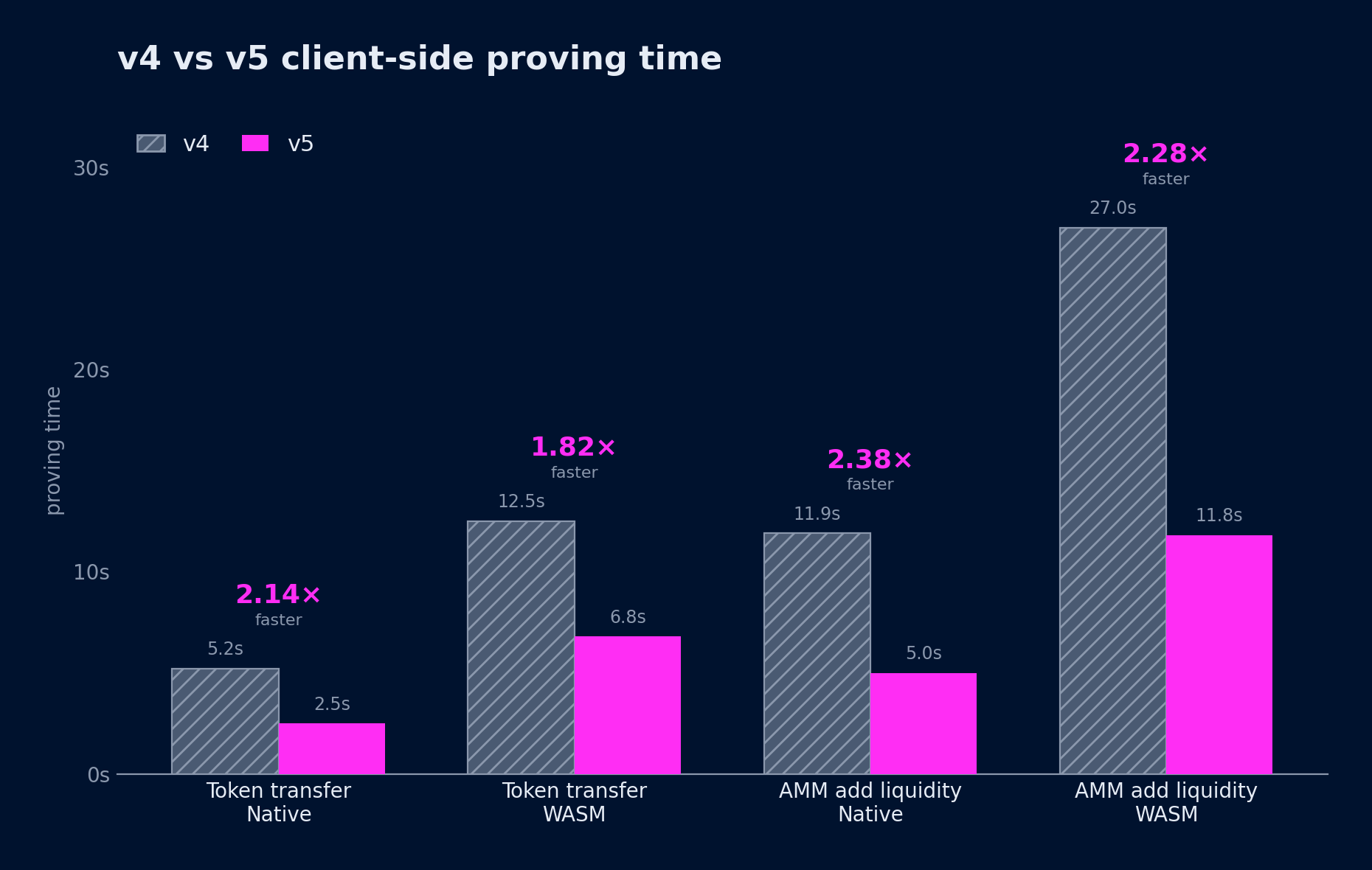
  1. Slow client-side ZK proving: Aztec's client-side proving system (Chonk) is optimized specifically for fast recursive proving on resource-constrained devices such as phones (and even in the browser).
  2. Expensive L1 proof verification: Aztec amortises the gas costs of L1 verification across thousands of users per rollup. Instead of “millions of gas per user” it costs hundreds of gas; that’s pennies per user transaction.
  3. DeFi composability with private state: Private token contracts on Aztec can be unshielded to easily interact with Ethereum DeFi contracts, and the resulting state can be shielded, without leaking who did the interaction. Or you can just design composable private DeFi contracts within Aztec.  
  4. Deposit/withdrawal leakage: Aztec isn’t a basic shielded pool, so users don’t need to keep withdrawing to do useful things. Users can use their funds within private smart contracts. Privacy leakage doesn’t happen if all transaction activity stays in private-land.
  5. No native wallet support: Of course Ethereum wallets don’t natively support privacy; Ethereum doesn’t have native privacy. There are a huge number of new concepts that are needed to design a private smart contract wallet. Aztec wallets are built from the ground up to enable a rich private onchain experience. 
  6. Reliance on external networks, TEEs, FHE, and relayers: The private and public execution environments of Aztec aren't reliant on external networks. Aztec is a fully decentralised L2, without these centralisation concerns. 
  7. Keccak is inefficient inside ZK circuits: The entire Aztec protocol uses Poseidon2, so complex private txs are rapid to prove on a phone. 
  8. Slow private state sync: Brute-force scanning of the entire chain’s history is not necessary. Aztec's tagging scheme lets recipients pinpoint their notes in seconds from a shared secret.
  9. Fragmented privacy sets: All private smart contracts on Aztec share one global note tree and one global nullifier tree. All network activity contributes to and draws from a single privacy set.
  10. No tooling or standards for private contracts: Aztec has a huge suite of tools to ship private contracts. Noir, a smart contract framework, a private state manager, a keystore, the PXE for executing contracts locally, a JS SDK, testing frameworks, local test networks, a CLI, and a slew of advanced private contract standards.

1. ZK proof generation time on user devices

Ethereum Problem: Proof generation is too slow on user devices, especially mobile. Elliptic-curve pairing operations are a specific bottleneck. Server-side proving is a censorship and privacy leak vector. Sub-second proving was the stated threshold.

Aztec solution: Proving on Aztec runs locally in the PXE (Private eXecution Environment, pronounced "pixie"), so no data ever leaves the user's device. Chonk, our client-side zk proving system, is ruthlessly optimised for fast recursive proving on low-memory devices like phones, native and in-browser. Years of optimization have already gone in, and we're still finding more. It’s best in class and we haven’t even merged-in GPU acceleration yet!

The slow pairing checks that PSE's interviewees called out as a bottleneck aren’t a problem with Aztec; pairings are simply batched together and deferred away from the user's device, handled by the more powerful network instead, without leaking any information. With such a powerful local prover, there’s little need to outsource proving to an untrusted party.

2. ZK proof verification gas on L1

Ethereum Problem: Verifying a ZK proof on Ethereum is prohibitively expensive. A Groth16 proof for a private transfer costs several hundred thousand L1 gas. A Halo2 (KZG Plonk) proof can cost approximately one million gas

Aztec solution: Aztec amortises L1 verification gas across all transactions in the rollup. At current network throughput, that cost is split across roughly 2,000 users per proof. Later this year, it’s slated to be split across ~20,000. Rollup costs are also partially subsidised by Aztec block rewards.

Net result: hundreds of L1 gas per user instead of millions. Plus cheap L2 gas. The user pays pennies for an Aztec transaction.

3. DeFi composability with private state

Ethereum Problem: Wrapping and unwrapping tokens leaks privacy and breaks composability. Smart contracts can't easily interact with encrypted balances. Private state is isolated; contract state is normally shared.

Aztec solution: Private state is not isolated on Aztec. The private state of one contract can be composed with that of another. This can unlock new privacy-preserving DeFi patterns directly on Aztec.

A single private transaction can call a stack of private functions across multiple contracts, with private inputs, private state transitions, and privacy over which functions were even executed and how many. Observers see that a transaction landed. They do not see what happened inside it. Stew on that for a second: a call stack of nested private functions across contracts written by different developers, each causing state transitions, all completely private.

Aztec also runs public functions, similar to Ethereum, inside the same smart contract, so you can build existing DeFi primitives on Aztec

For Ethereum DeFi specifically, Aztec has a tidy L1-to-L2 messaging layer. Private balances can be unshielded to interact with L1 protocols and shielded back, without leaking who did the interaction and without leaky public gas payments. And for private DeFi primitives that need genuinely shared private state (state nobody knows the value of, but which anyone can mutate), people have built Aztec contracts that compose conventional Aztec private state with co-snark or FHE sidecars.

Private and public state are peers inside a single Aztec smart contract. Builders mix and match.

4. Deposit/withdrawal privacy leakage

Ethereum Problem: Entry and exit points are the dominant privacy leak, not the protocol itself. Depositing and quickly withdrawing makes identity analysis trivial.

Aztec solution: The main fix is to stop crossing the boundary so often. (Or even if you do cross the boundary, Aztec has leakage protections).

Imagine if thousands of private smart contracts lived on the same network and could call each other without leaking which contracts were called, which arguments were passed, or what was returned. Imagine they all shared one global note tree and one global nullifier tree. That's Aztec. Once funds are inside, users don't need to keep crossing the private/public boundary to do useful things: Aztec is its own rich environment for composable, private execution of smart contracts.

Even when a private function does need to call a public function – be it an L1 DeFi contract, or a native public function within Aztec – the developer controls the information they reveal; not the protocol. The call can even be "incognito" to hide msg_sender. A single environment for many private apps to thrive also means re-usable tooling for builders.

5. Lack of native wallet support

Ethereum Problem: Privacy features (per-dapp addresses, private transfers) aren't natively integrated into major wallets. Reliance on dapp-specific UIs damages UX.

Aztec solution: Ethereum wallets weren't built for any of this, and they don't need to be: the chain underneath them has no private state to protect. Aztec wallets are an entirely new category of software.

Aztec wallets are able to manage all these new privacy-centric concepts:

  • Authorize your transactions however you want, without revealing your identity to the world. Native account abstraction lets you choose any auth scheme you like, and that choice doesn't expose who you are.
  • Hold multiple specialized privacy keys. Distinct nullifier, viewing, and efficient message-signing keys.
  • Keep your full private state on your own device. An encrypted local database holds your notes and nullifiers (siloed by private contract address), along with private data, private messages, shared secrets, and private contract bytecode.
  • Fine-grained contract access control for your private data.. Access permissions for contracts to read your private data are granular and revocable, rather than all-or-nothing.
  • Run private contracts without cross-contract interference. Built-in protections can stop malicious private contracts from reading or manipulating the private state of other contracts.
  • Establish shared secrets with your counterparties. Wallets can support both on-chain and off-chain methods for setting these up.
  • Catch privacy leaks before you sign. Pre-flight transaction privacy analysis warns when your data might be leaked via public args, msg_sender, fee payment, or even through the shape of the tx.
  • Make your tx look like every other tx on the network. Random padding is added to notes, nullifiers, and logs, and gas settings, anchor blocks, and inclusion deadlines are randomized so every tx blends in with the crowd.
  • Submit transactions privately to the network. Txns can be submitted to the network through a private submission path.
  • Pay fees through generic private fee paymasters. This gives users convenience and enables experimentation over the best private token contract designs for different use cases.
  • Use your wallet to gatekeep which frontends can access which private data . Apps shouldn’t have unfettered access to everything; a wallet needs to protect users’ private data..
  • Get post-quantum hygiene warnings. Wallets are able to flag risky patterns around address reuse and ephemeral-key broadcasts.

Aztec wallets are in active development, and this is an area where we expect many teams to build different wallets that are customized to various user needs. An early wallet is already baked into the protocol for developers to start using today. 

6. Reliance on relayers, FHE coprocessors, and TEEs

Ethereum Problem: Encrypted tokens and many privacy protocols depend on external networks for encryption, decryption, or relaying. Threshold-decryption committees and TEE hardware vendors are added trust assumptions on top of the chain itself.

Aztec solution: Aztec's private and public execution environments are not reliant on external networks. Aztec is its own decentralised network: ~4,000 validators stake on it, block proposers are randomly selected, a random committee attests, and a decentralised set of provers proves the rollup's execution. Validity is ultimately backed by cryptographic proofs settled on Ethereum.

External networks (co-snark networks, TEEs, MPC or FHE sidecars) become an opt-in choice for the specific case of private shared state. The trust tradeoffs there are something the contract developer signs up for explicitly, not a tax every user pays on every transaction by default.

7. Hash function inefficiency inside ZK circuits

Ethereum Problem: Keccak is inefficient to prove inside ZK circuits. There is no native support for a ZK-friendly hash like Poseidon.

Aztec solution: Poseidon2 is enshrined across the entire Aztec protocol, for rapid proving of every tx. Every Aztec state tree, the proving system, the innards of the protocol; everywhere. Reading and writing state inside a circuit is as cheap as it gets.

Keccak, SHA, and Blake hashes are still available through optimised Noir libraries when contracts need them for L1 interoperability. The default is ZK-friendly; the L1-friendly hashes are there when you reach for them.

8. Private state synchronisation

Ethereum Problem: Syncing private state (scanning for incoming notes and events) is a client-side bottleneck. Users wait for scans to complete before seeing their balance. Tachyon-style oblivious sync was cited as a path forward.

Aztec solution: Brute-force syncing of private state is rarely needed. Most real-world use cases involve a sender and recipient who can establish a shared secret offchain first.

From that shared secret, both parties can derive a sequence of random-looking “tags”. Each encrypted note log is prepended with the next tag in the sequence. The recipient already knows the next tag, so they know exactly what to query. Note discovery happens in seconds, not minutes. The scheme slots cleanly into PIR or mixnet approaches for extra privacy on the query itself, and smart contracts that don't trust senders to use the correct tag can just constrain it inside the circuit.

That’s not to say that Aztec requires interactivity between all senders and recipients. For genuinely non-interactive use cases (recipient can't talk to the sender before the transfer), Aztec enables devs to customize both their log emission and their note-discovery logic however they like. (Aztec also has ways to speed up the brute-force scanning approach from "scan the whole chain" to "scan a tiny subset of non-interactive handshake txs"

9. Fragmented privacy sets

Ethereum Problem: Shielded pools are fragmented across dapps and chains, reducing the effective privacy set for all users. Each new privacy protocol must bootstrap its own.

Aztec solution: There is one global note tree and one global nullifier tree on Aztec, shared by every smart contract on the network. Every private app contributes to and draws from the same privacy set. No per-app bootstrap. No walled gardens.

Private payments, private swaps, lending, payroll, treasury, identity attestations: all of them land in the same global commitment set, by construction.

10. Tooling and standards for private contracts

Ethereum Problem: Ethereum developer tooling lacks support for private transfers and private state. Standards for private tokens, compliance, and wallet interactions are missing. Many privacy teams are small, with short runway and expensive audits.

Aztec solution: Aztec ships the full toolchain for private contracts: Noir for writing private logic, the Aztec smart contract framework with macros that hide the protocol mess so devs can focus on app logic, the PXE for keys / state / syncing / proof generation, a JS SDK, a local node for testing, a CLI, and a real, live, decentralised L2.

The mental overhead of building a privacy protocol on Aztec collapses to "just write the app logic." Here is an example of a complete private transfer function on Aztec:

#[authorize_once("from", "authwit_nonce")]
#[external("private")]

fn transfer_in_private(from: AztecAddress, to: AztecAddress, amount: u128, authwit_nonce: Field) {
    self.storage.balances.at(from).sub(amount).deliver(MessageDelivery.ONCHAIN_CONSTRAINED);
    self.storage.balances.at(to).add(amount).deliver(MessageDelivery.ONCHAIN_CONSTRAINED);
}

Look at how simple that is.

A two-line function body.

Two lines.

Aztec takes care of the rest.

Behind those #[...] macros, the framework handles: caller authorisation, note syncing, fetching notes from the user's private db, Merkle membership proofs against the global note tree, safe nullifier creation (without leaking master secrets to the circuit), randomness for new notes, encrypted ciphertext generation, log tagging for fast recipient discovery, and public-input population. The PXE handles key management, private state, and proof generation. The smart contract itself contains its own message-processing logic for log discovery, decryption, and storage on the recipient side.

If you want whitelists, blacklists, association sets, custom tx authorisation, viewing-key hierarchies, temporary view access, selective disclosure to specific counterparties, just import a Noir library. Want something more adventurous than private payments? Same toolchain. 

What this adds up to

PSE's findings are not ten unrelated bugs. They're the same problem refracted ten ways: privacy retrofitted onto a chain that was not designed for it yields bad tradeoffs. 

Aztec was designed against this list before it was a list. One global note tree and one global nullifier tree. Private and public state inside the same contract. Compose calls between private contracts without leaking anything. Fast client-side proving on phones via Chonk. Snark-friendliness everywhere. Rollup-amortised L1 gas costs, fractions of a cent per user. Native account abstraction with private fee paymasters. No painfully slow private state syncing: a tagging-based note discovery scheme that runs in seconds. An entirely new category of wallet that treats privacy as a first-class concern. Simple, high-level smart contract syntax that collapses a basic private token transfer function into two lines.

There were 10 privacy features Ethereum devs wanted, all of them live on Aztec. The infrastructure is in place. Build the thing.

Go to our docs to start building

Aztec is the blockchain that solved the privacy problem. Start at docs.aztec.network or read the architecture deep-dive on The Best of Both Worlds: How Aztec Blends Private and Public State.

Aztec Network
Aztec Network
31 Mar
xx min read

Announcing the Alpha Network

Alpha is live: a fully feature-complete, privacy-first network. The infrastructure is in place, privacy is native to the protocol, and developers can now build truly private applications. 

Nine years ago, we set out to redesign blockchain for privacy. The goal: create a system institutions can adopt while giving users true control of their digital lives. Privacy band-aids are coming to Ethereum (someday), but it’s clear we need privacy now, and there’s an arms race underway to build it. Privacy is complex, it’s not a feature you can bolt-on as an afterthought. It demands a ground-up approach, deep tech stack integration, and complete decentralization.

In November 2025, the Aztec Ignition Chain went live as the first decentralized L2 on Ethereum, it’s the coordination layer that the execution layer sits on top of. The network is not operated by the Aztec Labs or the Aztec Foundation, it’s run by the community, making it the true backbone of Aztec. 

With the infrastructure in place and a unanimous community vote, the network enters Alpha. 

What is the Alpha Network?

Alpha is the first Layer 2 with a full execution environment for private smart contracts. All accounts, transactions, and the execution itself can be completely private. Developers can now choose what they want public and what they want to keep private while building with the three privacy pillars we have in place across data, identity, and compute.

These privacy pillars, which can be used individually or combined, break down into three core layers: 

  1. Data: The data you hold or send remains private, enabling use cases such as private transactions, RWAs, payments and stablecoins.
  2. Identity: Your identity remains private, enabling accounts that privately connect real world identities onchain, institutional compliance, or financial reporting where users selectively disclose information.
  3. Compute: The actions you take remain private, enabling applications in private finance, gaming, and beyond.

The Key Components  

Alpha is feature complete–meaning this is the only full-stack solution for adding privacy to your business or application. You build, and Aztec handles the cryptography under the hood. 

It’s Composable. Private-preserving contracts are not isolated; they can talk to each other and seamlessly blend both private and public state across contracts. Privacy can be preserved across contract calls for full callstack privacy. 

No backdoor access. Aztec is the only decentralized L2, and is launching as a fully decentralized rollup with a Layer 1 escape hatch.

It’s Compliant. Companies are missing out on the benefits of blockchains because transparent chains expose user data, while private networks protect it, but still offer fully customizable controls. Now they can build compliant apps that move value around the world instantly.

How Apps Work on Alpha 

  1. Write in Noir, an open-source Rust-like programming language for writing smart contracts. Build contracts with Aztec.nr and mark functions private or public.
  1. Prove on a device. Users execute private logic locally and a ZK proof is generated.
  1. Submit to Aztec. The proof goes to sequencers who validate without seeing the data. Any public aspects are then executed.
  1. Settle on Ethereum. Proofs of transactions on Aztec are settled to Ethereum L1.

Developers can explore our privacy primitives across data, identity, and compute and start building with them using the documentation here. Note that this is an early version of the network with known vulnerabilities, see this post for details. While this is the first iteration of the network, there will be several upgrades that secure and harden the network on our path to Beta. If you’d like to learn more about how you can integrate privacy into your project, reach out here

To hear directly from our Cofounders, join our live from Cannes Q&A on Tuesday, March 31st at 9:30 am ET. Follow us on X to get the latest updates from the Aztec Network.

Aztec Network
Aztec Network
27 Mar
xx min read

Critical Vulnerability in Alpha v4

On Wednesday 17 March 2026 our team discovered a new vulnerability in the Aztec Network. Following the analysis, the vulnerability has been confirmed as a critical vulnerability in accordance with our vulnerability matrix.

The vulnerability affects the proving system as a whole, and is not mitigated via public re-execution by the committee of validators. Exploitation can lead to severe disruption of the protocol and theft of user funds.

In accordance with our policy, fixes for the network will be packaged and distributed with the “v5” release of the network, currently planned for July 2026.

The actual bug and corresponding patch will not be publicly disclosed until “v5.”

Aztec applications and portals bridging assets from Layer 1s should warn users about the security guarantees of Alpha, in particular, reminding users not to put in funds they are not willing to lose. Portals or applications may add additional security measures or training wheels specific to their application or use case.

State of Alpha security

We will shortly establish a bug tracker to show the number and severity of bugs known to us in v4. The tracker will be updated as audits and security researchers discover issues. Each new alpha release will get its own tracker. This will allow developers and users to judge for themselves how they are willing to use the network, and we will use the tracker as a primary determinant for whether the network is ready for a "Beta" label.

Additional bug disclosure

We have identified a vulnerability in barretenberg allowing inclusion of incorrect proofs in the Aztec Network mempool, and ask all nodes to upgrade to versions v.4.1.2 or later.

We’d like to thank Consensys Diligence & TU Vienna for a recent discovery of a separate vulnerability in barretenberg categorized as medium for the network and critical for Noir:

We have published a fixed version of barretenberg.

We’d also like to thank Plainshift AI for discovery, reproduction, and reporting of one more vulnerability in the Aztec Network and their ongoing work to help secure the network.

Aztec Network
Aztec Network
18 Mar
xx min read

How Aztec Governance Works

Decentralization is not just a technical property of the Aztec Network, it is the governing principle. 

No single team, company, or individual controls how the network evolves. Upgrades are proposed in public, debated in the open, and approved by the people running the network. Decentralized sequencing, proving, and governance are hard-coded into the base protocol so that no central actor can unilaterally change the rules, censor transactions, or appropriate user value.

The governance framework that makes this possible has three moving parts: Aztec Improvement Proposal (AZIP), Aztec Upgrade Proposal (AZUP), and the onchain vote. Together, they form a pipeline that takes an idea to a live protocol change, with multiple independent checkpoints along the way.

The Virtual Town Square

Every upgrade starts with an AZIP. AZIPs are version-controlled design documents, publicly maintained on GitHub, modeled on the same EIP process that has governed Ethereum since its earliest days. Anyone is encouraged to suggest improvements to the Aztec Network protocol spec.

Before a formal proposal is opened, ideas live in GitHub Discussions, an open forum where the community can weigh in, challenge assumptions, and shape the direction of a proposal before it hardens into a spec. This is the virtual town square: the place where the network's future gets debated in public, not decided behind closed doors.

The AZIP framework is what decentralization looks like in practice. Multiple ideas can surface simultaneously, get stress-tested by the community, and the strongest ones naturally rise. Good arguments win, not titles or seniority. The process selects for quality discussion precisely because anyone can participate and everything is visible.

Once an AZIP is formalized as a pull request, it enters a structured lifecycle: Draft, Ready for Discussion, then Accepted or Rejected. Rejected AZIPs are not deleted — they remain permanently in the repository as a record of what was tried and why it was rejected. Nothing gets quietly buried.

Security Considerations are mandatory for all Core, Standard, and Economics AZIPs. Proposals without them cannot pass the Draft stage. Security is structural, not an afterthought.

From Proposal to Upgrade

Once Core Contributors, a merit-based and informal group of active protocol contributors, have reviewed an AZIP and approved it for inclusion, it gets bundled into an AZUP.

An AZUP takes everything an AZIP described and deploys it — a real smart contract, real onchain actions. Each AZUP includes a payload that encodes the exact onchain changes that will occur if the upgrade is approved. Anyone can inspect the payload on a block explorer and see precisely what will change before voting begins.

The payload then goes to sequencers for signaling. Sequencers are the backbone of the network. They propose blocks, attest to state, and serve as the first governance gate for any upgrade. A payload must accumulate enough signals from sequencers within a fixed round to advance. The people actually running the network have to express coordinated support before any change reaches a broader vote.

Once sequencers signal quorum, the proposal moves to tokenholders. Sequencers' staked voting power defaults to "yea" on proposals that came through the signaling path, meaning opposition must be active, not passive. Any sequencer or tokenholder who wants to vote against a proposal must explicitly re-delegate their stake before the voting snapshot is taken. The system rewards genuine engagement from all sides.

For a proposal to pass, it must meet quorum, a supermajority margin, and a minimum participation threshold, all three. If any condition is unmet, the proposal fails.

Built-In Delays, Built-In Safety

Even after a proposal passes, it does not execute immediately. A mandatory delay gives node operators time to deploy updated software, allows the community to perform final checks, and reduces the risk of sudden uncoordinated changes hitting the network. If the proposal is not executed within its grace period, it expires.

Failed AZUPs cannot be resubmitted. A new proposal must be created that directly addresses the feedback received. There is no way to simply retry and hope for a different result.

No Single Point of Control

The teams building the network have no special governance power. Sequencers, tokenholders, and Core Contributors are the governing actors, each playing a distinct and non-redundant role.

No single party can force or block an upgrade. Sequencers can withhold signals. Tokenholders can vote nay. Proposals not executed within the grace period expire on their own.

This is decentralization working as intended. The network upgrades not because a team decides it should, but because the people running it agree that it should.

If you want to help shape what Aztec becomes, the forum is open. The proposals are public. The town square is yours. 

Follow Aztec on X to stay up to date on the latest developments.