Research
Aug 8th, 2024
## min read

Does zero-knowledge provide privacy?

In this blog post, we explore zero-knowledge (ZK) property, investigate if ZK-rollups have any ZK, and differentiate between ZK as a technology and as a marketing term.

Share
Written by
Edited by

Intro

In blockchain narrative, the term “zero knowledge” entered our vocabulary when rollups first emerged. In particular, we’ve heard it a lot in the context of zero knowledge rollups (ZK-rollups). But, zero knowledge technology has existed for years before. The first article on zero knowledge was published back in 1989.

In this blog, we’ll break it down to clarify what zero knowledge (ZK) is and what it ISN’T (the latter might actually be more interesting than the former). We’ll investigate if ZK-rollups have any ZK for real, and if not, why they get to use the term at all, and dive into the difference between ZK as a technology and ZK as a marketing term.
For those who need answers right away:

  • ZK-rollup provides a succinct verification mechanism
  • But ZK-rollup does NOT provide privacy

*by privacy we mean (i) user privacy (transaction sender and recipient), (ii) data privacy (payload of the transaction, e.g., the asset or value being transacted), and (iii) code privacy (the program logic).

Now let’s dive a bit deeper.

Zero Knowledge Property Outside of Rollups

If we want to discuss ZK in a rollup context, we first need to understand zero knowledge property on its own. As we mentioned above, the concept of ZK was introduced in 1989 (years before the first blockchain was baked) in a paper titled, “The knowledge complexity of interactive proof systems.” It wasn’t until around 2018 that the Ethereum community figured out ZK might be a good fit for a rollup universe.

We usually consider zero knowledge as a property of a proving system. In blockchain, we often say ZKP, meaning zero knowledge proof. But “proof” might mean proof of statement or proof of knowledge. So, in the next section of this article, we will differentiate between the two types of proofs.

Proof of Statement

Proof of statement proves that a statement is true without revealing anything about the statement itself.

Examples of statements:

  • z is a square modular n: z = x^2 mod n
  • The graphs G and H are non-isomorphic
  • The number 638634389........3427 has 3 prime factors

Proof of Knowledge

Proof of knowledge proves that the person making an assertion has some knowledge about the statement.

So, if we look at the examples from the previous paragraph side-by-side:

Proof of StatementProof of Knowledgez is a square modular n: z = x^2 mod n.I know a value x such that z = x^2 (mod n).The graphs G and H are non-isomorphic.I know the isomorphism between two graphs, G and H.The number 638634389........3427 has 3 prime factors.I know the factors of the number 638634389........3427.

One should note that every proof of knowledge is a proof of statement (but not the opposite). For instance, if one proves that they know a value x such that z = x^2 (mod n), this will be proof of knowledge, but it also automatically proves that z is a square modulo n (proof of statement).

Let’s explore one of these examples to see how proof of statement and proof of knowledge can be constructed!

Exploring Examples: the Graph-Isomorphism Problem

Let’s use the graph-isomorphism problem. To do this, we’ll say proof of graph non-isomorphism will be proof of statement, while a proof of graph isomorphism will be proof of knowledge.

What Is the Graph-Isomorphism Problem?

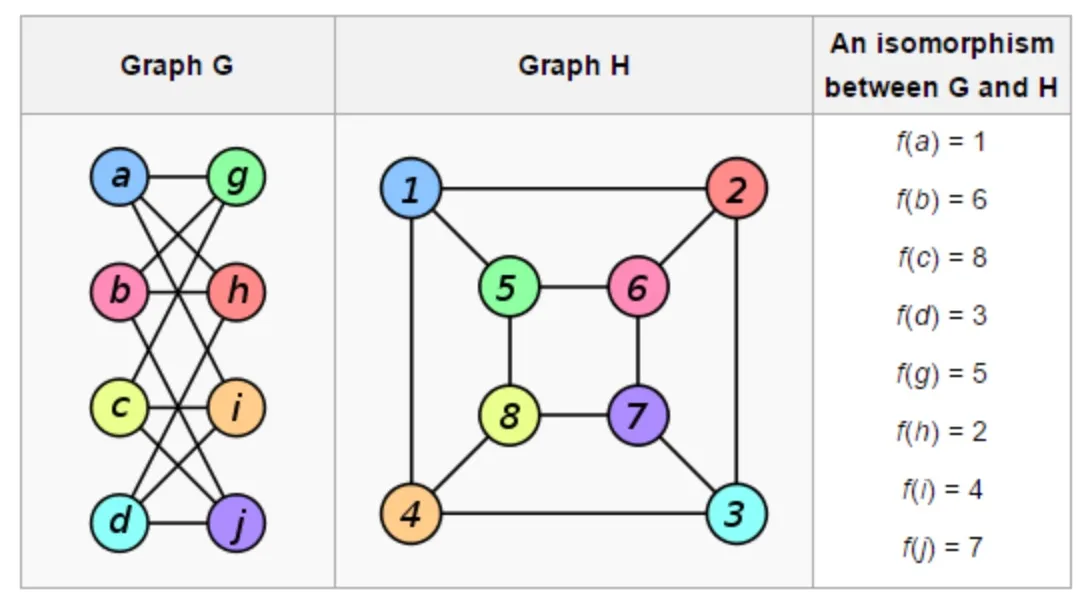
Basically graph isomorphism (denoted by ≅) is the following: two graphs with labeled nodes are isomorphic if they are "the same" up to a permutation of the labels. That is to say, there exists a permutation of the labels of one graph that results in the other graph.

More formally, we say that two graphs G and H are isomorphic if there is a bijective function f between the vertices’ labels of G and H such that there is an edge between the vertices u and v in G if and only if there is an edge between the vertices f(u) and f(v) in H.

An example of two isomorphic graphs:
Source

If there exists no such permutation, we say that the two graphs are non-isomorphic. Now, assume we want to prove that two graphs are non-isomorphic. We only want to prove this single fact; nothing about the graphs themselves, no other knowledge except for the statement that they are non-isomorphic.

Example of A Proof of statement: the Graph-Non-Isomorphism Problem

Proof intuition:

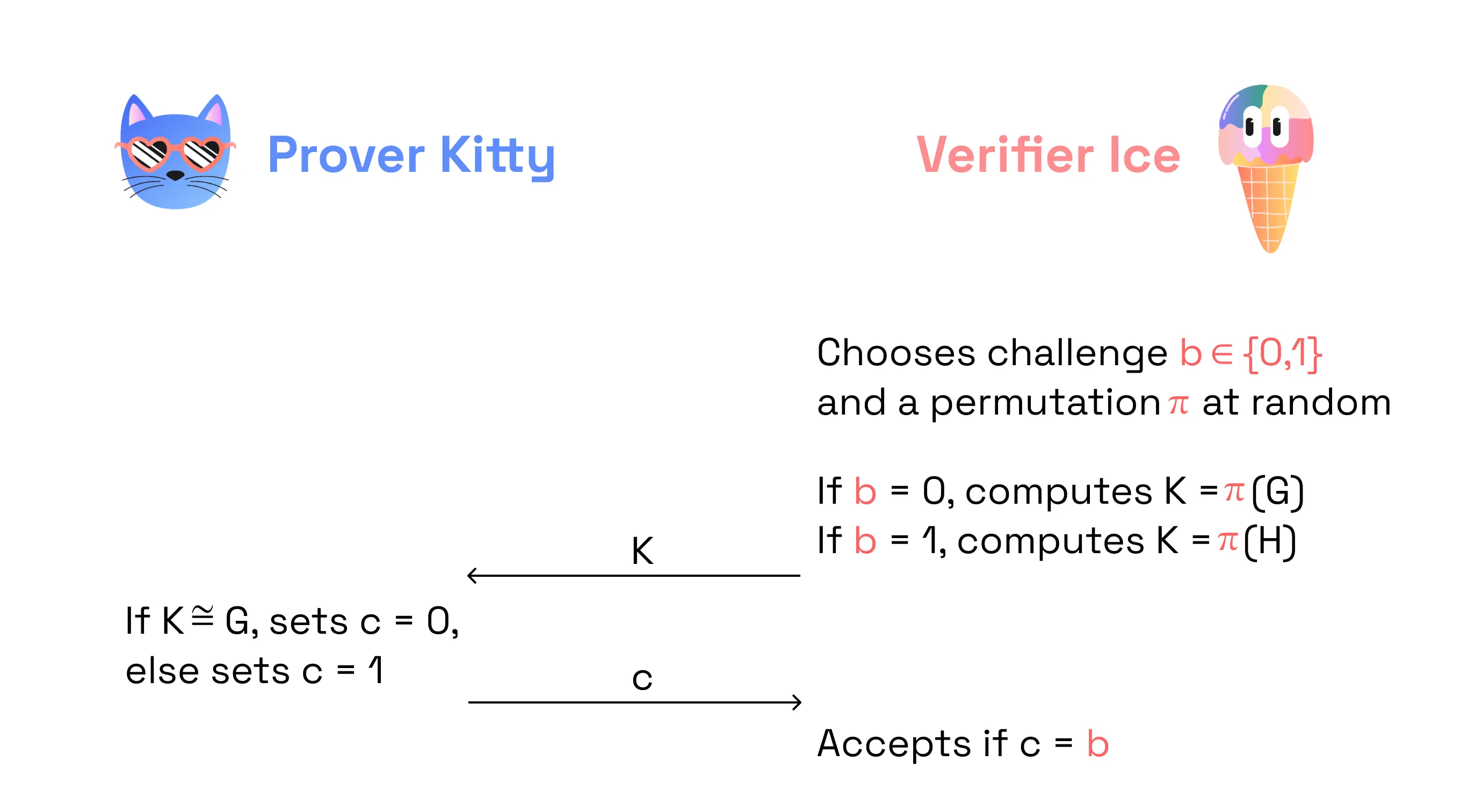
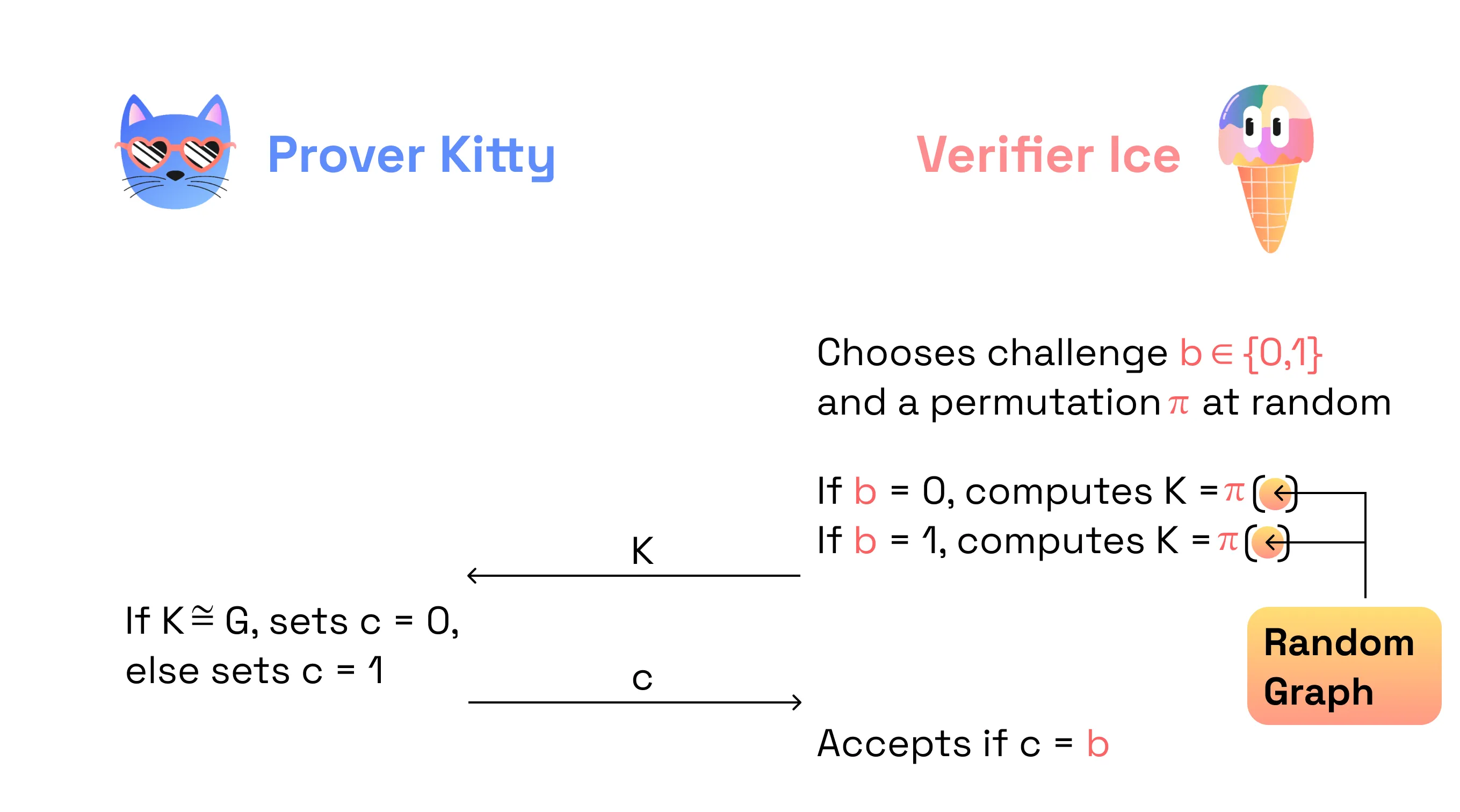
  • If there are two non-isomorphic graphs G and H, one randomly chooses a permutation π (re-orders elements in a deterministic way) as well as randomly chooses one of two graphs, and calculates K = π{G or H} that is K is a permutation of either G or H.
  • If G and H were isomorphic, anyone else should NOT be able to tell from which of the two graphs K was computed, and could only guess.
  • The probability of guessing would be ½. Repeating the protocol enough times makes the probability of guessing negligible.

One round of protocol:
Example of A Proof of Knowledge: Graph Isomorphism

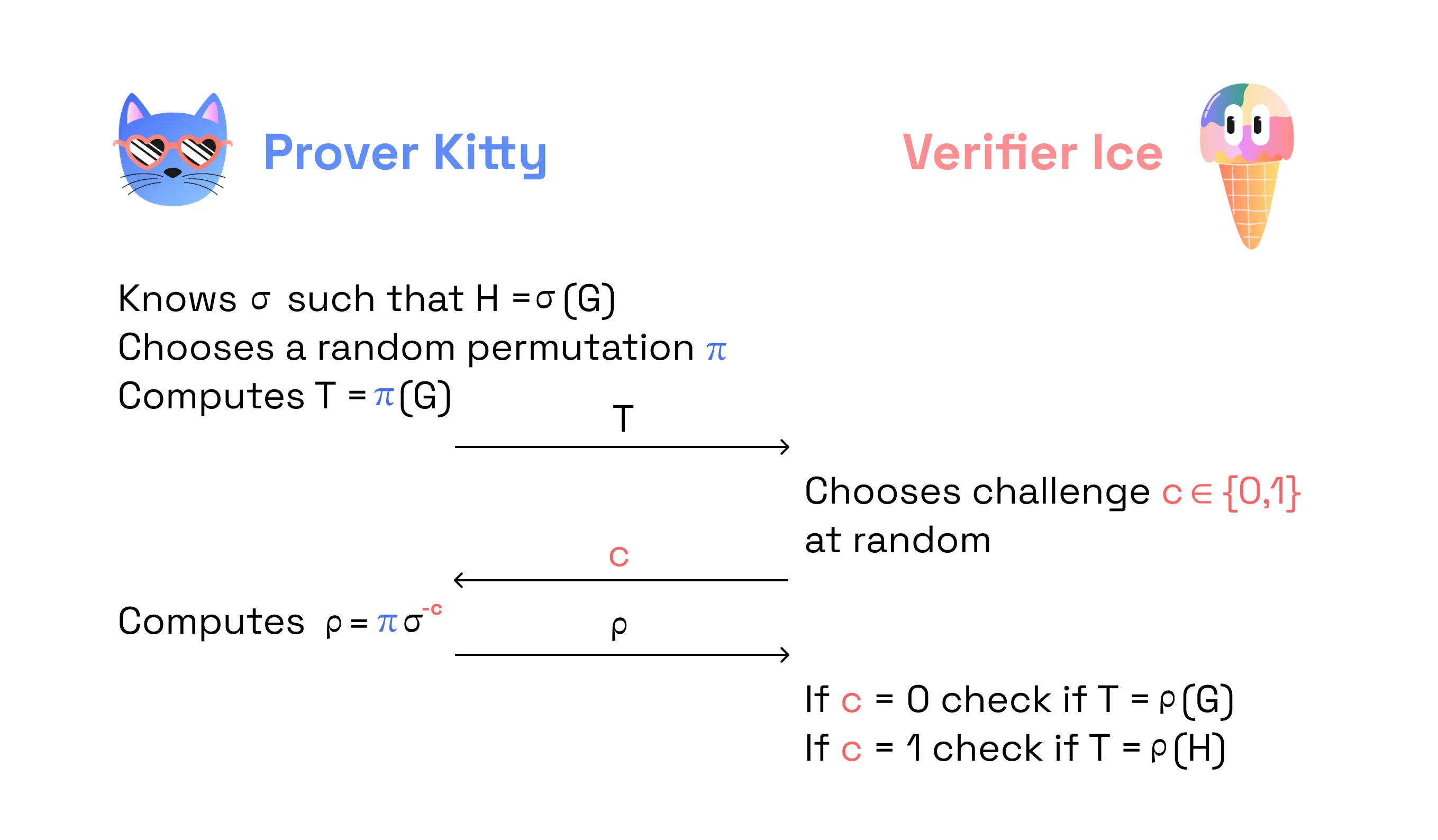
Now, let’s think… What if we want to prove two graphs are isomorphic? In other words, the Prover wants to prove that they know the isomorphism σ such that H = σ(G).

Proof intuition:

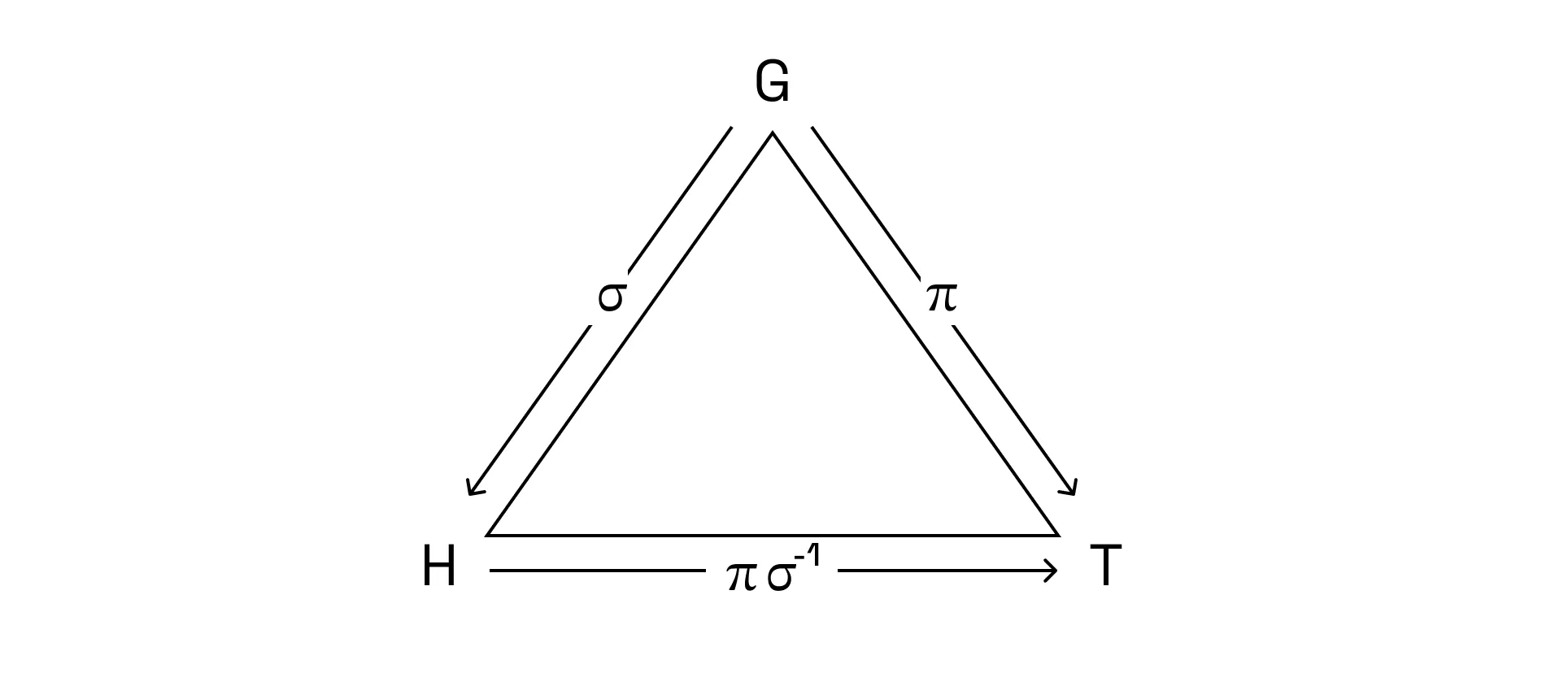
  • If σ is an isomorphism between two graphs, it means that H = σ(G) and G = σ^{-1}(H) where σ^{-1} is the reverse isomorphism.
  • Let π be a permutation randomly chosen by the Prover. Using ρ = πσ^{-c} (where the Verifier randomly assigns 0 or 1 to c), they get either  ρ = π or ρ = πσ^{-1}.
  • By applying ρ = π to a graph, one will get its permutation. By applying  ρ = πσ^{-1} to a graph, one will get its permuted reverse isomorphism:
One round of protocol:
Back to Zero Knowledge!

Now that we’ve explored examples of proof of statement and proof of knowledge, let’s discuss whether or not they have zero knowledge property.

Informally, zero knowledge means that a Verifier can’t retrieve any additional information from a Prover (except for the information clear from the proof itself).

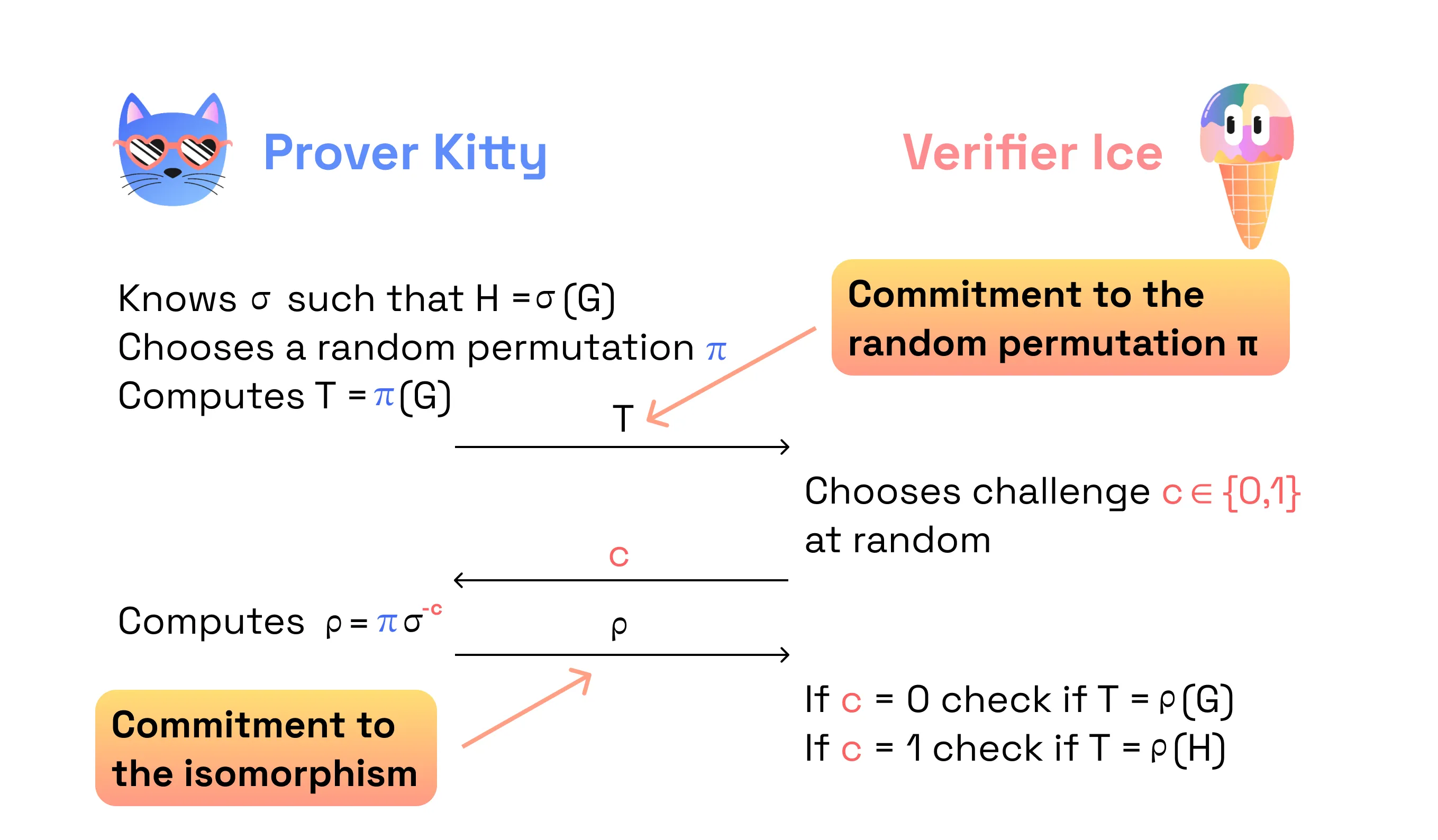
In the example of graph isomorphism, proof of knowledge is zero knowledge (with honest Verifier). According to the protocol, the Prover doesn’t reveal any information on the isomorphism or permutation to the Verifier. Instead, they send the Verifier commitments and that’s it.
However, in the example of the proof of graph non-isomorphism, it’s not zero knowledge. Because, instead of setting K = π(G) or K = π(H), a malicious Verifier (i.e. a Verifier which deviates from the protocol) can set K = π{RANDOM GRAPH} and as a result of the protocol execution by the Prover, the Verifier will know if RANDOM_GRAPH is isomorphic to either G or H. So the Verifier is definitely able to retrieve additional information.
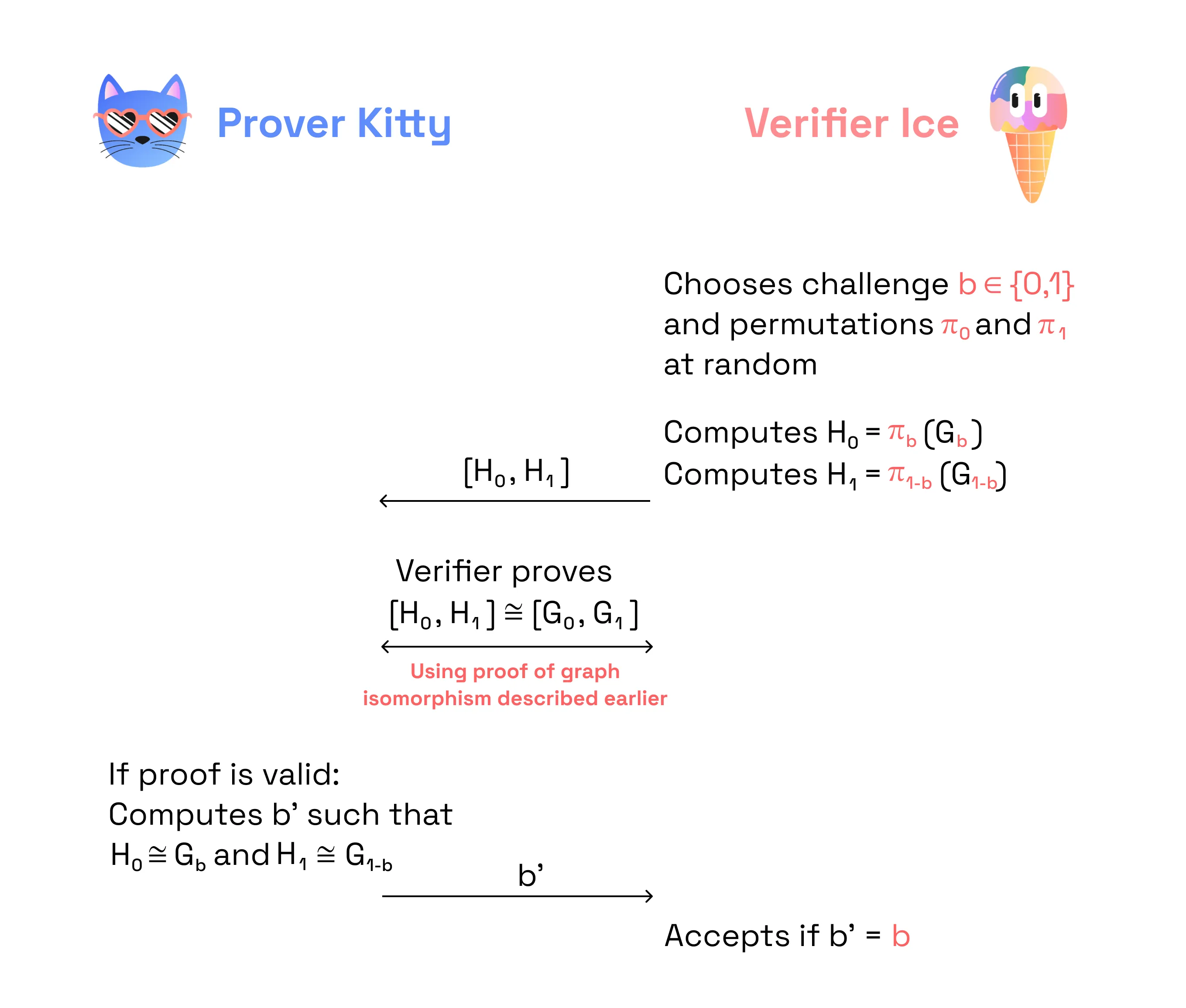
Can we convert our proof of graph non-isomorphism into zero knowledge? Yes, we can. The Verifier should also provide proof that (i) the graph it sends is isomorphic either to G or to H (meaning the graph they’re sending is not arbitrary), and (ii) they know the isomorphism.
One should note that most protocols in the space are only honest-verifier ZK (i.e. ZK property doesn’t hold with malicious verifier). However, this isn’t an issue because the protocols are made non-interactive with the Fiat-Shamir heuristic. Hence – there is no distinction for non-interactive protocols as the verifier cannot "misbehave.”

Now, when we differentiated between proof of statement and proof of knowledge and saw that both of them can have zero knowledge property or not have it, let’s take a look at ZK-rollup and figure out (i) does it use proof of statement or proof of knowledge, (ii) does it have zero knowledge property?

Finally, Back to ZK-Rollups!

In a ZK-rollups, the logic is pretty similar to the graph-non-isomorphism problem (where we prove the statement that two graphs are non-isomorphic). In ZK-rollup, we prove the statement that the state transition was done correctly.

A Glimpse into How ZK-Rollups Work

In this section, we’ll briefly cover how ZK-rollups work and how they utilize proofs. By “ZK-rollups,'' we mean regular (i.e. NON-privacy-preserving) ZK-rollups such as Scroll, Starknet, zksync, Taiko, and many more.

The main use of “vanilla” ZK-rollups is to enable scalability by posting a single proof of the validity of transactions.

ZK-rollups execute transactions off-chain and post proof on L1 (Ethereum) that whatever they did off-chain was done correctly. Their purpose is to prove that the new chain state is correct.

To generate a proof of correct state transition, one needs to prove that all transactions were executed correctly on given inputs.

For the sake of this, the Prover needs to know previous state and input values.

However, for the Verifier to verify the proof, they need to have the proof as well as to know new state, previous state, and input values:

Inputs

There are two types of inputs, public and private. In ZK-rollups, “private input” does NOT mean “secret” even though they are called “private.” Instead, it means that private inputs are consumed by Prover only while public inputs are consumed both by Prover and Verifier (sometimes private inputs are also called “witness” as a reference to the NP complexity class). Public inputs are expensive as they need to be submitted to L1 hence we want it to be as small (“succinct”) as possible. In terms of what these inputs consist of in the context of the proof:

Public inputs (consumed by Prover AND Verifier) – all data that needs to be submitted to L1 so that everyone can update their records of the current state. This will include new state root as well as might include signatures, sender, receiver, functions, contract addresses, function arguments, newly-deployed contract data, storage slots which have changed and their new values, events that were emitted. One should note that this reveals A LOT of information to a public observer. The specific list of public inputs will depend on the specific ZK-rollup design.

Private inputs (consumed by Prover ONLY) – all information that was needed by rollup circuits to prove correctness of the state transition. This will include Merkle membership proofs (hash paths) as well as the execution trace (might include transaction inputs such as newly-deployed contract data, storage slots which have changed and their new values, and events that were emitted).

As you can see from the logic above, private inputs have nothing to do with privacy. So if a ZK-rollup is generating a proof that Alice sent Bob 1ETH, both the Prover and the Verifier will be aware of this information (i.e. no privacy at all!).

To sum it up, in the case of a ZK-rollup, we want to prove the validity of transactions, it is a proof of statement and it does NOT have zero-knowledge property because all the information (i.e. state, functions, inputs) is public and everything that is not provided explicitly can be derived by a Verifier.
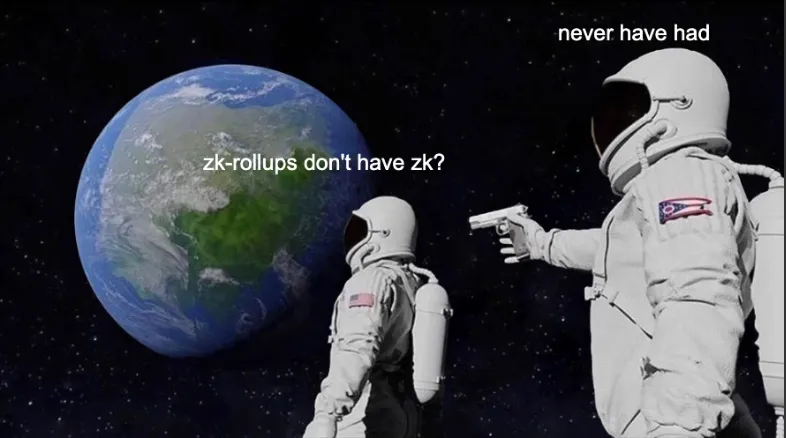
That is to say, there is no ZK in a vanilla ZK-rollup. Why is it called ZK-rollup then?

Maybe… For the sake of marketing =)

And Still, Can ZK Provide Privacy?

Short answer: yes, it can. While the main use of “vanilla” ZK-rollups is to enable scalability, the main use of Aztec is to enable scalability AND allow privacy. And, it utilizes ZK exactly for the privacy purpose.

Aztec provides privacy by means of client-side proof generation, i.e. whatever should be processed privately is processed on the user’s device and then a proof of its correct execution is supplied to the mempool.

Processed privately means that

  • Transactions are processed privately (on user’s device)
  • Their outputs shroud side effects (such as note hashes and nullifiers)
  • And those get added to the global state without revealing any information to anyone except for (i) the client who executed transactions and emitted side effects, and (ii) the receiver of side effects (for example, in case of a transfer from Alice to Bob, Alice executes transactions client-side and emits side effects and Bob receives side effects).

Client-side proofs are then verified by the sequencer (who manages the mempool).
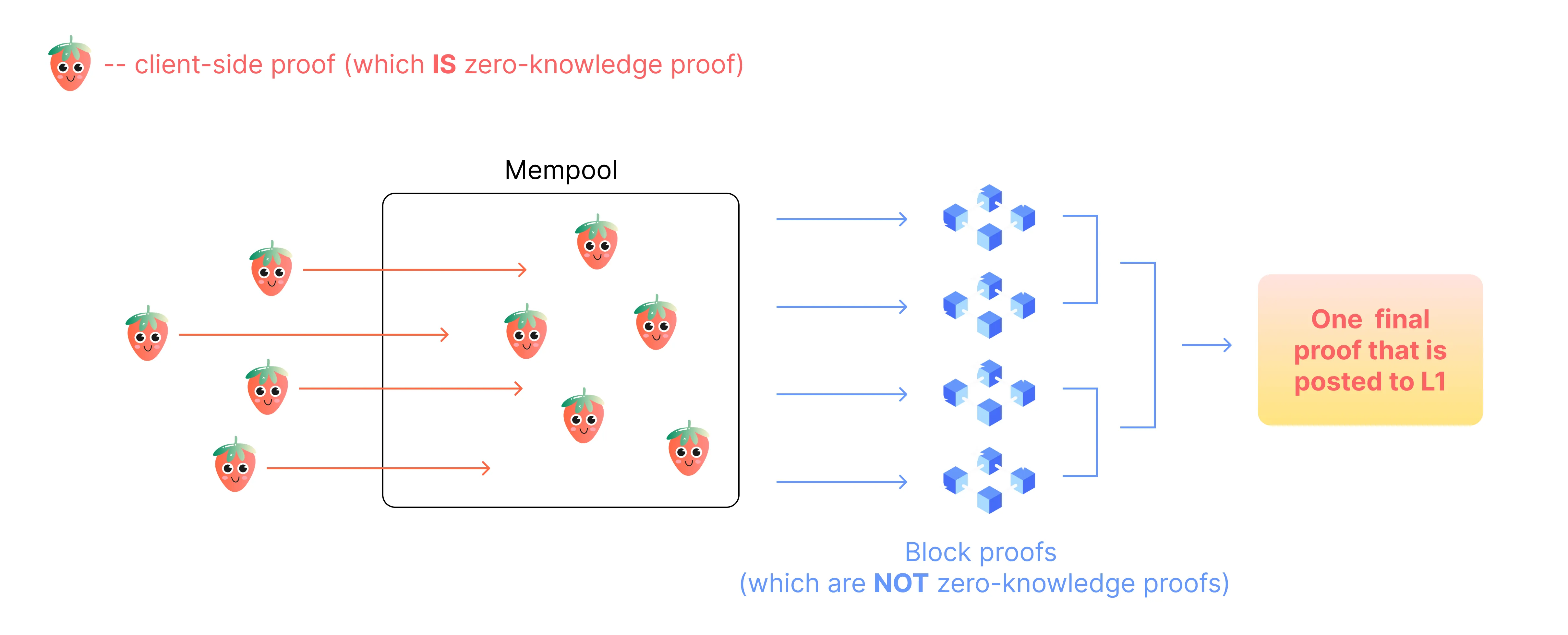
In this case, client-side proof is a zero knowledge proof of statement: the sequencer verifies the proof validity without any information about what was executed on the client-side, and is unable to retrieve any information about it.

After client-side proofs have been verified by the sequencer, everything is similar to a vanilla ZK-rollup mechanism as described in the previous section. That is to say, Aztec ZK-rollup first generates a number of client-side proofs (which are zero knowledge proofs) and then a block proof (which is not zero knowledge).

One Can’t Just Add ZK to Get Privacy
It’s not possible to add privacy ad-hoc to an already existing ZK-rollup. It should be designed to be private from the very beginning.

One first needs to give a precise definition of “privacy” as the statements proved, depending on the rollup design, may reveal unnecessary information and harm user privacy.

If builders want their dApps to interact with the external world; meaning that dApps aren’t monolithically private but instead allow some functions and variables to be private while some functions and variables stay public (e.g. necessary for AMMs, lending protocols, etc.), rollup state management becomes very non-trivial. Now it has to process public and private state updates separately. However, it’s exactly the latter approach that unlocks dozens of use cases we’ve been dreaming about for years! (Think programmable on-chain identity management and DeFi alternatives to conservative financial institutions).

As of today, Aztec is one of very few privacy-preserving L2s on Ethereum where privacy is provided by processing private information on the client-side. Check out this article to dive into client-side proof generation and this article to learn more about Aztec smart contracts anatomy allowing for hybrid private and public state management.

Ready to join Aztec’s building pioneers? Let us know by filling out this form.

Many thanks to Palla, Patrick, and Brecht for review.
Read more
Aztec Network
Aztec Network
7 Aug
xx min read

Alpha V5 Proving System Vulnerability

Status

Core contributors identified a critical vulnerability affecting the V5 Alpha proving system on 27 July 2026 through internal AI-assisted auditing.

V5 remains Alpha software. Critical findings can arise during this phase, and the audit process exists to identify them before broader deployment. This finding places V5 funds, applications, and contract state at risk.

Treat funds and applications on V5 as exposed to a protocol-level failure until contributors complete incident response work and operators carry out the required network actions.

What we are disclosing

An attacker may be able to exploit a flaw in the current V5 proving system by constructing a proof that passes verification for a transaction the network should reject. If accepted, that transaction could produce a state transition outside the rules V5 intends to enforce.

Contributors cannot determine whether anyone exploited the flaw before this finding. The affected system lacks the information needed to distinguish ordinary accepted transactions from transactions accepted through the flawed proving path. Historical chain activity cannot establish whether exploitation occurred or quantify its impact.

Application safeguards

We expect application teams to prepare safeguards in the coming weeks.

Those safeguards may include changes to application controls, deployment procedures, user flows, and migration plans. We expect each team to assess its contracts and determine which protections fit its architecture and users.

We expect teams planning a V5 deployment to pause that work until contributors publish further guidance. We expect teams with live contracts to review their ability to limit user exposure, isolate affected functionality, and move users to fresh deployments if needed.

We expect applications that maintain administrative or emergency controls to assess whether those controls can reduce user risk during the incident timeframe.

Next steps

Core contributors are working with operators, application teams, and bridge operators as applications add security guards around affected flows.

The findings from this incident will inform the V6 release, including circuit updates that prevent the network from accepting proofs tied to an affected proving system.

V5 launched as Alpha software, with V6 planned for later in 2026. Contributors will publish a security roadmap covering the remaining work and release path.

Known vulnerability status

Reviewers have not identified other high-severity or critical V5 Alpha vulnerabilities at this time.

Internal and external human audits have completed, and contributors continue AI-assisted auditing. Alpha is the period for identifying faults before production deployment.

Community
Community
4 Aug
xx min read

Dark Forest Aztec Game Goes Live

Dark Forest is a real-time strategy game played across a procedurally generated universe where most of the map is hidden. You cannot see rival players, their planets, or their fleets. You only know what you have explored. Everyone shares one universe, and nobody has the full picture.

In most onchain games, every position and every move is public, because the chain is public. Dark Forest used zero-knowledge proofs to break that assumption: players prove their moves are valid without revealing where those moves came from. The result is a game of hidden information running on a public network.

Dark Forest Aztec ports the original Dark Forest 0.6 to Aztec. It keeps the gameplay from the original and rebuilds the privacy layer on Aztec's programmable privacy.

A note before diving in: this is early, experimental software on Aztec Alpha V5. Treat it as an alpha and play accordingly.

The universe you cannot see

You start on a single home planet with almost the entire map dark. To find anything you mine the universe, running a client that explores coordinates and reveals what sits there: unclaimed planets, resources, and eventually the edges of other players' territory.

You are never handed a view of the board. You earn it one region at a time, and everyone else works under the same fog.

What is hidden on Aztec

Your home coordinates and your fleet movements are private state, expressed as first-class private notes on Aztec. Your location and where you send energy stay hidden, enforced in the contracts by zero-knowledge cryptography.

What sits onchain is a set of cryptographic commitments. Instead of storing every planet's full details in the open, the contracts store Poseidon2 hashes of entity state. When you make a move, your client supplies the full state, the contract checks it against the stored hash, applies the change under zero-knowledge constraints, and writes a new hash back. Full game state lives offchain and gets rebuilt from public logs by an indexer, which is what renders your map without exposing every player's position.

So you can prove you made a legal move from a planet you own without revealing where that planet is. Aztec applies the same principle to private payments and private contracts.

How you play

Four actions carry the game.

Explore. Your explorer sits in the bottom left. Set it running and it uncovers the map around you, surfacing planets, resources, and other players.

Send energy. Most planets produce energy. Click and drag from a planet you own toward a target to capture or weaken it.

Route silver. Asteroid fields produce silver. Move it to your planets and spend it on upgrades, or send it to a Spacetime Rip to convert it into score.

Hunt artifacts. Some planets hold artifacts. Your Gear ship discovers them. Once harvested, you deposit them on planets to boost stats.

Four stats drive most decisions.

Energy is the core resource. Planets generate it over time up to a capacity, and you spend it on everything: claiming planets, reinforcing your own, attacking rivals. Two details matter. Moves are taxed, so a flat percentage of a planet's total capacity burns every time you send energy, which discourages small frequent moves. And energy decays over distance, so send it too far and almost nothing arrives. A common rule of thumb is to let a planet fill to about 75%, then send it down to about 25%.

Defense reduces the damage incoming energy does when it lands. Higher-level planets often have lower defense, but they hold much more energy, so they still take more to capture. Defense matters most on front lines.

Range sets how far a planet can send energy. It governs how fast you expand and how efficiently you move energy inside your own empire, since shorter relative distances mean less decay. Good range also lets you strike deep into an opponent's territory.

Speed sets how quickly a move arrives. Usually secondary, though a fast strike can land before a rival reacts, and some playstyles reward capturing many nearby planets quickly.

Planets can also be upgraded with silver and enhanced with artifacts. Space types carry different multipliers, from mild Nebula to punishing Dead Space, so where a planet sits changes how it plays.

How scoring works

There is a scoreboard, and territory alone does not win it. This round scores two activities: discovering artifacts with your Gear ship, and withdrawing silver through Spacetime Rips.

Point values from the in-game help page:

  • Each unit of silver withdrawn: 1
  • Common artifact: 2,000
  • Rare: 10,000
  • Epic: 200,000
  • Legendary: 3,000,000
  • Mythic: 20,000,000

Silver accrues one point at a time. A single Mythic artifact is worth twenty million of them, so artifact hunting decides rounds and silver withdrawal sets your floor.

Silver has two competing uses. Spend it on upgrades and your planets get stronger, extending range and hardening defense. Withdraw it through a Spacetime Rip and it becomes scored points, but it is gone. Every unit is a choice between building the empire and banking points.

Upgrades tend to win early, since a stronger empire reaches more asteroid fields and finds more artifacts. Late in a round that calculation flips, because a planet you never use is worth less than points already scored.

Artifacts do both jobs at once. They score on discovery, and once deposited they boost a planet's stats, which makes the next expedition easier.

Why you explore

Nothing happens until you find something to act on. Your explorer turns dark space into planets you can capture, asteroid fields you can mine, and artifact-bearing planets you can raid. Sitting still means no new energy, no silver, no score.

Exploring also buys information. The map you have uncovered is an advantage nobody else holds. Knowing where high-level planets sit, which asteroid fields are unclaimed, and where space types shift lets you plan further ahead than someone still working through their starting region.

You find other players as a byproduct. There is no player list. You explore outward until your revealed region touches territory someone already owns: a planet in another player's colors, sitting where you were about to expand. Their home coordinates stay private, so you learn something narrow. Someone is here, roughly this direction, holding this much. You infer the rest, and you have no way of knowing whether they found you first.

What happens when you run into someone

You have three broad options.

Stay quiet and keep growing. Nothing forces you to engage. Keep exploring elsewhere, keep routing silver, keep upgrading. Your positions stay private, so silence costs you only time, which is what you want if they are stronger. The risk is that they are doing the same thing faster.

Fortify the border. If the contact sits somewhere you cannot lose, spend energy hardening the planets facing them. Defense is worth most where an attack will actually land. This keeps the option to fight without committing to one.

Attack. Send enough energy to overwhelm the target's defense and the planet becomes yours, along with its production and its position as a staging post. Higher-level planets are the prize and take proportionally more to crack.

Attacking costs more than energy. A move that lands tells your rival where you strike from, and that you are close enough to be worth answering. Retaliation can then come from directions you have not explored, launched from planets you cannot see.

Multiplayer in practice

Everyone plays one shared universe in real time. No turns, no lobbies. Energy regenerates whether you are watching or not, moves stay in flight while you sleep, and rivals expand while you are away from the screen.

Most strategy games let you watch a threat approach. Here you tend to see the consequences: a planet you owned this morning in someone else's colors, an incoming move you notice once it is already close.

That produces a particular kind of paranoia. You are trying to find everyone else while avoiding being found, and every expansion is a strategic bet that the space ahead is empty.

Information becomes tradeable, because it is scarce. Players compare notes, warn each other about aggressive neighbors, and agree who expands where, then break those agreements when the scoreboard makes it worth breaking.

Why it matters beyond the game

A fully onchain game where players cannot see each other's positions is hard to build, and building it well says something about the platform underneath.

Hidden state, private notes, and client-side proving are the same building blocks behind private applications across Aztec. Dark Forest is a way to watch them work.

Getting started

Dark Forest Aztec is playable now as an alpha. Expect a learning curve; the original was famous for it. DFArchon maintains onboarding material and a community for new players. Round One is live. The universe is dark, and everyone else is out there somewhere. Go find them, quietly.

Play Now

Follow the Builders

DFArchon on X

Source and docs

Aztec Network
Aztec Network
22 Jul
xx min read

How Gas Works on Aztec

Gas on Aztec

Gas on Aztec is known as Fee Juice and is used to pay for transaction costs. This is the same as $ETH on Ethereum. Some apps will handle transaction costs for you under the hood, but if you are using a browser extension wallet, you will not be able to send transactions without it. Fee Juice can be obtained by bridging the $AZTEC token on Ethereum to the Aztec Network L2. This means that under the hood, all activity that happens on Aztec is underpinned by the $AZTEC token bridged into the network. Some bridges like Shield (by human.tech) handle this for you, allowing you to allocate a portion of your bridged transaction to convert into Fee Juice and land in your wallet automatically.

Public vs Private Assets

Assets and transactions on the Aztec Network can be either public or private. If you bridge publicly, your tokens will arrive as public, traceable tokens visible to all. Privately bridging, on the other hand, will give you private assets that are visible only to you. These assets can then be sent privately to another user or wallet without ever revealing who you are, what tokens were sent, how many, or who the recipient is.

Public vs Private Gas

Like tokens on the Aztec Network, Fee Juice (gas) can also be public or private. The reason for this is that even if what you are sending is private, the gas you spend to execute that transaction could still be visible if you are using public Fee Juice, potentially revealing transaction patterns and activity. Private Fee Juice keeps your entire transaction footprint hidden. When you send a private transaction, you can use private Fee Juice, and when you send a public transaction, you can use public Fee Juice, which means your transaction costs are always aligned with the type of transaction you're making.

Fee Juice in Apps

Aztec has native fee abstraction, which means apps could let you pay for transactions in any token you want, or cover your fees entirely. Apps like Nyx may choose to cover part or all of a user's transaction costs, or allow you to pay in tokens that are convenient for you. This means you will most likely never see Fee Juice in an app; instead, you'll pay in whatever makes sense for what you're doing, on your terms. Similarly, you might never even see an Aztec wallet at all, because the app itself becomes your interface that you connect to using your MetaMask wallet.

Fee Juice in Browser Wallets

If you're using a browser extension like Azguard, you'll manage Fee Juice directly in your wallet alongside your private and public balances, converting between tokens as needed to cover transaction costs.

When you bridge tokens in, you'll need enough Fee Juice to cover the cost of your first transaction, then you'll need to monitor how much Fee Juice you have available to make transactions. Browser wallets will allow you to send either publicly or privately to other users and will default to using either public or private Fee Juice depending on the type of transaction. Both private Fee Juice and public Fee Juice will appear by default in your token list.

Wrapping up

How you handle Fee Juice depends on where you're transacting: apps can abstract it away entirely and let you pay in any token, while a browser wallet like Azguard puts it in your hands to manage across public and private balances. Match your gas to your transaction, keep private activity private down to the fee, and you move on your terms.

Aztec Network
Aztec Network
21 Jul
xx min read

Introducing Alpha V5

The Aztec Network today activated Alpha V5, a major protocol upgrade passed by token-holder governance and executed onchain. Alpha V5 reduces private-transaction proving times by more than 2x compared to the previous version, lowers the cost of a fully private transaction by roughly 50%, resolves the critical issues found in V4, and sees the first wave of apps go live. Users can now send private transactions and earn yield on Aave simply by connecting their Ethereum wallets on Nyx, bridge from Ethereum to Aztec using Shield or TRAIN, privately collect NFTs on RavenHouse, or play Dark Forest Aztec, a hidden-information strategy game in a universe that lives entirely onchain. 

"Alpha V5 continues Aztec's work at the frontier of client-side proving, with cryptographic breakthroughs that cut proving times by more than half this release," said Zac Williamson, Co-founder, Aztec Foundation. "We believe Aztec is now the fastest system in the world for proving a fully private transaction entirely on a user's own device, and every release moves the industry closer to private transactions at public transaction speeds."

As the only decentralized L2, Aztec is the credibly neutral privacy layer for Ethereum. Aztec allows anyone to write smart contracts that include both private and public aspects – every private transaction is proven on the user's own device, so no operator, sequencer, or intermediary can see the data. The Alpha V5 proving improvements come from cryptographic advances that make this client-side proving faster than any prior release. The network remains in alpha, but with V5 it is ready for teams to begin building and deploying applications.

Performance - 2.5 second fully private transactions 

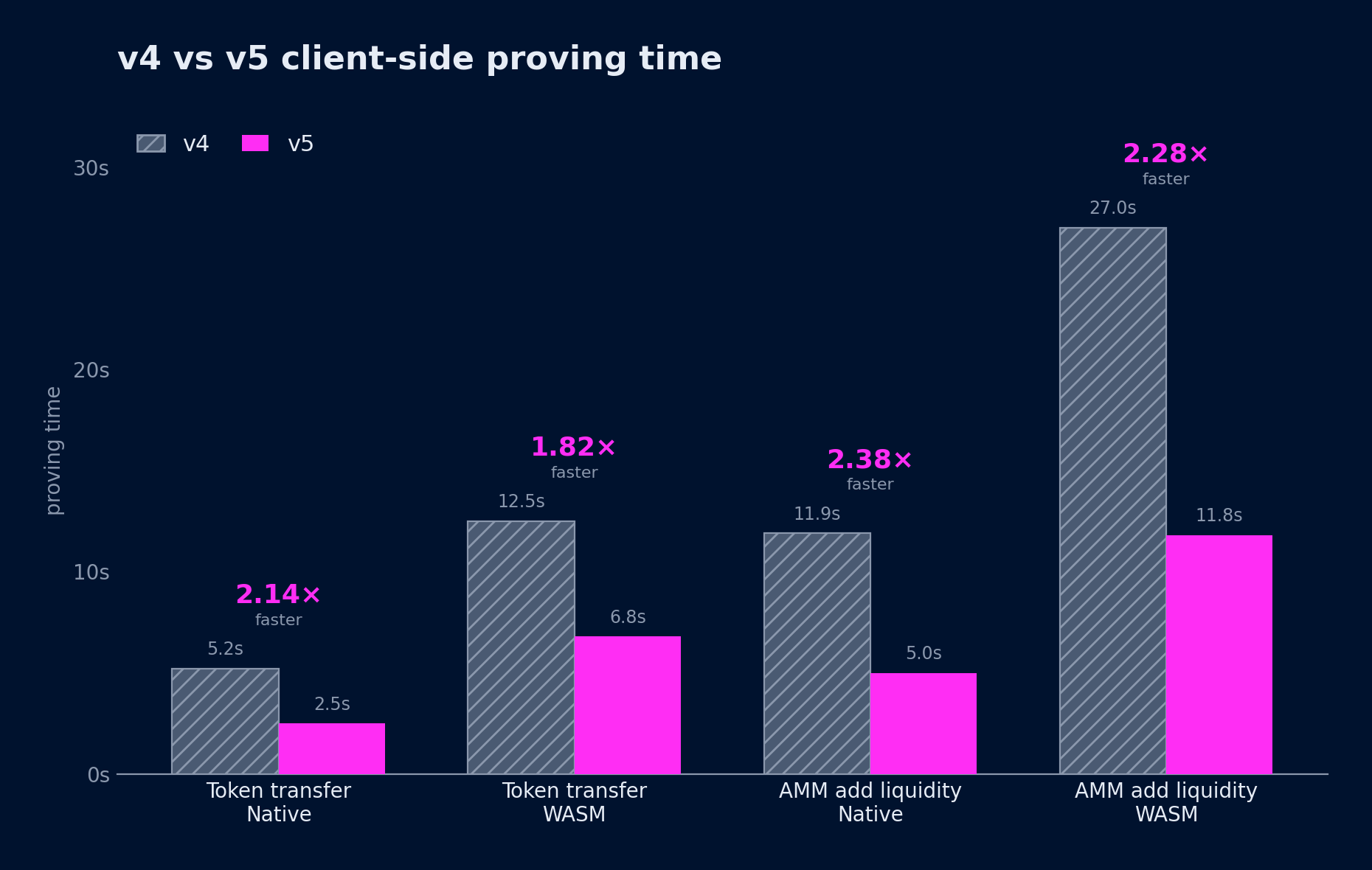
Making private transactions practical comes down to how quickly a proof can be generated on a user's own device, without offloading that work to a server that would learn what the user is doing. On Alpha V5, proving a private token transfer natively now takes approximately 2.5 seconds on a consumer laptop, down from 5.2 seconds on V4, and about 6.8 seconds in a browser, down from 12.5 seconds. Across every measured transaction flow, client-side proving times improved by approximately 2x compared with V4.

Bench machine: an M2 MacBook (12 cores, throttled to 8). "Native" runs Aztec's C++ proving binary; "WASM" runs the same prover in a browser engine (Node on V8).

Alpha V5 lowers ECDSA signature-verification cost by approximately 2x, speeds up Poseidon2 hashing by approximately 3x, and reduces the protocol circuit gate count by approximately 50% (gate count is the number of individual operations a proving circuit must perform, and it is the main driver of how long a proof takes to generate). Each of these lowers the amount of work a device performs to prove a transaction, and the reduction in gate count in particular compounds across every proof the network generates.

Apps - send, receive, and earn privately on Ethereum

Alpha V5 launches the first wave of apps on a network where privacy is built into the protocol rather than managed by an operator. On other networks that claim privacy, transactions still pass through an operator or node that reads them in plaintext, or depend on a viewing key that a third party holds, so users rely on someone else to protect their data and to decide when it gets disclosed. On Aztec, every private transaction is proven on the user's own device, so the app, the sequencer, and any operator never need to see the underlying data. Nyx is one of these apps, allowing users to privately send transactions and privately earn yield on Aave. 

"On Ethereum, everything you do is public. That's why we built Nyx: a private account governed by your Ethereum wallet", said Nikhil, Co-founder of Nyx. "Now you can send, receive and earn in private. Nyx was the first app live on the Aztec Alpha, and we're excited to expand participation to more users with the added stability of Alpha V5."

Other apps on Alpha V5 include Azguard and Nethermind (wallets), Shield, TRAIN, and RavenHouse (bridges), and the Aztecscan block explorers. Also launching is Dark Forest Aztec, a game where users explore a universe, control planets, manage planetary energy, expand territory, and launch attacks through strategic play with private state and hidden actions.

Dark Forest Aztec private universe-building gameplay

Lower costs, higher security 

Transaction fees on Aztec come from two main sources: the cost of proving a transaction and the cost of verifying the rollup proof on Ethereum. Alpha V5 reduces both. It lowers the network's proving-cost parameter by 50%, and it reduces the L1 gas required to verify a rollup proof by approximately 40%. Because rollup proofs are verified on Ethereum and that cost is shared across all transactions in a batch, the L1 reduction lowers fees for every user, while the lower proving-cost parameter reduces the per-transaction proving fee directly. Together, these bring the average cost of a fully private token transfer to under a $0.05 transaction cost.

Alpha V5 also hardens the network on several fronts. It resolves critical vulnerabilities found in Alpha V4 along with additional bugs discovered since launch. Aztec's bug bounty program on Cantina also drew more than 234 security researchers to participate. The network remains in alpha, and further bugs may surface as usage grows, but each release has closed the issues found in the last and strengthened the protocol against new ones. With the critical V4 issues resolved and these safeguards in place, Alpha V5 is stable enough for teams to begin building and deploying applications.

Availability

Alpha V5 is live now, view the Alpha V5 landing page for a full list of features, performance updates, and live apps to explore. 

About Aztec

Aztec is the only decentralized, privacy-first Layer 2 on Ethereum. Developers write private and public logic in the same smart contract, and private functions are executed and proven on the user's own device, so no operator sees the underlying data. The protocol is upgraded through onchain governance, and the network settles to Ethereum. For more information, visit aztec.network.