
Aztec Network
Nov 22nd, 2021
## min read

Infinite Privacy: New Anonymity Paradigms with Aztec Network

Discover how Aztec Network's latest privacy paradigms redefine anonymity, offering unprecedented privacy levels in the blockchain world.

Share
Written by
Jon Wu
Edited by

Endlessly expanding privacy sets with Aztec Network.

In the last article in our series on Aztec’s privacy architecture, we explored how a private network is even possible on a public blockchain.

Today we’re exploring why a private network can be private and compliant.

Aztec offers basic deposits and withdrawals — meant to provide consumer privacy to Ethereum users: our current private payments front-end zk.money has been live on mainnet since March and recently crossed 4,800 ETH in deposits bridged.

But zk.money also offers private internal transfers and will soon offer a full suite of Ethereum Layer 1 Defi functionality enabled by our bridge, Aztec Connect.

The addition of DeFi functionality means Aztec will offer a large and dynamic privacy set that will become increasingly more complex and privacy-protecting—a concept we like to call Infinite Privacy.

The Infinite City

Imagine Aztec as a walled city. All an outside observer can see is users entering and leaving Aztec via our bridge.

Within the walls of the city, users can exchange assets with fully private transactions. Neither the network nor its participants can see the senders and recipients of transactions, nor their amounts.

Tenochtitlan, the capital of the Aztec Empire. With credit to http://joelgehringer.com/blog/the-city-of-dreams/.

In addition, once inside the system, users can batch transactions and teleport back to L1 — to swap, stake for yield, lend funds, vote in DAOs, or buy NFTs. In the near future the contributors to ConstitutionDAO will be able to do so privately, and with nearly 0 gas.

Because Aztec allows for these two new anonymizing activities — internal transactions and batched interactions with Layer 1 Ethereum— the privacy set is difficult for an observer to calculate.

That’s a very good thing.

Sleuthing and Deducing

Let’s put ourselves in the shoes of an adversary attempting to run de-anonymizing transaction graph analysis.

As an observer watching Ethereum activity, we might watch deposits to and from Aztec, and attempt to deduce what set of deposits a certain withdrawal might belong to.

This is what we mean by privacy or anonymity set — the group or set of users a forensic target could be. If the privacy set the target belongs to is large, then we can only guess with a small probability which addresses and transactions the target is associated with.

Once the privacy set you belong to approaches 1, the probability an observer knows who you are also approaches 1, and your privacy is no longer protected.

Let’s talk through an example.

Anonymity Sets 101

Pretend we were internet sleuths trying to de-anonymize other privacy protocols .️

If we saw someone withdraw 1 ETH, we’d know for certain that they’d deposited at least 1 ETH. Because there are no internal transfers, aggregation of multiple deposits into a larger withdrawal simply isn’t possible.

“So,” we’d puzzle, “all we need to figure out is how many people have ever deposited at least 1 ETH, and then the withdrawer must be one of those people!”

Good thing we have Dune Analytics to help us visualize how some of these privacy sets might work! You can see our privacy set dashboard here: https://dune.xyz/jaosef/Aztec-2.

The answer to the question of who the 1 ETH withdrawal could be in this case would be “everyone to the right of 1 ETH in this diagram,” which turns out to be 1,174 deposits.
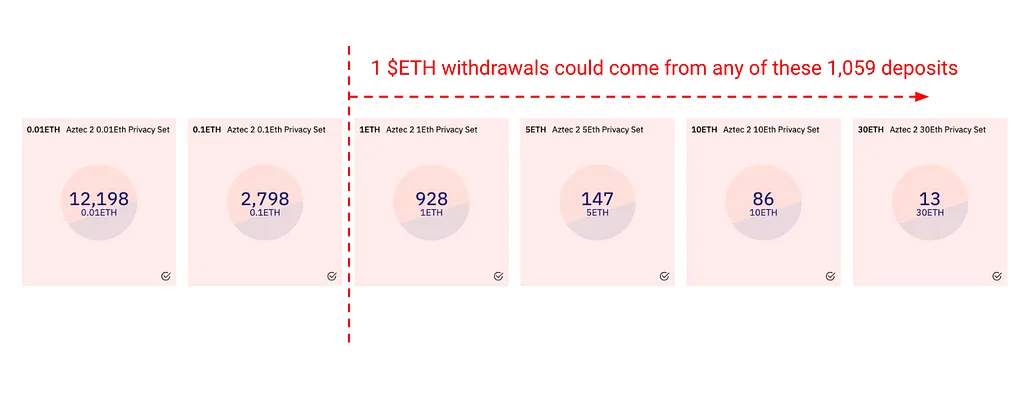
The privacy set in a world without internal transfers.

Of course, the probability that a 1-ETH withdrawer came from the 1 ETH deposit set is much higher than the probability that she came from the >1 ETH deposit set, for a purely behavioral reason:

It’s annoying to break 5-, 10-, or 30-ETH deposits into smaller 1 ETH withdrawals. It’s much simpler to do one big monolithic withdrawal.

So as sophisticated sleuths, our investigative instincts would say that there is some non-zero but small probability that the withdrawer deposited an amount >1 ETH, with that probability diminishing for larger deposits:
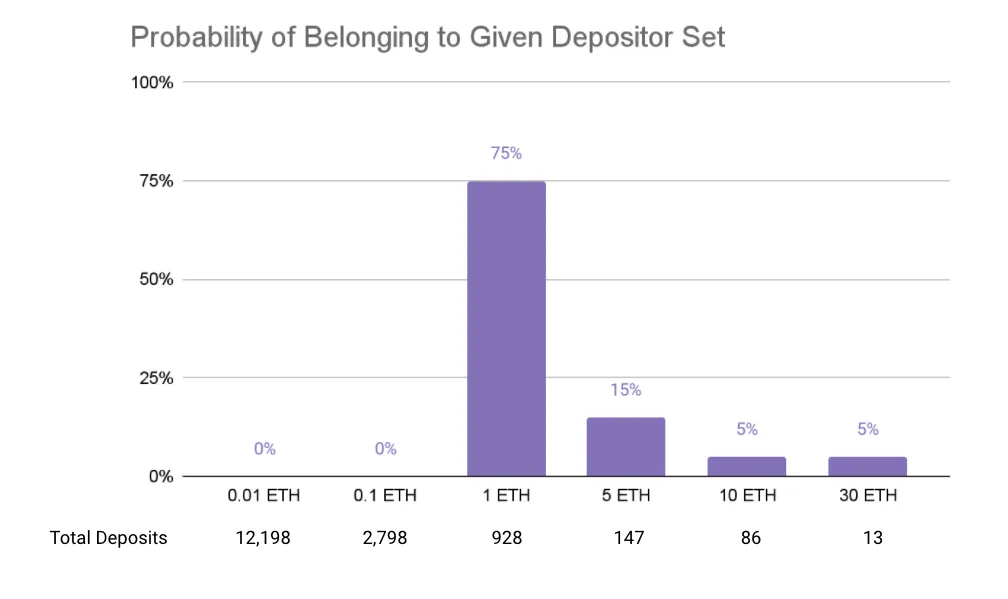
This is an example of a simple probability distribution — and the “spikier” it is, the more certainty an adversary has about user behaviors.

In this case, based on observations of other protocols and comparable behaviors on Defi, a forensic analyst might think the probability of a 1 ETH withdrawal coming from a 5 ETH deposit is 5x lower than the probability of a 1 ETH withdrawal coming from a 1 ETH deposit.

Standing In or Standing Out

Let’s establish a rough heuristic guide to thinking about privacy sets:

In order to figure out how to blend in, figure out how to stand out, and then do the opposite.

The most obvious way for me to stand out in the case without internal transactions would be if I bridged a massive monolithic deposit and withdrew the same amount shortly afterward.

To make myself even more highly identifiable, I would use a unique quantity of a certain asset (e.g. depositing 69.696969 ETH to Aztec, then subsequently withdrawing 69.696969 ETH). To prevent de-anonymizing behavior, the zk.money front-end suggests round-number deposits and withdrawals — so you don’t stand out — and will soon also nudge users toward the largest anonymity sets.

As users what we want to do is introduce uncertainty into any forensic analysis. Keen observers should feel frustrated by our actions. They should say something like, “Dang, calculating the probability that these two addresses are affiliated is so complex and low-probability that it’s not meaningful for me to try to figure out which deposit is related to which withdrawal.”

I sum our conclusions in this extremely sophisticated 2x2 matrix of behaviors:

Very. Sophisticated.

So given what we know, how as a collective can we introduce more uncertainty into the adversary’s analysis?

  1. Increase the size of each deposit set, especially large deposits
  2. “Spread out” the probability that the withdrawal could have come from any deposit set!

Other protocols focus on #1. Let’s talk about what #2 adds.

Internal Transfers: The Inner Sanctum

There is a big caveat here that differentiates our current zk.money front-end — there is a possibility that your anonymity set includes deposits that are smaller than your withdrawal amount.

How? Because of internal transfers.

Say you withdraw 10 ETH. You could have deposited 10 ETH.

Or you could have deposited 5 ETH, used or coordinated offchain with 5 unassociated addresses to deposit and send you 1 ETH each internally, and then in the end withdrew 10 ETH. Suddenly you could be, well, pretty much anyone, so long as two things hold:

  • The amount of assets in the system is sufficient to support the hypothetical withdrawal scenario
  • The number of transactions in the intervening time exceeds the number needed to compose the hypothetical withdrawal scenario

So in this case, you could be some combination of internal transactions summing to 10E:

  • 10 internal 1E transfers
  • 100 internal 0.1E transfers
  • 1,000 internal 0.01E transfers
  • Some combination of the above

Of course, as the number of internal transfers needed to sum to a withdrawal amount increases, the less likely it actually happened — realistically, who’s going to coordinate 1,000 unaffiliated addresses to privately send them funds!

That’s why the internal economy of Aztec matters, and why Aztec Connect — a bridge allowing anyone to interact with defi contracts on Layer 1 — will help explode the anonymity set, making it highly improbable to associate any deposits with withdrawals.

Internal transfers muddy up anonymity set calculations, but only if there are a sufficient number of internal transfers and a large enough quantity of deposits in the system.

Aztec Connect: The Bridge to Infinity

Now let’s introduce the idea of Aztec Connect, an expansion of zk.money’s functionality to include batch interactions with any Layer 1 smart contract.

That means to begin with, any Layer 1 Defi functionality will be available to Aztec users.

Deposit $ETH on zk.money? On a competing protocol, you’d have to wait for the funds to be “seasoned” before withdrawal— essentially waiting for the privacy set to grow before withdrawing funds. That’s why for instance there are billions sitting in privacy protocols.

Using Aztec Connect, you can bridge funds back to Layer 1 and make shielded assets productive while you wait — meaning you might not want to ever withdraw!

With a simple conventional privacy protocol, you deposit funds and simply wait — for what, you ask? For the anonymity set to grow! Meanwhile, deposited funds are completely unproductive. Capital efficiency, schmapital efficiency.

Here are some arbitrary possible examples of using private assets while they are inside the system:

  • Staking ETH in Lido for stETH, depositing it in the stETH-ETH pool and getting double yield
  • Entering into an Element.fi fixed rate yield vault
  • Swapping ETH for OHM on OlympusDAO, staking for sOHM, and (3, 3)ing privately

This is just a teaser! We’ll cover Aztec Connect in depth later in this series, but for now I want to focus on the idea that investing capital for yield on Aztec will grow the value locked in the system.

Bridging back to Ethereum functionally has the same privacy-set-expanding benefits as having new users deposit fresh funds or having you deposit more funds, while being privacy-protected.

This spreads out the probability distribution:
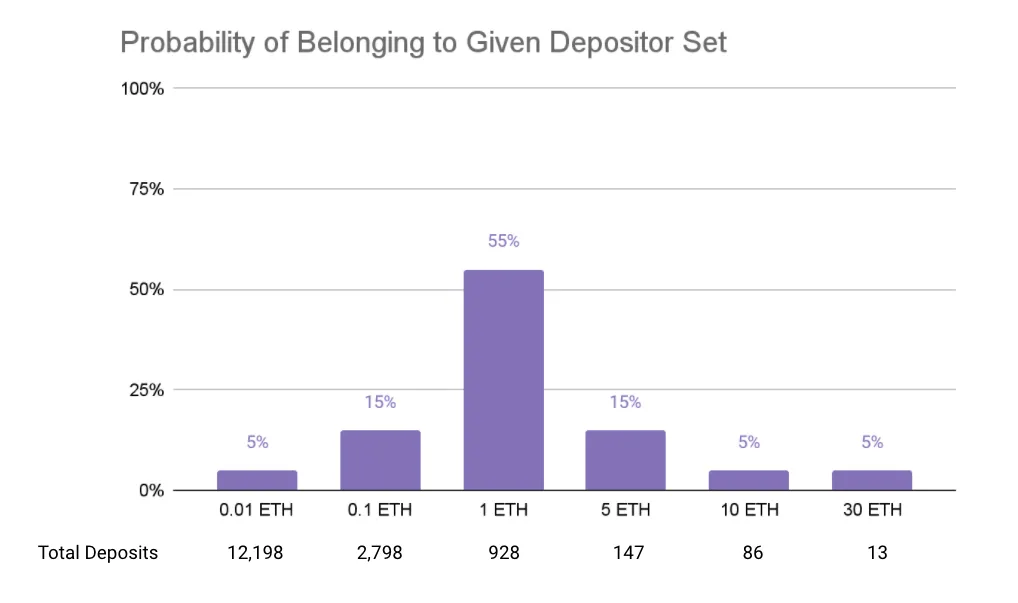
And makes it less and less likely that you belong to any one given depositor set. Imagine depositing 0.1 ETH and (3, 3)ing on OlympusDAO until your OHM is worth 1 ETH! Now you’ve really thrown off the scent.

Purify Before Entering

Now, what Aztec doesn’t do is protect users on mainnet, and poor security hygiene on Ethereum can hurt user privacy.

But there’s some good news here — simply follow privacy best-practices.

Let’s start with one of the biggest no-no’s for any privacy preservation system: withdrawing to the same address.
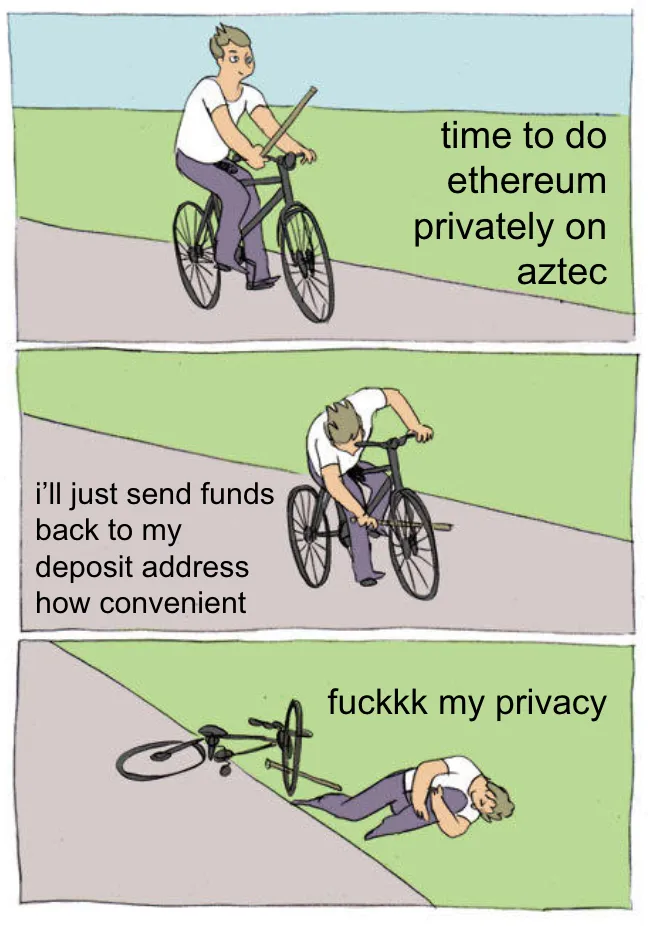
Don’t do this.

Why is withdrawing to the same address “bad?” In addition to reducing your own anonymity, you’re basically screwing everyone else over. You’re reducing the anonymity set by removing yourself from it, saying, “I’m taking my ball back.”

Now there’s no way your deposit could actually be the source of anyone else’s withdrawal but your own!

Withdrawing to the same address you deposited is akin to saying, “These are the funds I brought! It’s special because my mommy gave it to me.” Okay Jimmy, that’s fine, but imagine if everyone did that. If everyone identified themselves and their funds, it would:

  1. defeat the purpose of using private transfers in the first place
  2. harm everyone else’s privacy
Jimmy always takes his ball back. Dang it, Jimmy.

Now consider the inverse: a large number of addresses deposit, and a large number (but not the same!) addresses withdraw. Now we’d have a very hard time associating one wallet with another.

Critically, any transaction graph analysis on Layer 1 may be able to associate those accounts and therefore collapse many addresses. Depositing to Aztec and withdrawing to an address already associated with the depository address is akin to withdrawing to the same address. That’s why withdrawals should only happen to untouched or otherwise unaffiliated wallets.

Hygiene takeaways:

  • Use common deposit and withdrawal amounts
  • Avoid making large deposits or large withdrawals (though large withdrawals are worse)
  • Don’t withdraw to the same address you deposited to

To Infinity and Beyond

We hope this helps you understand how and why Aztec Network builds upon the fundamental preservation mechanisms used by privacy protocols.

This stuff is meant to hurt your brain! The harder it is to deduce your set, the harder it is for a de-anonymizing foe. And if you are a researcher interested in de-anonymization, forensics, and transaction graph analysis, please reach out to us at hello@aztecprotocol.com.

Join the Aztec community

We’re also always on the lookout for talented engineers and applied cryptographers. If joining our mission to bring scalable privacy to Ethereum excites you — get in touch with us! hello@aztecprotocol.com.

And continue the conversation with us on Discord or Twitter.

Infinite Privacy: New Anonymity Paradigms with Aztec Network was originally published in Aztec on Medium, where people are continuing the conversation by highlighting and responding to this story.
Read more
Aztec Network
Aztec Network
7 Aug
xx min read

Alpha V5 Proving System Vulnerability

Status

Core contributors identified a critical vulnerability affecting the V5 Alpha proving system on 27 July 2026 through internal AI-assisted auditing.

V5 remains Alpha software. Critical findings can arise during this phase, and the audit process exists to identify them before broader deployment. This finding places V5 funds, applications, and contract state at risk.

Treat funds and applications on V5 as exposed to a protocol-level failure until contributors complete incident response work and operators carry out the required network actions.

What we are disclosing

An attacker may be able to exploit a flaw in the current V5 proving system by constructing a proof that passes verification for a transaction the network should reject. If accepted, that transaction could produce a state transition outside the rules V5 intends to enforce.

Contributors cannot determine whether anyone exploited the flaw before this finding. The affected system lacks the information needed to distinguish ordinary accepted transactions from transactions accepted through the flawed proving path. Historical chain activity cannot establish whether exploitation occurred or quantify its impact.

Application safeguards

We expect application teams to prepare safeguards in the coming weeks.

Those safeguards may include changes to application controls, deployment procedures, user flows, and migration plans. We expect each team to assess its contracts and determine which protections fit its architecture and users.

We expect teams planning a V5 deployment to pause that work until contributors publish further guidance. We expect teams with live contracts to review their ability to limit user exposure, isolate affected functionality, and move users to fresh deployments if needed.

We expect applications that maintain administrative or emergency controls to assess whether those controls can reduce user risk during the incident timeframe.

Next steps

Core contributors are working with operators, application teams, and bridge operators as applications add security guards around affected flows.

The findings from this incident will inform the V6 release, including circuit updates that prevent the network from accepting proofs tied to an affected proving system.

V5 launched as Alpha software, with V6 planned for later in 2026. Contributors will publish a security roadmap covering the remaining work and release path.

Known vulnerability status

Reviewers have not identified other high-severity or critical V5 Alpha vulnerabilities at this time.

Internal and external human audits have completed, and contributors continue AI-assisted auditing. Alpha is the period for identifying faults before production deployment.

Community
Community
4 Aug
xx min read

Dark Forest Aztec Game Goes Live

Dark Forest is a real-time strategy game played across a procedurally generated universe where most of the map is hidden. You cannot see rival players, their planets, or their fleets. You only know what you have explored. Everyone shares one universe, and nobody has the full picture.

In most onchain games, every position and every move is public, because the chain is public. Dark Forest used zero-knowledge proofs to break that assumption: players prove their moves are valid without revealing where those moves came from. The result is a game of hidden information running on a public network.

Dark Forest Aztec ports the original Dark Forest 0.6 to Aztec. It keeps the gameplay from the original and rebuilds the privacy layer on Aztec's programmable privacy.

A note before diving in: this is early, experimental software on Aztec Alpha V5. Treat it as an alpha and play accordingly.

The universe you cannot see

You start on a single home planet with almost the entire map dark. To find anything you mine the universe, running a client that explores coordinates and reveals what sits there: unclaimed planets, resources, and eventually the edges of other players' territory.

You are never handed a view of the board. You earn it one region at a time, and everyone else works under the same fog.

What is hidden on Aztec

Your home coordinates and your fleet movements are private state, expressed as first-class private notes on Aztec. Your location and where you send energy stay hidden, enforced in the contracts by zero-knowledge cryptography.

What sits onchain is a set of cryptographic commitments. Instead of storing every planet's full details in the open, the contracts store Poseidon2 hashes of entity state. When you make a move, your client supplies the full state, the contract checks it against the stored hash, applies the change under zero-knowledge constraints, and writes a new hash back. Full game state lives offchain and gets rebuilt from public logs by an indexer, which is what renders your map without exposing every player's position.

So you can prove you made a legal move from a planet you own without revealing where that planet is. Aztec applies the same principle to private payments and private contracts.

How you play

Four actions carry the game.

Explore. Your explorer sits in the bottom left. Set it running and it uncovers the map around you, surfacing planets, resources, and other players.

Send energy. Most planets produce energy. Click and drag from a planet you own toward a target to capture or weaken it.

Route silver. Asteroid fields produce silver. Move it to your planets and spend it on upgrades, or send it to a Spacetime Rip to convert it into score.

Hunt artifacts. Some planets hold artifacts. Your Gear ship discovers them. Once harvested, you deposit them on planets to boost stats.

Four stats drive most decisions.

Energy is the core resource. Planets generate it over time up to a capacity, and you spend it on everything: claiming planets, reinforcing your own, attacking rivals. Two details matter. Moves are taxed, so a flat percentage of a planet's total capacity burns every time you send energy, which discourages small frequent moves. And energy decays over distance, so send it too far and almost nothing arrives. A common rule of thumb is to let a planet fill to about 75%, then send it down to about 25%.

Defense reduces the damage incoming energy does when it lands. Higher-level planets often have lower defense, but they hold much more energy, so they still take more to capture. Defense matters most on front lines.

Range sets how far a planet can send energy. It governs how fast you expand and how efficiently you move energy inside your own empire, since shorter relative distances mean less decay. Good range also lets you strike deep into an opponent's territory.

Speed sets how quickly a move arrives. Usually secondary, though a fast strike can land before a rival reacts, and some playstyles reward capturing many nearby planets quickly.

Planets can also be upgraded with silver and enhanced with artifacts. Space types carry different multipliers, from mild Nebula to punishing Dead Space, so where a planet sits changes how it plays.

How scoring works

There is a scoreboard, and territory alone does not win it. This round scores two activities: discovering artifacts with your Gear ship, and withdrawing silver through Spacetime Rips.

Point values from the in-game help page:

  • Each unit of silver withdrawn: 1
  • Common artifact: 2,000
  • Rare: 10,000
  • Epic: 200,000
  • Legendary: 3,000,000
  • Mythic: 20,000,000

Silver accrues one point at a time. A single Mythic artifact is worth twenty million of them, so artifact hunting decides rounds and silver withdrawal sets your floor.

Silver has two competing uses. Spend it on upgrades and your planets get stronger, extending range and hardening defense. Withdraw it through a Spacetime Rip and it becomes scored points, but it is gone. Every unit is a choice between building the empire and banking points.

Upgrades tend to win early, since a stronger empire reaches more asteroid fields and finds more artifacts. Late in a round that calculation flips, because a planet you never use is worth less than points already scored.

Artifacts do both jobs at once. They score on discovery, and once deposited they boost a planet's stats, which makes the next expedition easier.

Why you explore

Nothing happens until you find something to act on. Your explorer turns dark space into planets you can capture, asteroid fields you can mine, and artifact-bearing planets you can raid. Sitting still means no new energy, no silver, no score.

Exploring also buys information. The map you have uncovered is an advantage nobody else holds. Knowing where high-level planets sit, which asteroid fields are unclaimed, and where space types shift lets you plan further ahead than someone still working through their starting region.

You find other players as a byproduct. There is no player list. You explore outward until your revealed region touches territory someone already owns: a planet in another player's colors, sitting where you were about to expand. Their home coordinates stay private, so you learn something narrow. Someone is here, roughly this direction, holding this much. You infer the rest, and you have no way of knowing whether they found you first.

What happens when you run into someone

You have three broad options.

Stay quiet and keep growing. Nothing forces you to engage. Keep exploring elsewhere, keep routing silver, keep upgrading. Your positions stay private, so silence costs you only time, which is what you want if they are stronger. The risk is that they are doing the same thing faster.

Fortify the border. If the contact sits somewhere you cannot lose, spend energy hardening the planets facing them. Defense is worth most where an attack will actually land. This keeps the option to fight without committing to one.

Attack. Send enough energy to overwhelm the target's defense and the planet becomes yours, along with its production and its position as a staging post. Higher-level planets are the prize and take proportionally more to crack.

Attacking costs more than energy. A move that lands tells your rival where you strike from, and that you are close enough to be worth answering. Retaliation can then come from directions you have not explored, launched from planets you cannot see.

Multiplayer in practice

Everyone plays one shared universe in real time. No turns, no lobbies. Energy regenerates whether you are watching or not, moves stay in flight while you sleep, and rivals expand while you are away from the screen.

Most strategy games let you watch a threat approach. Here you tend to see the consequences: a planet you owned this morning in someone else's colors, an incoming move you notice once it is already close.

That produces a particular kind of paranoia. You are trying to find everyone else while avoiding being found, and every expansion is a strategic bet that the space ahead is empty.

Information becomes tradeable, because it is scarce. Players compare notes, warn each other about aggressive neighbors, and agree who expands where, then break those agreements when the scoreboard makes it worth breaking.

Why it matters beyond the game

A fully onchain game where players cannot see each other's positions is hard to build, and building it well says something about the platform underneath.

Hidden state, private notes, and client-side proving are the same building blocks behind private applications across Aztec. Dark Forest is a way to watch them work.

Getting started

Dark Forest Aztec is playable now as an alpha. Expect a learning curve; the original was famous for it. DFArchon maintains onboarding material and a community for new players. Round One is live. The universe is dark, and everyone else is out there somewhere. Go find them, quietly.

Play Now

Follow the Builders

DFArchon on X

Source and docs

Aztec Network
Aztec Network
22 Jul
xx min read

How Gas Works on Aztec

Gas on Aztec

Gas on Aztec is known as Fee Juice and is used to pay for transaction costs. This is the same as $ETH on Ethereum. Some apps will handle transaction costs for you under the hood, but if you are using a browser extension wallet, you will not be able to send transactions without it. Fee Juice can be obtained by bridging the $AZTEC token on Ethereum to the Aztec Network L2. This means that under the hood, all activity that happens on Aztec is underpinned by the $AZTEC token bridged into the network. Some bridges like Shield (by human.tech) handle this for you, allowing you to allocate a portion of your bridged transaction to convert into Fee Juice and land in your wallet automatically.

Public vs Private Assets

Assets and transactions on the Aztec Network can be either public or private. If you bridge publicly, your tokens will arrive as public, traceable tokens visible to all. Privately bridging, on the other hand, will give you private assets that are visible only to you. These assets can then be sent privately to another user or wallet without ever revealing who you are, what tokens were sent, how many, or who the recipient is.

Public vs Private Gas

Like tokens on the Aztec Network, Fee Juice (gas) can also be public or private. The reason for this is that even if what you are sending is private, the gas you spend to execute that transaction could still be visible if you are using public Fee Juice, potentially revealing transaction patterns and activity. Private Fee Juice keeps your entire transaction footprint hidden. When you send a private transaction, you can use private Fee Juice, and when you send a public transaction, you can use public Fee Juice, which means your transaction costs are always aligned with the type of transaction you're making.

Fee Juice in Apps

Aztec has native fee abstraction, which means apps could let you pay for transactions in any token you want, or cover your fees entirely. Apps like Nyx may choose to cover part or all of a user's transaction costs, or allow you to pay in tokens that are convenient for you. This means you will most likely never see Fee Juice in an app; instead, you'll pay in whatever makes sense for what you're doing, on your terms. Similarly, you might never even see an Aztec wallet at all, because the app itself becomes your interface that you connect to using your MetaMask wallet.

Fee Juice in Browser Wallets

If you're using a browser extension like Azguard, you'll manage Fee Juice directly in your wallet alongside your private and public balances, converting between tokens as needed to cover transaction costs.

When you bridge tokens in, you'll need enough Fee Juice to cover the cost of your first transaction, then you'll need to monitor how much Fee Juice you have available to make transactions. Browser wallets will allow you to send either publicly or privately to other users and will default to using either public or private Fee Juice depending on the type of transaction. Both private Fee Juice and public Fee Juice will appear by default in your token list.

Wrapping up

How you handle Fee Juice depends on where you're transacting: apps can abstract it away entirely and let you pay in any token, while a browser wallet like Azguard puts it in your hands to manage across public and private balances. Match your gas to your transaction, keep private activity private down to the fee, and you move on your terms.

Aztec Network
Aztec Network
21 Jul
xx min read

Introducing Alpha V5

The Aztec Network today activated Alpha V5, a major protocol upgrade passed by token-holder governance and executed onchain. Alpha V5 reduces private-transaction proving times by more than 2x compared to the previous version, lowers the cost of a fully private transaction by roughly 50%, resolves the critical issues found in V4, and sees the first wave of apps go live. Users can now send private transactions and earn yield on Aave simply by connecting their Ethereum wallets on Nyx, bridge from Ethereum to Aztec using Shield or TRAIN, privately collect NFTs on RavenHouse, or play Dark Forest Aztec, a hidden-information strategy game in a universe that lives entirely onchain. 

"Alpha V5 continues Aztec's work at the frontier of client-side proving, with cryptographic breakthroughs that cut proving times by more than half this release," said Zac Williamson, Co-founder, Aztec Foundation. "We believe Aztec is now the fastest system in the world for proving a fully private transaction entirely on a user's own device, and every release moves the industry closer to private transactions at public transaction speeds."

As the only decentralized L2, Aztec is the credibly neutral privacy layer for Ethereum. Aztec allows anyone to write smart contracts that include both private and public aspects – every private transaction is proven on the user's own device, so no operator, sequencer, or intermediary can see the data. The Alpha V5 proving improvements come from cryptographic advances that make this client-side proving faster than any prior release. The network remains in alpha, but with V5 it is ready for teams to begin building and deploying applications.

Performance - 2.5 second fully private transactions 

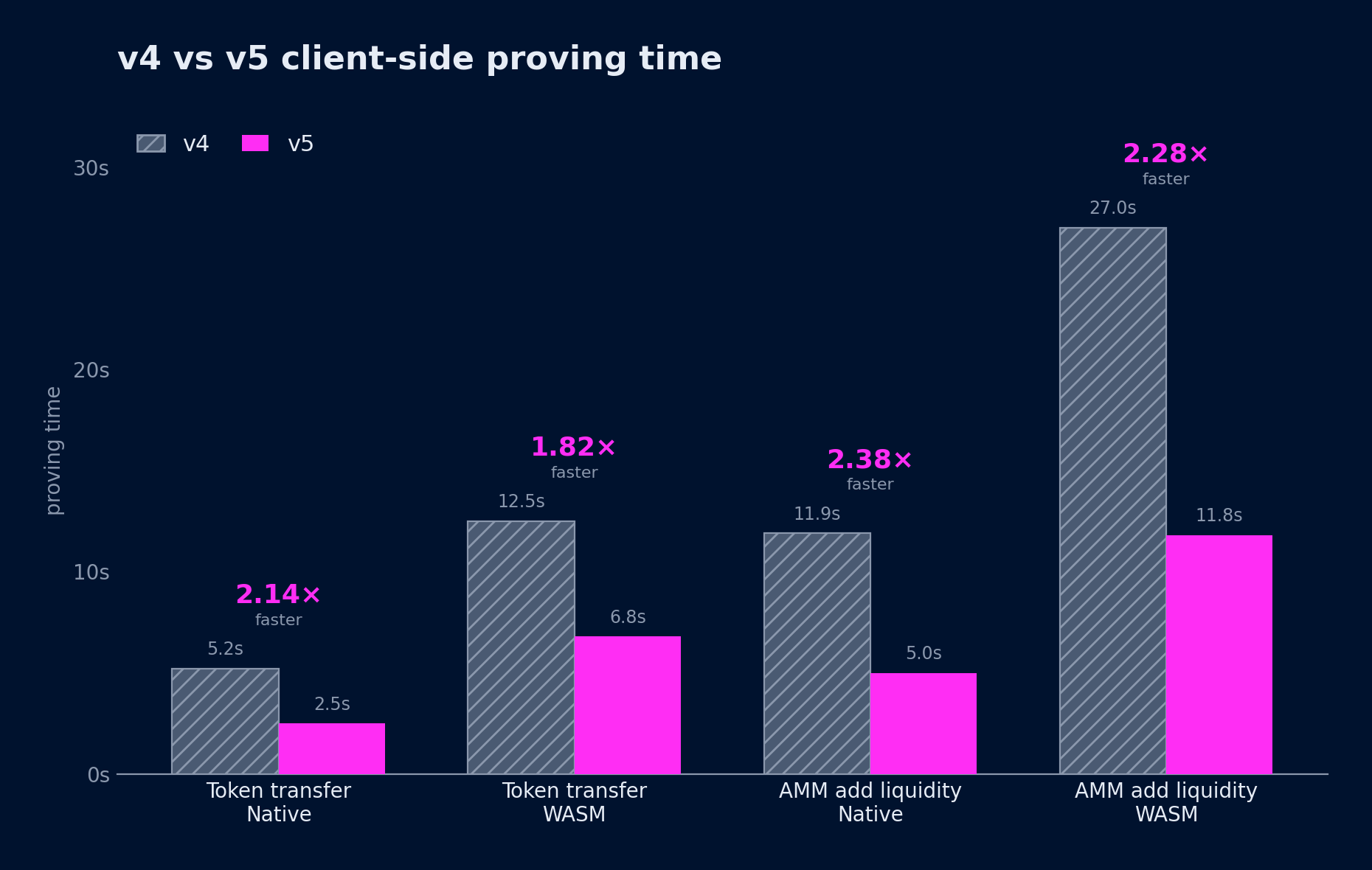
Making private transactions practical comes down to how quickly a proof can be generated on a user's own device, without offloading that work to a server that would learn what the user is doing. On Alpha V5, proving a private token transfer natively now takes approximately 2.5 seconds on a consumer laptop, down from 5.2 seconds on V4, and about 6.8 seconds in a browser, down from 12.5 seconds. Across every measured transaction flow, client-side proving times improved by approximately 2x compared with V4.

Bench machine: an M2 MacBook (12 cores, throttled to 8). "Native" runs Aztec's C++ proving binary; "WASM" runs the same prover in a browser engine (Node on V8).

Alpha V5 lowers ECDSA signature-verification cost by approximately 2x, speeds up Poseidon2 hashing by approximately 3x, and reduces the protocol circuit gate count by approximately 50% (gate count is the number of individual operations a proving circuit must perform, and it is the main driver of how long a proof takes to generate). Each of these lowers the amount of work a device performs to prove a transaction, and the reduction in gate count in particular compounds across every proof the network generates.

Apps - send, receive, and earn privately on Ethereum

Alpha V5 launches the first wave of apps on a network where privacy is built into the protocol rather than managed by an operator. On other networks that claim privacy, transactions still pass through an operator or node that reads them in plaintext, or depend on a viewing key that a third party holds, so users rely on someone else to protect their data and to decide when it gets disclosed. On Aztec, every private transaction is proven on the user's own device, so the app, the sequencer, and any operator never need to see the underlying data. Nyx is one of these apps, allowing users to privately send transactions and privately earn yield on Aave. 

"On Ethereum, everything you do is public. That's why we built Nyx: a private account governed by your Ethereum wallet", said Nikhil, Co-founder of Nyx. "Now you can send, receive and earn in private. Nyx was the first app live on the Aztec Alpha, and we're excited to expand participation to more users with the added stability of Alpha V5."

Other apps on Alpha V5 include Azguard and Nethermind (wallets), Shield, TRAIN, and RavenHouse (bridges), and the Aztecscan block explorers. Also launching is Dark Forest Aztec, a game where users explore a universe, control planets, manage planetary energy, expand territory, and launch attacks through strategic play with private state and hidden actions.

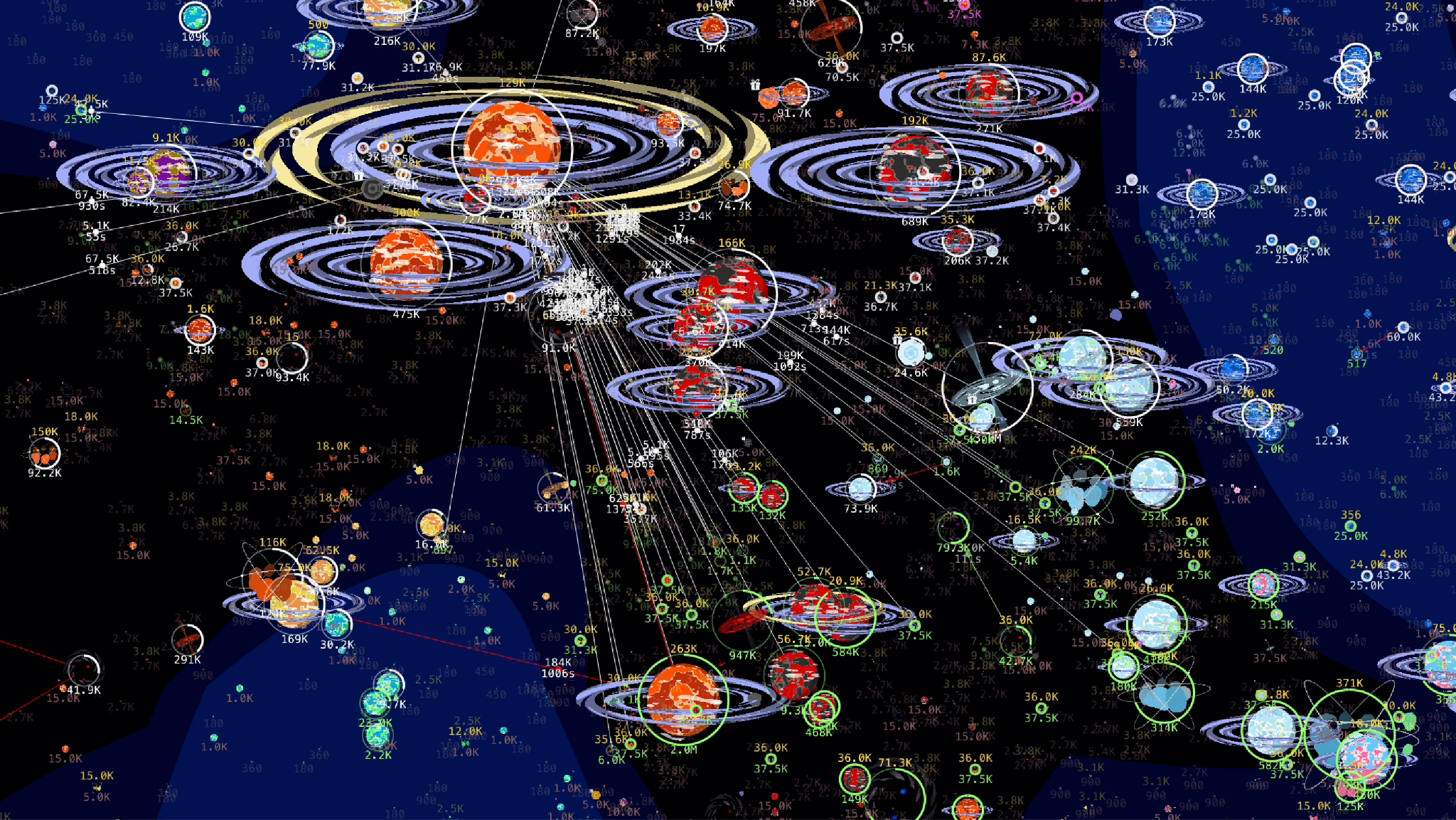
Dark Forest Aztec private universe-building gameplay

Lower costs, higher security 

Transaction fees on Aztec come from two main sources: the cost of proving a transaction and the cost of verifying the rollup proof on Ethereum. Alpha V5 reduces both. It lowers the network's proving-cost parameter by 50%, and it reduces the L1 gas required to verify a rollup proof by approximately 40%. Because rollup proofs are verified on Ethereum and that cost is shared across all transactions in a batch, the L1 reduction lowers fees for every user, while the lower proving-cost parameter reduces the per-transaction proving fee directly. Together, these bring the average cost of a fully private token transfer to under a $0.05 transaction cost.

Alpha V5 also hardens the network on several fronts. It resolves critical vulnerabilities found in Alpha V4 along with additional bugs discovered since launch. Aztec's bug bounty program on Cantina also drew more than 234 security researchers to participate. The network remains in alpha, and further bugs may surface as usage grows, but each release has closed the issues found in the last and strengthened the protocol against new ones. With the critical V4 issues resolved and these safeguards in place, Alpha V5 is stable enough for teams to begin building and deploying applications.

Availability

Alpha V5 is live now, view the Alpha V5 landing page for a full list of features, performance updates, and live apps to explore. 

About Aztec

Aztec is the only decentralized, privacy-first Layer 2 on Ethereum. Developers write private and public logic in the same smart contract, and private functions are executed and proven on the user's own device, so no operator sees the underlying data. The protocol is upgraded through onchain governance, and the network settles to Ethereum. For more information, visit aztec.network.