Aztec Network
11 Dec
## min read

Announcing the Aztec Sandbox Alpha Program

Share
Written by
Jon Wu
Edited by

Supporting the earliest builders on Aztec’s privacy-first Layer 2

In September, Aztec Labs launched the Aztec Sandbox, a prototype local developer testnet for privacy-first applications on the Aztec network.

Shortly thereafter, we recruited a small group of dedicated blockchain and ZK developers to a friendly, closed-invite feedback partnership program.

We had three goals for this program:

  1. Improve developer experience with added features
  2. Stabilize the Sandbox with bug reports and technical feedback
  3. Encourage experimentation and development of novel applications using the Sandbox’s Private Execution Environment (PXE) and public-private state management functionality

We’re now wrapping up the first round of closed-invite Sandbox feedback partnerships, with two more rounds to come, before we gear up for an open testnet launch.

We believe the Sandbox environment is alpha-ready: stable, well-documented, and well-featured enough for dedicated partners to use.

As a result, we are opening the alpha to developers in a hands-on program. Experience with Noir, Aztec, or Sandbox is strongly preferred but not necessary.

The Program

{{blog_divider}}

Of course non-men are also wanted.

The Sandbox Alpha Program is meant to onboard the earliest, most hardcore, and most dedicated privacy-first developers. No prior experience with Noir, Aztec, or ZK is necessary, but alpha partners will need to have:

  • Exceptional technical skills
  • Ability to commit 15-20 hours a week for ~4-6 weeks
  • Regular check-ins with the Aztec Labs core team

In return, alpha partners will receive:

  • A modest stipend
  • Comarketing support
  • A dedicated core Aztec protocol engineer as a partner
  • Opportunity to be a highly valued member of the Aztec community and join early to voice your feedback in the development of our network
  • Help from the Aztec core team in building fully-fledged Aztec applications on Aztec’s eventual mainnet
  • And, of course, honor and glory

📝 If you’re interested in becoming an Alpha partner, apply here:

What’s so special about Aztec?

Aztec is a privacy-first layer 2 on Ethereum. What that means is Aztec enables:

  • Reading and writing smart contract data to private storage
  • Private execution of smart contract functions
  • Public-private state interactions in the same transaction

Aztec also comes with private L1<>L2 messaging functionality and native account abstraction.

Practically, smart contracts can store public information, legible to all, and also write information to private, encrypted datastores.

Users–and only users–are able to retrieve their own private data and compute over that data locally, on their own devices.

This not only establishes ironclad privacy, but enables broad new blockchain functionality. For starters, Aztec easily enables identity privacy, meaning every transaction in Aztec can start privately (from your account contract) which can then execute functions privately or publicly.

A dapp can have private and public methods in the same contract, with public-private contract calls.Aztec has identity privacy by default. Meaning even when applications are deployed to public memory, users can interact with those applications privately.

Feedback Partners Proofs of Concept

The design space for private applications goes far beyond “DeFi but private” or “NFTs but private” given that fully encrypted data ownership (“private state”) is now a reality.

Here are just some of the example projects built in the Sandbox during our closed-door feedback round:

Ikigai (web3 Patreon) - Resurgence Labs

As an example, take Resurgence Labs, who are building a project called Ikigai, a private web3 version of Patreon. The way Patreon works in web2 is individuals commit funds on a recurring basis to Patreon, unlocking rewards. Payments are verified using a web2 payment API (e.g. Stripe), allowing access to paywalled content.

👀 See the Ikigai project Github here.

How would you build a Patreon like service on Ethereum without forcing individuals to leak their subscriptions? For instance, on Ethereum everyone can see your address sending payments to your chosen creators.

Using the Aztec Sandbox, Resurgence Labs created a smart contract that allows individuals to purchase a private NFT–kept in one’s own encrypted datastore, which when proven to Ikigai, grants access to gated premium content.

The contract first mints an encrypted NFT with details of the subscription. At any time, the NFT owner can prove ownership and non-expiry of the NFT to Ikigai’s server.

“Unlike most web3 dapps, we can actually cite something other than decentralization as our USP over our web2 counterpart (say Patreon). With this feature, people can subscribe to something without having to let the world know about it (or be judged over it).”

Private Optimistic Oracle - DeFi Wonderland

Wonderland built a private ask-and-answer platform on which a requester can pose a private query for information. This query is encrypted specifically for a third party that can furnish answers for the requester, and all questions and responses are kept private to everyone but the involved parties.

👀 See DeFi Wonderland's Github projects here, here, and here.

The requester escrows funds privately to a contract, where the answerer can eventually redeem the funds, without any established relationship between the requester and the answerer.

Wonderland’s design opens up significant opportunities across messaging and oracle services:

Not only can individuals privately request information and data on-chain, but they can also exchange funds attached to answers furnished.

The notion that two parties can privately escrow funds in advance of a unilateral transaction is a powerful primitive we think could be used in everything from oracles to on-chain legal contracts and business agreements.

Zybil, a Sybil-Resistant Identity Protocol - Mach34

Mach34 created a mock of a Gitcoin Passport-style Sybil Resistance protocol that allows the creation of a sybil resistance score that encrypts “stamps” of data ingested from various web2 and web3 sources. By aggregating stamps, a public sybil score can be created for use in other applications, proving you meet a minimum sybil score without revealing the individual data sources used. Users can also post encrypted attestations to identity back to L1.

👀 See Mach34's project Github here.

In the future, such functionality can be extended to things like legal identities which could confer proof of age, residency, or other personal identifiable information without privacy leakage.

Aztec Labs has always believed provable attestations and identity would be a significant step ahead in securing blockchains, improving fair token distributions, and unlocking DeFi primitives like undercollateralized lending.

Imagine identity passports with completely private attestations, any combination of which a protocol can request in order for the user to access additional functionality.

Private On-Chain Poker - Zach Obront

Poker is a trivial game to design in a trusted game environment. A trusted dealer custodies face-down cards, shuffles them, and deals them to players. Players assume fairness in shuffling and distribution.

👀 See Zach's project Github here.

Zach Obront is an Aztec Labs grantee who developed a poker game with no centralized, trusted dealer. The players cryptographically generate the deck and use Aztec’s infrastructure to keep their cards private while performing betting and hand resolution logic.

  • Each player generates a secret key, derives a public key, and posts proof that they know the secret key corresponding with the public key.
  • Each player takes turns shuffling the order of the cards, and then encrypting the value. They submit a ZK proof that the shuffle was done legitimately.
  • After all players have shuffled, no group (except the whole table) could have colluded to know which encrypted value corresponds to which card, and all cards are encrypted with the aggregate public key.
  • To deal the cards, we count off which card belongs to which player, and everyone else decrypts it. Then the player can privately decrypt to view the card.

While playing fully on-chain poker is likely too transaction- and latency-intensive to be feasible, we believe such a design could be implemented using state channels (where the end state of the hand is settled on-chain) or an L3 built on top of Aztec.

“ZK proof of correct shuffle is as easy as a for loop. That would have been the bottleneck to the whole thing working in any other environment.”
– Zach Obront on choosing Aztec

Join the Feedback Program

We want to work with dedicated, privacy-first individuals and teams who are willing to commit to working with Aztec’s infrastructure on a collaborative and open basis.

We are at the frontier of blockchain privacy. So to paraphrase Ernest Shackleton, Antarctic explorer:

DEVS WANTED

  • For hazardous journey, small wages, bitter bugs, long months of debugging, constant updates, working code doubtful, honor and recognition in case of success

What we’re looking for

  • Prior experience with building apps/infra either for blockchains or the ZK domain
  • A commitment to collaborating on application concepts and feature improvements for Aztec
  • Solid foundational understanding of smart contracts, blockchain applications and Ethereum Layer 2’s

📝 To join our next round of Sandbox Alpha Partners, apply here.
Read more
Aztec Network
Aztec Network
18 Mar
xx min read

How Aztec Governance Works

Decentralization is not just a technical property of the Aztec Network, it is the governing principle. 

No single team, company, or individual controls how the network evolves. Upgrades are proposed in public, debated in the open, and approved by the people running the network. Decentralized sequencing, proving, and governance are hard-coded into the base protocol so that no central actor can unilaterally change the rules, censor transactions, or appropriate user value.

The governance framework that makes this possible has three moving parts: Aztec Improvement Proposal (AZIP), Aztec Upgrade Proposal (AZUP), and the onchain vote. Together, they form a pipeline that takes an idea to a live protocol change, with multiple independent checkpoints along the way.

The Virtual Town Square

Every upgrade starts with an AZIP. AZIPs are version-controlled design documents, publicly maintained on GitHub, modeled on the same EIP process that has governed Ethereum since its earliest days. Anyone is encouraged to suggest improvements to the Aztec Network protocol spec.

Before a formal proposal is opened, ideas live in GitHub Discussions, an open forum where the community can weigh in, challenge assumptions, and shape the direction of a proposal before it hardens into a spec. This is the virtual town square: the place where the network's future gets debated in public, not decided behind closed doors.

The AZIP framework is what decentralization looks like in practice. Multiple ideas can surface simultaneously, get stress-tested by the community, and the strongest ones naturally rise. Good arguments win, not titles or seniority. The process selects for quality discussion precisely because anyone can participate and everything is visible.

Once an AZIP is formalized as a pull request, it enters a structured lifecycle: Draft, Ready for Discussion, then Accepted or Rejected. Rejected AZIPs are not deleted — they remain permanently in the repository as a record of what was tried and why it was rejected. Nothing gets quietly buried.

Security Considerations are mandatory for all Core, Standard, and Economics AZIPs. Proposals without them cannot pass the Draft stage. Security is structural, not an afterthought.

From Proposal to Upgrade

Once Core Contributors, a merit-based and informal group of active protocol contributors, have reviewed an AZIP and approved it for inclusion, it gets bundled into an AZUP.

An AZUP takes everything an AZIP described and deploys it — a real smart contract, real onchain actions. Each AZUP includes a payload that encodes the exact onchain changes that will occur if the upgrade is approved. Anyone can inspect the payload on a block explorer and see precisely what will change before voting begins.

The payload then goes to sequencers for signaling. Sequencers are the backbone of the network. They propose blocks, attest to state, and serve as the first governance gate for any upgrade. A payload must accumulate enough signals from sequencers within a fixed round to advance. The people actually running the network have to express coordinated support before any change reaches a broader vote.

Once sequencers signal quorum, the proposal moves to tokenholders. Sequencers' staked voting power defaults to "yea" on proposals that came through the signaling path, meaning opposition must be active, not passive. Any sequencer or tokenholder who wants to vote against a proposal must explicitly re-delegate their stake before the voting snapshot is taken. The system rewards genuine engagement from all sides.

For a proposal to pass, it must meet quorum, a supermajority margin, and a minimum participation threshold, all three. If any condition is unmet, the proposal fails.

Built-In Delays, Built-In Safety

Even after a proposal passes, it does not execute immediately. A mandatory delay gives node operators time to deploy updated software, allows the community to perform final checks, and reduces the risk of sudden uncoordinated changes hitting the network. If the proposal is not executed within its grace period, it expires.

Failed AZUPs cannot be resubmitted. A new proposal must be created that directly addresses the feedback received. There is no way to simply retry and hope for a different result.

No Single Point of Control

The teams building the network have no special governance power. Sequencers, tokenholders, and Core Contributors are the governing actors, each playing a distinct and non-redundant role.

No single party can force or block an upgrade. Sequencers can withhold signals. Tokenholders can vote nay. Proposals not executed within the grace period expire on their own.

This is decentralization working as intended. The network upgrades not because a team decides it should, but because the people running it agree that it should.

If you want to help shape what Aztec becomes, the forum is open. The proposals are public. The town square is yours. 

Follow Aztec on X to stay up to date on the latest developments.

Aztec Network
Aztec Network
10 Mar
xx min read

Alpha Network Security: What to Expect

Aztec’s Approach to Security

Aztec is novel code — the bleeding edge of cryptography and blockchain technology. As the first decentralized L2 on Ethereum, Aztec is powered by a global network of sequencers and provers. Decentralization introduces some novel challenges in how security is addressed; there is no centralized sequencer to pause or a centralized entity who has power over the network. The rollout of the network reflects this, with distinct goals at each phase.

Ignition

Validate governance and decentralized block building work as intended on Ethereum Mainnet. 

Alpha

Enable transactions at 1TPS, ~6s block times and improve the security of the network via continual ongoing audits and bug bounty. New releases of the alpha network are expected regularly to address any security vulnerabilities. Please note, every alpha deployment is distinct and state is not migrated between Alpha releases. 

Beta

We will transition to Beta once the network scales to >10 TPS, with reduced block times while ensuring 99.9% uptime. Additionally, the transition requires no critical bugs disclosed via bug bounty in 3 months. State migrations across network releases can be considered.

TL;DR: The roadmap from Ignition to Alpha to Beta is designed to reflect the core team's growing confidence in the network's security.

This phased approach lets us balance ecosystem growth while building security confidence and steadily expanding the community of researchers and tools working to validate the network’s security, soundness and correctness.

Ultimately, time in production without an exploit is the most reliable indicator of how secure a codebase is.

At the start of Alpha, that confidence is still developing. The core team believes the network is secure enough to support early ecosystem use cases and handle small amounts of value. However this is experimental alpha software and users should not deposit more value than they are willing to lose. Apps may choose to limit deposit amounts to mitigate risk for users.

Audits are ongoing throughout Alpha, with the goal to achieve dual external audits across the entire codebase.

The table below shows current security and audit coverage at the time of writing.

The main bug bounty for the network is not yet live, other than for the non-cryptographic L1 smart contracts as audits are ongoing. We encourage security researchers to responsibly disclose findings in line with our security policy .

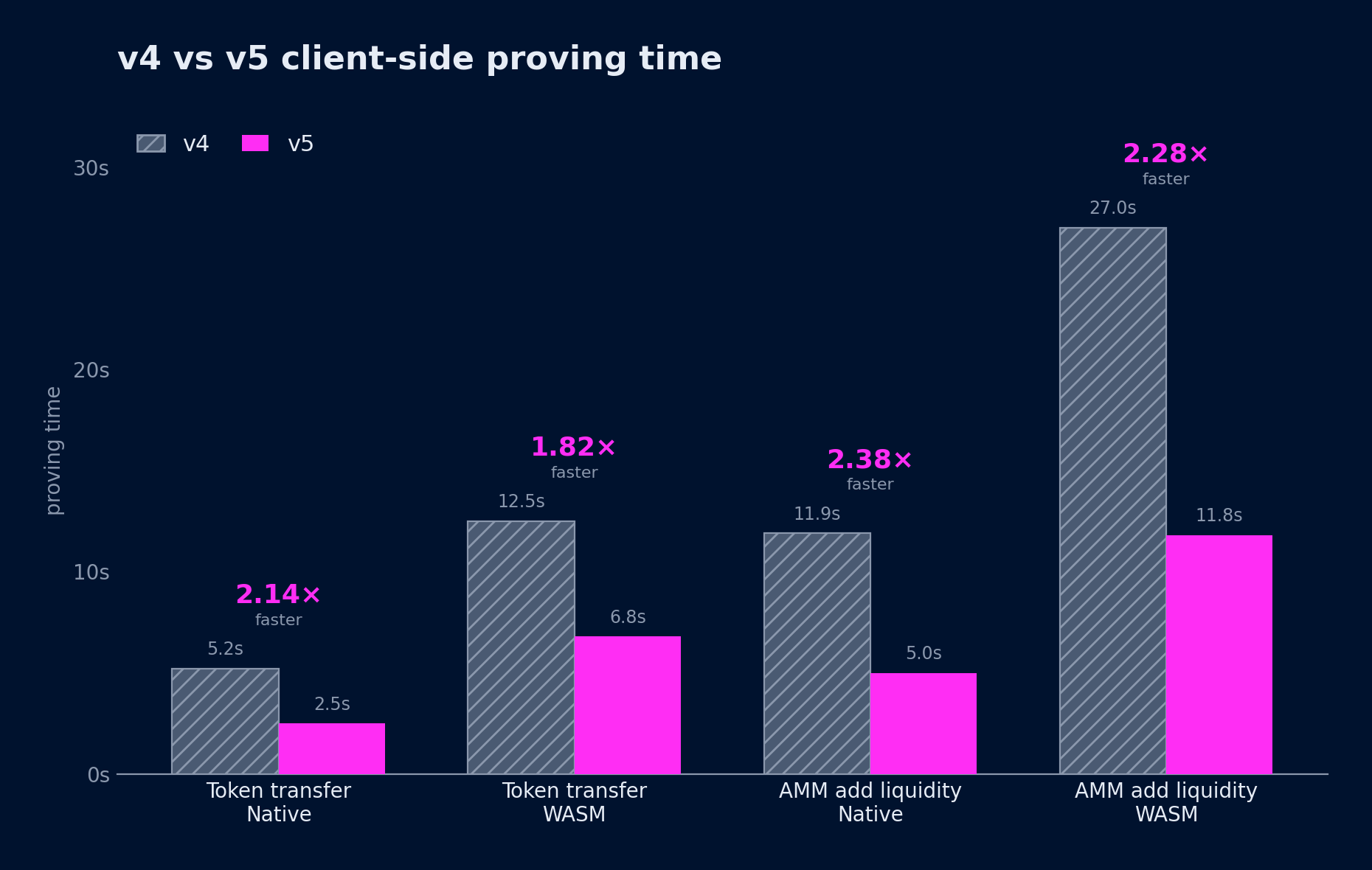
As the audits are still ongoing, we expect to discover vulnerabilities in various components. The fixes will be packaged and distributed with the “v5” release.

If we discover a Critical vulnerability in “v4” in accordance with the following severity matrix, which would require the change of verification keys to fix, we will first alert the portal operators to pause deposits and then post a message on the forum, stating that the rollup has a vulnerability.

Security of the Aztec Virtual Machine (AVM)

Aztec uses a hybrid execution model, handling private and public execution separately — and the security considerations differ between them.

As per the audit table above, it is clear that the Aztec Virtual Machine (AVM) has not yet completed its internal and external audits. This is intentional as all AVM execution is public, which allows it to benefit from a “Training Wheel” — the validator re-execution committee.

Every 72 seconds, a collection of newly proposed Aztec blocks are bundled into a "checkpoint" and submitted to L1. With each proposed checkpoint, a committee of 48 staking validators randomly selected from the entire set of validators (presently 3,959) re-execute all txs of all blocks in the checkpoint, and attest to the resulting state roots. 33 out of 48 attestations are required for the checkpoint proposal to be considered valid. The committee and the eventual zk proof must agree on the resultant state root for a checkpoint to be added to the proven chain. As a result, an attacker must control 33/48 of any given committee to exploit any bug in the AVM.

The only time the re-execution committee is not active is during the escape hatch, where the cost to propose a block is set at a level which attempts to quantify the security of the execution training wheel. For this version of the alpha network, this is set a 332M AZTEC, a figure intended to approximate the economic protection the committee normally provides, equivalent to roughly 19% of the un-staked circulating supply at the time of writing. Since the Aztec Foundation holds a significant portion of that supply, the effective threshold is considerably higher in practice.

Quantifying the cost of committee takeover attacks

A key design assumption is that just-in-time bribery of the sequencer committee is impractical and the only ****realistic attack vector is stake acquisition, not bribery.

Assuming a sequencer set size of 4,000 and a committee that rotates each epoch (~38.4mins) from the full sequencer set using a Fisher-Yates shuffle seeded by L1 RANDAO we can see the probability and amount of stake required in the table below.

To achieve a 99% probability of controlling at least one supermajority within 3 days, an attacker would need to control approximately 55.4% of the validator set - roughly 2,215 sequencers representing 443M AZTEC in stake. Assuming an exploit is successful their stake would likely de-value by 70-80%, resulting in an expected economic loss of approximately 332M AZTEC.

To achieve only a 0.5% probability of controlling at least one supermajority within 6 months, an attacker would need to control approximately 33.88% of the validator set.

What does this means for builders?

The practical effect of this training wheel is that the network can exist while there are known security issues with the AVM, as long as the value an attacker would gain from any potential exploit is less than the cost of acquiring 332M AZTEC.

The training wheel allows security researchers to spend more time on the private execution paths that don’t benefit from the training wheel and for the network to be deployed in an alpha version where security researchers can attempt to find additional AVM exploits.

In concrete terms, the training wheel means the Alpha network can reasonably secure value up to around 332M AZTEC (~$6.5M at the time of writing).

Ecosystem builders should keep the above limits in mind, particularly when designing portal contracts that bridge funds into the network.

Portals are the main way value will be bridged into the alpha network, and as a result are also the main target for any exploits. The design of portals can allow the network to secure far higher value. If a portal secures > 332M AZTEC and allows all of its funds to be taken in one withdrawal without any rate limits, delays or pause functionality then it is a target for an AVM exploit attack.

If a portal implements a maximum withdrawal per user, pause functionality or delays for larger withdrawals it becomes harder for an attacker to steal a large quantum of funds in one go.

Conclusion

The Aztec Alpha code is ready to go. The next step is for someone in the community to submit a governance proposal and for the network to vote on enabling transactions. This is decentralization working as intended.

Once live, Alpha will run at 1 TPS with roughly 6 second block times. Audits are still ongoing across several components, so keep deposits small and only put in what you're comfortable losing.

On the security side, a 48-validator re-execution committee provides the main protection during Alpha, requiring 33/48 consensus on every 72-second checkpoint. Successfully attacking the AVM would require controlling roughly 55% of the validator set at a cost of around 332M AZTEC, putting the practical security ceiling at approximately $6.5M.

Alpha is about growing the ecosystem, expanding the security of the network, and accumulating the one thing no audit can shortcut: time in production. This is the network maturing in exactly the way it was designed to as it progresses toward Beta.

Aztec Network
Aztec Network
4 Mar
xx min read

Aztec Network: Roadmap Update

The Ignition Chain launched late last year, as the first fully decentralized L2 on Ethereum– a huge milestone for decentralized networks. The team has reinvented what true programmable privacy means, building the execution model from the ground up— combining the programmability of Ethereum with the privacy of Zcash in a single execution environment.

Since then, the network has been running with zero downtime with 3,500+ sequencers and 50+ provers across five continents. With the infrastructure now in place, the network is fully in the hands of the community, and the culmination of the past 8 years of work is now converging. 

Major upgrades have landed across four tracks: the execution layer, the proving system, the programming language, Noir, and the decentralization stack. Together, these milestones deliver on Aztec’s original promise, a system where developers can write fully programmable smart contracts with customizable privacy.

The infrastructure is in place. The code is ready. And we’re ready to ship. 

What’s New on the Roadmap?

The Execution Layer

The execution layer delivers on Aztec's core promise: fully programmable, privacy-preserving smart contracts on Ethereum. 

A complete dual state model is now in place–with both private and public state. Private functions execute client-side in the Private Execution Environment (PXE), running directly in the user's browser and generating zero-knowledge proofs locally, so that private data never leaves the original device. Public functions execute on the Aztec Virtual Machine (AVM) on the network side. 

Aztec.js is now live, giving developers a full SDK for managing accounts and interacting with contracts. Native account abstraction has been implemented, meaning every account is a smart contract with customizable authentication rules. Note discovery has been solved through a tagging mechanism, allowing recipients to efficiently query for relevant notes without downloading and decrypting everything on the network.

Contract standards are underway, with the Wonderland team delivering AIP-20 for tokens and AIP-721 for NFTs, along with escrow contracts and logic libraries, providing the production-ready building blocks for the Alpha Network. 

The Proving System

The proving system is what makes Aztec's privacy guarantees real, and it has deep roots.

In 2019, Aztec's cofounder Zac Williamson and Chief Scientist Ariel Gabizon introduced PLONK, which became one of the most widely used proving systems in zero-knowledge cryptography. Since then, Aztec's cryptographic backend, Barretenberg, has evolved through multiple generations, each facilitating faster, lighter, and more efficient proving than the last. The latest innovation, CHONK (Client-side Highly Optimized ploNK), is purpose-built for proving on phones and browsers and is what powers proof generation for the Alpha Network.

CHONK is a major leap forward for the user experience, dramatically reducing the memory and time required to generate proofs on consumer devices. It leverages best-in-class circuit primitives, a HyperNova-style folding scheme for efficiently processing chains of private function calls, and Goblin, a hyper-efficient purpose-built recursion acceleration scheme. The result is that private transactions can be proven on the devices people actually use, not just powerful servers.

This matters because privacy on Aztec means proofs are generated on the user's own device, keeping private data private. If proving is too slow or too resource-intensive, privacy becomes impractical. CHONK makes it practical.

Decentralization

Decentralization is what makes Aztec's privacy guarantees credible. Without it, a central operator could censor transactions, introduce backdoors, or compromise user privacy at will. 

Aztec addressed this by hardcoding decentralized sequencing, proving, and governance directly into the base protocol. The Ignition Chain has proven the stability of this consensus layer, maintaining zero downtime with over 3,500 sequencers and 50+ provers running across five continents. Aztec Labs and the Aztec Foundation run no sequencers and do not participate in governance.

Noir

Noir 1.0 is nearing completion, bringing a stable, production-grade language within reach. Aztec's own protocol circuits have been entirely rewritten in Noir, meaning the language is already battle-tested at the deepest layer of the stack. 

Internal and external audits of the compiler and toolchain are progressing in parallel, and security tooling including fuzzers and bytecode parsers is nearly finished. A stable, audited language means application teams can build on Alpha with confidence that the foundation beneath them won't shift.

What Comes Next

The code for Alpha Network, a functionally complete and raw version of the network, is ready.

The Alpha Network brings fully programmable, privacy-preserving smart contracts to Ethereum for the first time. It's the culmination of years of parallel work across the four tracks in the Aztec Roadmap. Together, they enable efficient client-side proofs that power customizable smart contracts, letting users choose exactly what stays private and what goes public. 

No other project in the space is close to shipping this. 

The code is written. The network is running. All the pieces are in place. The governance proposal is now live on the forum and open for discussion. Read through it, ask questions, poke holes, and help shape the path forward. 

Once the community is aligned, the proposal moves to a vote. This is how a decentralized network upgrades. Not by a team pushing a button, but by the people running it.

Programmable privacy will unlock a renaissance in onchain adoption. Real-world applications are coming and institutions are paying attention. Alpha represents the culmination of eight years of intense work to deliver privacy on Ethereum. 

Now it needs to be battle-tested in the wild. 

View the updated product roadmap here and join us on Thursday, March 5th, at 3 pm UTC on X to hear more about the most recent updates to our product roadmap.

Aztec Network
Aztec Network
22 Jan
xx min read

The $AZTEC TGE Vote: What You Need to Know

The TL:DR:

  • The $AZTEC token sale, conducted entirely onchain concluded on December 6, 2025, with ~50% of the capital committed coming from the community. 
  • Immediately following the sale, tokens could be withdrawn from the sale website into personal Token Vault smart contracts on the Ethereum mainnet.
  • The proposal for TGE (Token Generation Event) is now live, and sequencers can start signaling to bring the proposal to a vote to unlock these tokens and make them tradeable. 
  • Anyone who participated in the token sale can participate in the TGE vote. 

The $AZTEC token sale was the first of its kind, conducted entirely onchain with ~50% of the capital committed coming from the community. The sale was conducted completely onchain to ensure that you have control over your tokens from day one. As we approach the TGE vote, all token sale participants will be able to vote to unlock their tokens and make them tradable. 

What Is This Vote About?

Immediately following the $AZTEC token sale, tokens could be withdrawn from the sale website into your personal Token Vault smart contracts on the Ethereum mainnet. Right now, token holders are not able to transfer or trade these tokens. 

The TGE is a governance vote that decides when to unlock these tokens. If the vote passes, three things happen:

  1. Tokens purchased in the token sale become fully transferable 
  2. Trading goes live for the Uniswap v4 pool
  3. Block rewards become transferable for sequencers

This decision is entirely in the hands of $AZTEC token holders. The Aztec Labs and Aztec Foundation teams, and investors cannot participate in staking or governance for 12 months, which includes the TGE governance proposal. Team and investor tokens will also remain locked for 1 year and then slowly unlock over the next 2 years. 

The proposal for TGE is now live, and sequencers are already signaling to bring the proposal to a vote. Once enough sequencers have signaled, anyone who participated in the token sale will be able to connect their Token Vault contract to the governance dashboard to vote. Note, this will require you to stake/unstake and follow the regular 15-day process to withdraw tokens.

If the vote passes, TGE can go live as early as February 12, 2026, at 7am UTC. TGE can be executed by the first person to call the execute function to execute the proposal after the time above. 

How Do I Participate?

If you participated in the token sale, you don't have to do anything if you prefer not to vote. If the vote passes, your tokens will become available to trade at TGE. If you want to vote, the process happens in two phases:

Phase 1: Sequencer Signaling

Sequencers kick things off by signaling their support. Once 600 out of 1,000 sequencers signal, the proposal moves to a community vote.

Phase 2: Community Voting

After sequencers create the proposal, all Token Vault holders can vote using the voting governance dashboard. Please note that anyone who wants to vote must stake their tokens, locking their tokens for at least 15 days to ensure the proposal can be executed before the voter exits. Once signaling is complete, the timeline is as follows:

  • Days 1–3: Waiting period 
  • Days 4–10: Voting period (7 days to cast your vote)
  • Days 11–17: Execution delay
  • Days 18–24: Grace period to execute the proposal

Vote Requirements:

  • At least 100M tokens must participate in the vote. This is less than 10% of the tokens sold in the token sale.  
  • 66% of votes must be in favor for the vote to pass.

Frequently Asked Questions

Do I need to participate in the vote? No. If you don't vote, your tokens will become available for trading when TGE goes live. 

Can I vote if I have less than 200,000 tokens? Yes! Anyone who participated in the token sale can participate in the TGE vote. You'll need to connect your wallet to the governance dashboard to vote. 

Is there a withdrawal period for my tokens after I vote? Yes. If you participate in the vote, you will need to withdraw your tokens after voting. Voters can initiate a withdrawal of their tokens immediately after voting, but require a standard 15-day withdrawal period to ensure the vote is executed before voters can exit.

If I have over 200,000 tokens is additional action required to make my tokens tradable after TGE? Yes. If you purchased over 200,000 $AZTEC tokens, you will need to stake your tokens before they become tradable. 

What if the vote fails? A new proposal can be submitted. Your tokens remain locked until a successful vote is completed, or the fallback date of November 13, 2026, whichever happens first.

I'm a Genesis sequencer. Does this apply to me? Genesis sequencer tokens cannot be unlocked early. You must wait until November 13, 2026, to withdraw. However, you can still influence the vote by signaling, earn block rewards, and benefit from trading being enabled.

Where to Learn More

This overview covers the essentials, but the full technical proposal includes contract addresses, code details, and step-by-step instructions for sequencers and advanced users. 

Read the complete proposal on the Aztec Forum and join us for the Privacy Rabbit Hole on Discord happening this Thursday, January 22, 2026, at 15:00 UTC. 

Follow Aztec on X to stay up to date on the latest developments.