
Menu

Dark Forest Aztec, built by DFArchon, ports the classic zero-knowledge strategy game to Aztec, where your home coordinates and fleet movements live as private notes that stay hidden even as the universe runs onchain. Round One is live as an alpha: explore a dark map, capture planets, hunt artifacts, and try to find your rivals before they find you.
Dark Forest is a real-time strategy game played across a procedurally generated universe where most of the map is hidden. You cannot see rival players, their planets, or their fleets. You only know what you have explored. Everyone shares one universe, and nobody has the full picture.
In most onchain games, every position and every move is public, because the chain is public. Dark Forest used zero-knowledge proofs to break that assumption: players prove their moves are valid without revealing where those moves came from. The result is a game of hidden information running on a public network.
Dark Forest Aztec ports the original Dark Forest 0.6 to Aztec. It keeps the gameplay from the original and rebuilds the privacy layer on Aztec's programmable privacy.
A note before diving in: this is early, experimental software on Aztec Alpha V5. Treat it as an alpha and play accordingly.
You start on a single home planet with almost the entire map dark. To find anything you mine the universe, running a client that explores coordinates and reveals what sits there: unclaimed planets, resources, and eventually the edges of other players' territory.
You are never handed a view of the board. You earn it one region at a time, and everyone else works under the same fog.
Your home coordinates and your fleet movements are private state, expressed as first-class private notes on Aztec. Your location and where you send energy stay hidden, enforced in the contracts by zero-knowledge cryptography.
What sits onchain is a set of cryptographic commitments. Instead of storing every planet's full details in the open, the contracts store Poseidon2 hashes of entity state. When you make a move, your client supplies the full state, the contract checks it against the stored hash, applies the change under zero-knowledge constraints, and writes a new hash back. Full game state lives offchain and gets rebuilt from public logs by an indexer, which is what renders your map without exposing every player's position.
So you can prove you made a legal move from a planet you own without revealing where that planet is. Aztec applies the same principle to private payments and private contracts.
Four actions carry the game.
Explore. Your explorer sits in the bottom left. Set it running and it uncovers the map around you, surfacing planets, resources, and other players.
Send energy. Most planets produce energy. Click and drag from a planet you own toward a target to capture or weaken it.
Route silver. Asteroid fields produce silver. Move it to your planets and spend it on upgrades, or send it to a Spacetime Rip to convert it into score.
Hunt artifacts. Some planets hold artifacts. Your Gear ship discovers them. Once harvested, you deposit them on planets to boost stats.
Four stats drive most decisions.
Energy is the core resource. Planets generate it over time up to a capacity, and you spend it on everything: claiming planets, reinforcing your own, attacking rivals. Two details matter. Moves are taxed, so a flat percentage of a planet's total capacity burns every time you send energy, which discourages small frequent moves. And energy decays over distance, so send it too far and almost nothing arrives. A common rule of thumb is to let a planet fill to about 75%, then send it down to about 25%.
Defense reduces the damage incoming energy does when it lands. Higher-level planets often have lower defense, but they hold much more energy, so they still take more to capture. Defense matters most on front lines.
Range sets how far a planet can send energy. It governs how fast you expand and how efficiently you move energy inside your own empire, since shorter relative distances mean less decay. Good range also lets you strike deep into an opponent's territory.
Speed sets how quickly a move arrives. Usually secondary, though a fast strike can land before a rival reacts, and some playstyles reward capturing many nearby planets quickly.
Planets can also be upgraded with silver and enhanced with artifacts. Space types carry different multipliers, from mild Nebula to punishing Dead Space, so where a planet sits changes how it plays.
There is a scoreboard, and territory alone does not win it. This round scores two activities: discovering artifacts with your Gear ship, and withdrawing silver through Spacetime Rips.
Point values from the in-game help page:
Silver accrues one point at a time. A single Mythic artifact is worth twenty million of them, so artifact hunting decides rounds and silver withdrawal sets your floor.
Silver has two competing uses. Spend it on upgrades and your planets get stronger, extending range and hardening defense. Withdraw it through a Spacetime Rip and it becomes scored points, but it is gone. Every unit is a choice between building the empire and banking points.
Upgrades tend to win early, since a stronger empire reaches more asteroid fields and finds more artifacts. Late in a round that calculation flips, because a planet you never use is worth less than points already scored.
Artifacts do both jobs at once. They score on discovery, and once deposited they boost a planet's stats, which makes the next expedition easier.
Nothing happens until you find something to act on. Your explorer turns dark space into planets you can capture, asteroid fields you can mine, and artifact-bearing planets you can raid. Sitting still means no new energy, no silver, no score.
Exploring also buys information. The map you have uncovered is an advantage nobody else holds. Knowing where high-level planets sit, which asteroid fields are unclaimed, and where space types shift lets you plan further ahead than someone still working through their starting region.
You find other players as a byproduct. There is no player list. You explore outward until your revealed region touches territory someone already owns: a planet in another player's colors, sitting where you were about to expand. Their home coordinates stay private, so you learn something narrow. Someone is here, roughly this direction, holding this much. You infer the rest, and you have no way of knowing whether they found you first.
You have three broad options.
Stay quiet and keep growing. Nothing forces you to engage. Keep exploring elsewhere, keep routing silver, keep upgrading. Your positions stay private, so silence costs you only time, which is what you want if they are stronger. The risk is that they are doing the same thing faster.
Fortify the border. If the contact sits somewhere you cannot lose, spend energy hardening the planets facing them. Defense is worth most where an attack will actually land. This keeps the option to fight without committing to one.
Attack. Send enough energy to overwhelm the target's defense and the planet becomes yours, along with its production and its position as a staging post. Higher-level planets are the prize and take proportionally more to crack.
Attacking costs more than energy. A move that lands tells your rival where you strike from, and that you are close enough to be worth answering. Retaliation can then come from directions you have not explored, launched from planets you cannot see.
Everyone plays one shared universe in real time. No turns, no lobbies. Energy regenerates whether you are watching or not, moves stay in flight while you sleep, and rivals expand while you are away from the screen.
Most strategy games let you watch a threat approach. Here you tend to see the consequences: a planet you owned this morning in someone else's colors, an incoming move you notice once it is already close.
That produces a particular kind of paranoia. You are trying to find everyone else while avoiding being found, and every expansion is a strategic bet that the space ahead is empty.
Information becomes tradeable, because it is scarce. Players compare notes, warn each other about aggressive neighbors, and agree who expands where, then break those agreements when the scoreboard makes it worth breaking.
A fully onchain game where players cannot see each other's positions is hard to build, and building it well says something about the platform underneath.
Hidden state, private notes, and client-side proving are the same building blocks behind private applications across Aztec. Dark Forest is a way to watch them work.
Dark Forest Aztec is playable now as an alpha. Expect a learning curve; the original was famous for it. DFArchon maintains onboarding material and a community for new players. Round One is live. The universe is dark, and everyone else is out there somewhere. Go find them, quietly.
Many thanks to Remi Gai, Hannes Huitula, Giacomo Corrias, Avishay Yanai, Santiago Palladino, ais, ji xueqian, Brecht Devos, Maciej Kalka, Chris Bender, Alex, Lukas Helminger, Dominik Schmid, 0xCrayon, Zac Williamson for inputs, discussions, and reviews.
Contents
Prerequisites:
Buzzwords are dangerous. They amuse and fascinate as cutting-edge, innovative, mesmerizing markers of new ideas and emerging mindsets. Even better if they are abbreviations, insider shorthand we can use to make ourselves look smarter and more progressive:

Using buzzwords can obfuscate the real scope and technical possibilities of technology. Furthermore, buzzwords might act as a gatekeeper making simple things look complex, or on the contrary, making complex things look simple (according to the Dunning-Kruger effect).
In this article, we will briefly review several suggested privacy-related abbreviations, their strong points, and their constraints. And after that, we’ll think about whether someone will benefit from combining them or not. We’ll look at different configurations and combinations.
Disclaimer: It’s not fair to compare the technologies we’re discussing since it won’t be an apples-to-apples comparison. The goal is to briefly describe each of them, highlighting their strong and weak points. Understanding this, we will be able to make some suggestions about combining these technologies in a meaningful way.
POV: a new dev enters the space.
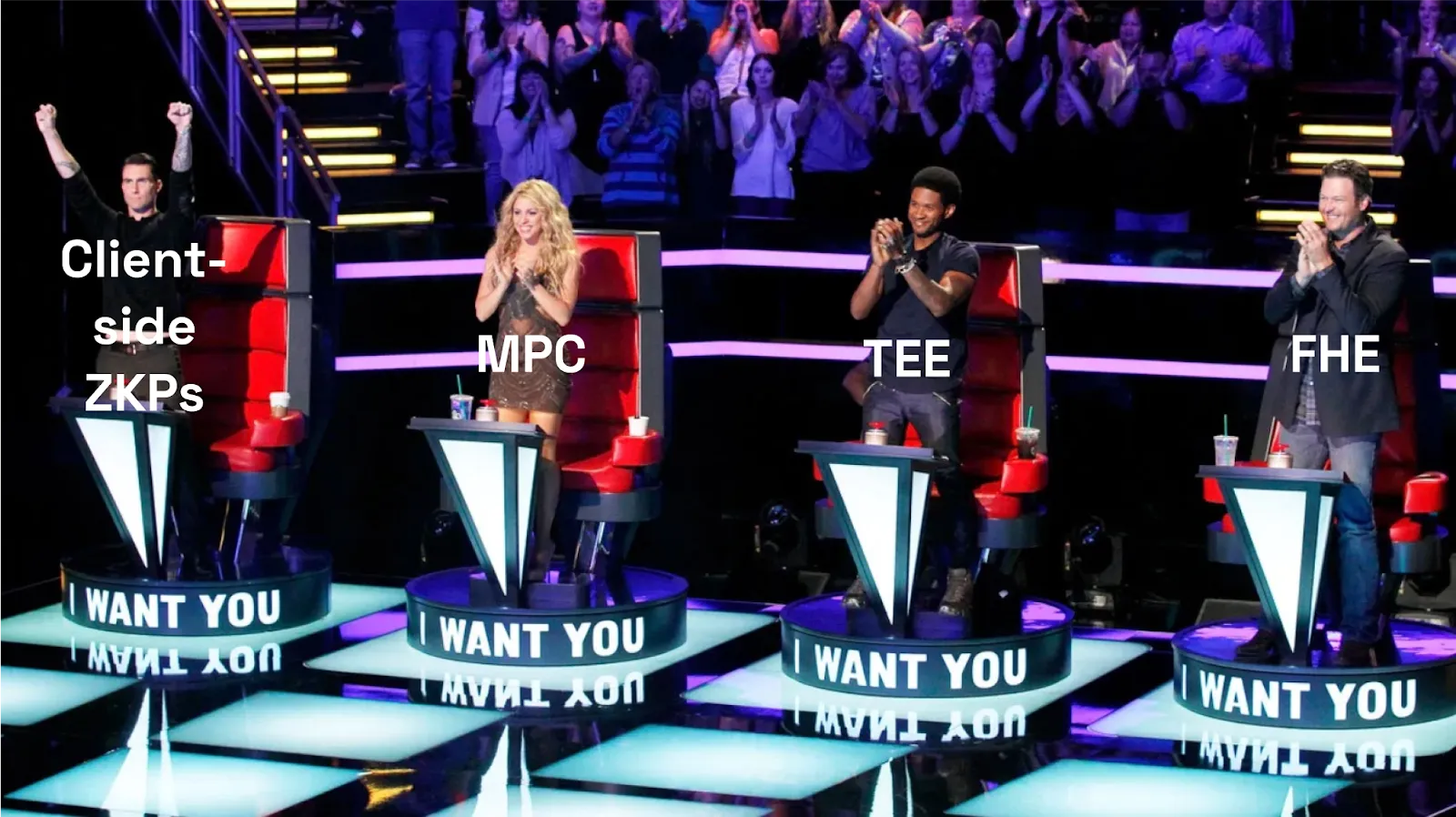
Client-side ZKP is a specific category of zero-knowledge proofs (started in 1989). The exploration of general ZKPs in great depth is out-of-scope for this piece. If you're curious to learn about it, check this article.
Essentially, zero-knowledge protocol allows one party (prover) to prove to another party (verifier) that some given statement is true, while avoiding conveying any information beyond the mere fact of that statement's truth.
Client-side ZKPs enable generation of the proof on a user's device for the sake of privacy. A user makes some arbitrary computations and generates proof that whatever they computed was computed correctly. Then, this proof can be verified and utilized by external parties.
One of the most widely known use cases of the client-side ZKPs is a privacy preserving L2 on Ethereum where, thanks to client-side data processing, some functions and values in a smart-contract can be executed privately, while the rest are executed publicly. In this case, the client-side ZKP is generated by the user executing the transaction, then verified by the network sequencer.
However, client-side proof generation is not limited to Ethereum L2s, nor to blockchain at all. Whenever there are two or more parties who want to compute something privately and then verify each other’s computation and utilize their results for some public protocols, client-side ZKPs will be a good fit.
Check this article for more details on how client-side ZKPs work.
The main concern today about on-chain privacy by means of client-side proof generation is the lack of a private shared state. Potentially, it can be mitigated with an MPC committee (which we will cover in later sections).
Speaking of limitations of client-side proving, one should consider:
What can we do with client-side ZKPs today:
Whom to follow for client-side ZKPs updates: Aztec Labs, Miden, Aleo.
Disclaimer: in this section, we discuss general-purpose MPC (i.e. allowing computations on arbitrary functions). There are also a bunch of specialized MPC protocols optimized for various use cases (i.e. designing customized functions) but those are out-of-scope for this article.
MPC enables a set of parties to interact and compute a joint function of their private inputs while revealing nothing but the output: f(input_1, input_2, …, input_n) → output.
For example, parties can be servers that hold a distributed database system and the function can be the database update. Or parties can be several people jointly managing a private key from an Ethereum account and the function can be a transaction signing mechanism.
One issue of concern with MPCs is that one or more parties participating in the protocol can be malicious. They can try to:
Hence in the context of MPC security, one wants to ensure that:
To think about MPC security in an exhaustive way, we should consider three perspectives:
Rather than requiring all parties in the computation to remain honest, MPC tolerates different levels of corruption depending on the underlying assumptions. Some models remain secure if less than 1/3 of parties are corrupt, some if less than 1/2 are corrupt, and some even have security guarantees even in the case that more than half of the parties are corrupt. For details, formal definition, and proof of MPC protocol security, check this paper.
There are three main corruption strategies:
Each of these assumptions will assume a different security model.
Two definitions of malicious behavior are:
When it comes to the definition of privacy, MPC guarantees that the computation process itself doesn’t reveal any information. However, it doesn’t guarantee that the output won’t reveal any information. For an extreme example, consider two people computing the average of their salaries. While it’s true that nothing but the average will be output, when each participant knows their own salary amount and the average of both salaries, they can derive the exact salary of the other person.
That is to say, while the core “value proposition” of MPC seems to be very attractive for a wide range of real world use cases, a whole bunch of nuances should be taken into account before it will actually provide a high enough security level. (It's important to clarify the problem statement and decide whether it is the right tool for this particular task.)
What can be done with MPC protocols today:
When we think about MPC performance, we should consider the following parameters: number of participating parties, witness size of each party, and function complexity.
When it comes to using MPC in blockchain context, it’s important to consider message complexity, computational complexity, and such properties as public verifiability and abort identifiability (i.e. if a malicious party causes the protocol to prematurely halt, then they can be detected). For message distribution, the protocol relies either on P2P channels between each two parties (requires a large bandwidth) or broadcasting. Another concern arises around the permissionless nature of blockchain since MPC protocols often operate over permissioned sets of nodes.
Taking into account all that, it’s clear that MPC is a very nuanced technology on its own. And it becomes even more nuanced when combined with other technologies. Adding MPC to a specific blockchain protocol often requires designing a custom MPC protocol that will fit. And that design process often requires a room full of MPC PhDs who can not only design but also prove its security.
Whom to follow for MPC updates: dWallet Labs, TACEO, Fireblocks, Cursive, PSE, Fairblock, Soda Labs, Silence Laboratories, Nillion.
TEE stands for Trusted Execution Environment. TEE is an area on the main processor of a device that is separated from the system's main operating system (OS). It ensures data is stored, processed, and protected in a separate environment. One of the most widely known units of TEE (and one we often mention when discussing blockchain) is Software Guard Extensions (SGX) made by Intel.
SGX can be considered a type of private execution. For example, if a smart contract is run inside SGX, it’s executed privately.
SGX creates a non-addressable memory region of code and data (separated from RAM), and encrypts both at a hardware level.
How SGX works:
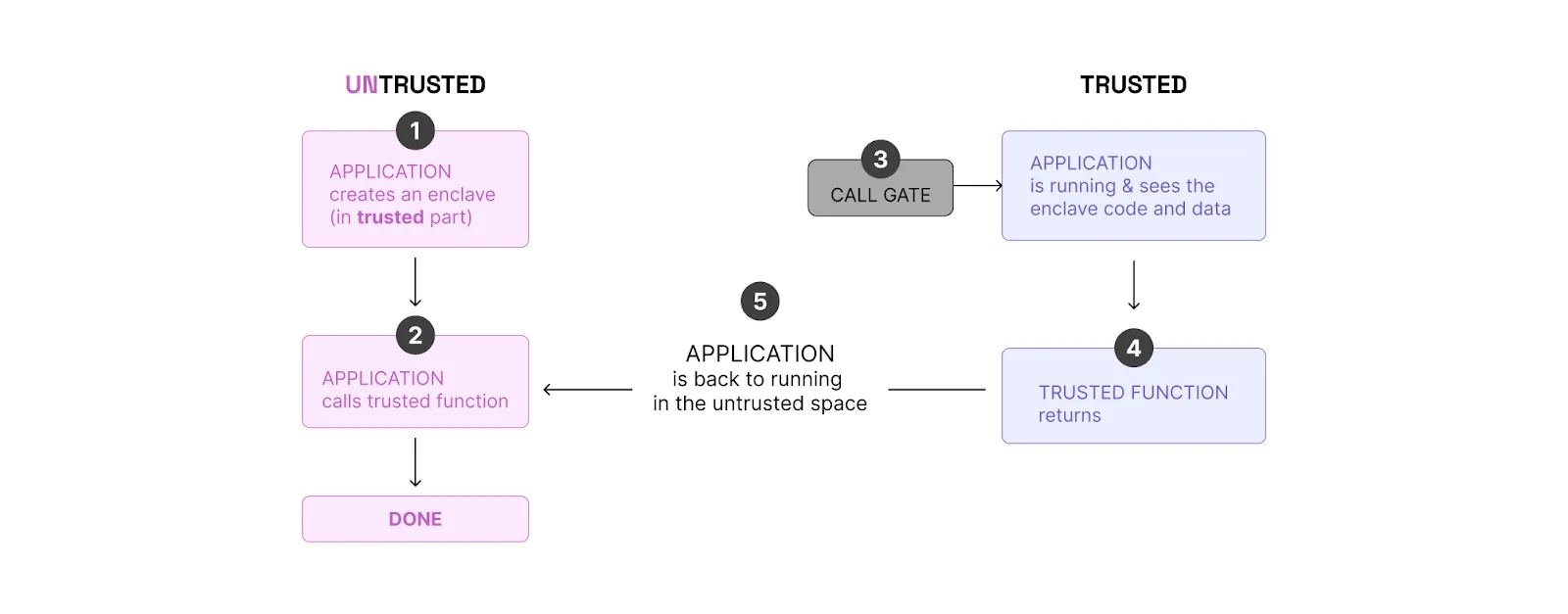
It’s worth noting that there is a key pair: a secret key and a public key. The secret key is generated inside of the enclave and never leaves it. The public key is available to anyone: Users can encrypt a message using a public key so only the enclave can decrypt it.
An SGX feature often utilized in the blockchain context is attestations. Attestation is the process of demonstrating that a software executable has been properly instantiated on a platform. Remote Attestation allows a remote party to be confident that the intended software is securely running within an enclave on a fully patched, Intel SGX-enabled platform.
Core SGX concerns:
Speaking of SGX cost, the proof generation cost can be considered free of charge. Though if one wants to use remote attestations, the initial one-time cost (once per SGX prover) for it is in the order of 1M gas (to make sure the code in SGX is running in the expected way).
Onchain verification cost equals to verifying an ECDSA signature (~5k gas while for ZK signature verification will cost ~300k gas).
When it comes to execution time, there is effectively no overhead. For example, for proving a zk-rollup block, it will be around 100ms.
Where SGX is utilized in blockchain today:
Whom to follow for TEE updates: Secret Network, Flashbots, Andrew Miller, Oasis, Phala, Marlin, Automata, TEN.
FHE enables encrypted data processing (i.e. computation on encrypted data).
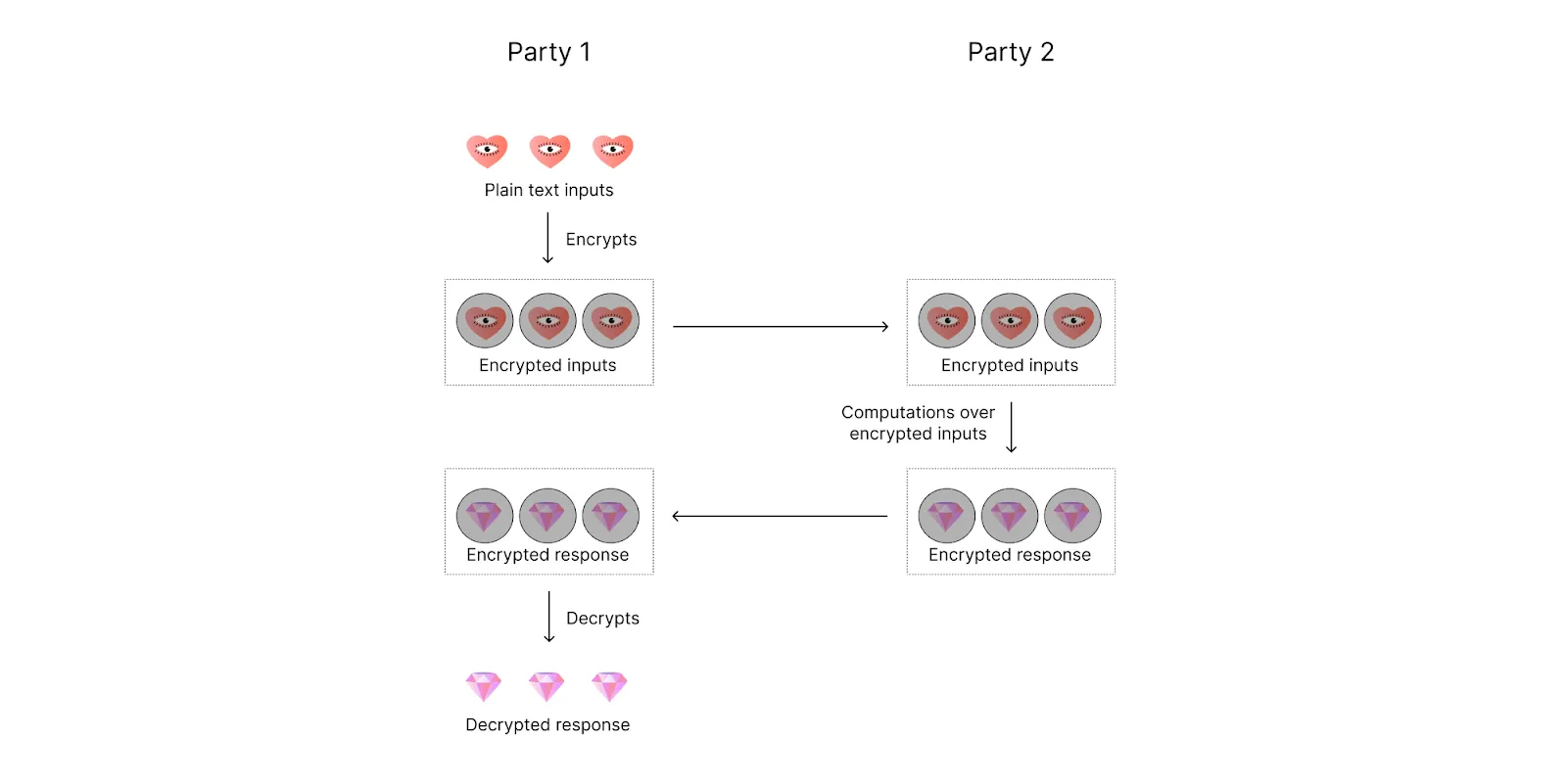
The idea of FHE was proposed in 1978 by Rivest, Adleman, and Dertouzos. “Fully” means that both addition and multiplication can be performed on encrypted data. Let m be some plain text and E(m) be an encrypted text (ciphertext). Then additive homomorphism is E(m_1 + m_2) = E(m_1) + E(m_2) and multiplicative homomorphism is E(m_1 * m_2) = E(m_1) * E(m_2).
Additive Homomorphic Encryption was used for a while, but Multiplicative Homomorphic Encryption was still an issue. In 2009, Craig Gentry came up with the idea to use ideal lattices to tackle this problem. That made it possible to do both addition and multiplication, although it also made growing noise an issue.
How FHE works:
Plain text is encoded into ciphertext. Ciphertext consists of encrypted data and some noise.
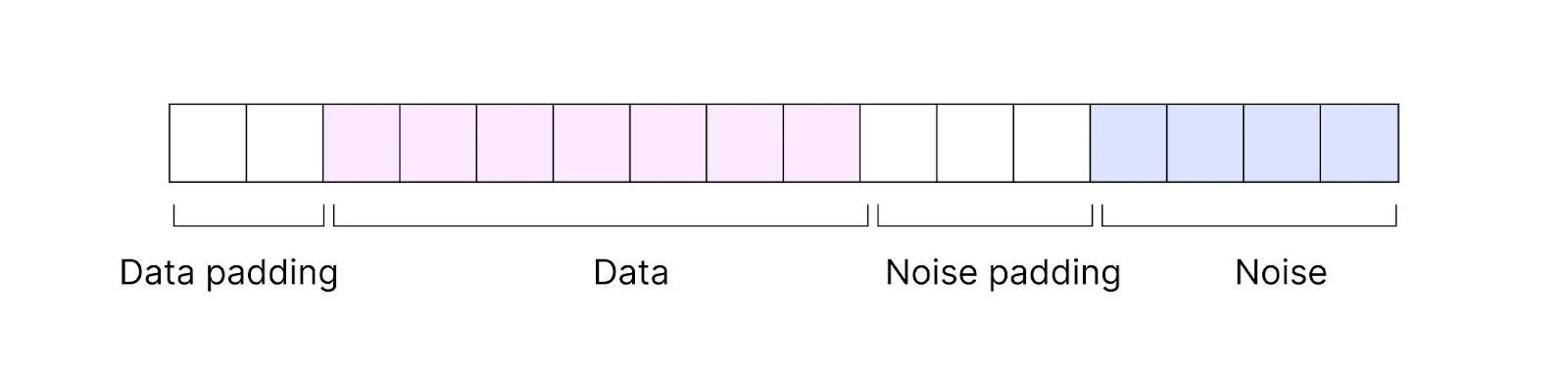
That means when computations are done on ciphertext, they are done not purely on data but on data together with added noise. With each performed operation, the noise increases. After several operations, it starts overflowing on the bits of actual data, which might lead to incorrect results.
A number of tricks were proposed later on to handle the noise and make the FHE work more reliably. One of the most well-known tricks was bootstrapping, a special operation that reset the noise to its nominal level. However, bootstrapping is slow and costly (both in terms of memory consumption and computational cost).
Researchers rolled out even more workarounds to make bootstrapping efficient and took FHE several more steps forward. Further details are out-of-scope for this article, but if you’re interested in FHE history, check out this talk by mathematician Zvika Brakerski.
Core FHE concerns:
Compared to computations on plain text, the best per-operation overhead available today is polylogarithmic [GHS12b] where if n is the input size, by polylogarithmic we mean O(log^k(n)), k is a constant. For communication overhead, it’s reasonable if doing batching and unbatching of a number of ciphertexts but not reasonable otherwise.
For evaluation keys, key size is huge (larger than ciphertexts that are large as well). The evaluation key size is around 160,000,000 bits. Furthermore, one needs to permanently compute on these keys. Whenever homomorphic evaluation is done, you’ll need to access the evaluation key, bring it into the CPU (a regular data bus in a regular processor will be unable to bring it), and make computations on it.
If you want to do something beyond addition and multiplication—a branch operation, for example—you have to break down this operation into a sequence of additions and multiplications. That’s pretty expensive. Imagine you have an encrypted database and an encrypted data chunk, and you want to insert this chunk into a specific position in the database. If you’re representing this operation as a circuit, the circuit will be as large as the whole database.
In the future, FHE performance is expected to be optimized both on the FHE side (new tricks discovered) and hardware side (acceleration and ASIC design). This promises to allow for more complex smart contract logics as well as more computation-intensive use cases such as AI/ML. A number of companies are working on designing and building FHE-specific FPGAs (e.g. Belfort).

“Misuse of FHE can lead to security faults.”
What can be done with FHE today:
Note: In all of these examples, we are talking about plain FHE, without any MPC or ZK superstructures handling the core FHE issues.
Whom to follow for FHE updates: Zama, Sunscreen, Zvika Brakerski, Inco, FHE Onchain.
As we can see from the technology overview, these technologies are not exactly interchangeable. That said, they can complement each other. Now let’s think. Which ones should be combined, and for what reason?

Disclaimer: Each of the technologies we are talking about is pretty complex on its own. The combinations of them we discuss below are, to a large extent, theoretical and hypothetical. However, there are a number of teams working on combining them at the time of writing (both research and implementation).
In this section, we mostly describe two papers as examples and don’t claim to be exhaustive.
One of the possible applications of ZK-MPC is a collaborative zk-snark. This would allow users to jointly generate a proof over the witnesses of multiple, mutually distrusting parties. The proof generation algorithm is run as an MPC among N provers where function f is the circuit representation of a zk-SNARK proof generator.

Collaborative zk-SNARKs also offer an efficient construction for a cryptographic primitive called a publicly auditable MPC (PA-MPC). This is an MPC that also produces a proof the public can use to verify that the computation was performed correctly with respect to commitments to the inputs.
ZK-MPC introduces the notion of MPC-friendly zk-SNARKs. That is to say, not just any MPC protocol or any zk-SNARK can feasibly be combined into ZK-MPC. This is because MPC protocols and zk-SNARK provers are each thousands of times slower than their underlying functionality, and their combination is likely to be millions of times slower.
For those familiar with elliptic curve cryptography, let’s think for a moment about why is ZK-MPC tricky:
If doing it naively, you could decompose an elliptic curve operation into operations over the curve’s base field; then there is an obvious way to perform them in an MPC. But curve additions require tens of field operations, and scalar products require thousands.
The core tricks suggested for use include:
Essentially, ZK-MPC in general and collaborative zk-SNARKs in particular are not just about combining ZK and MPC. Getting these two technologies to work in concert is complex and requires a huge chunk of research.
According to one of the papers on this topic, for collaborative zk-SNARKs, over a 3Gb/s link, security against a malicious minority of provers can be achieved with approximately the same runtime as a single prover. Security against N−1 malicious provers requires only a 2x slowdown. Both TACEO and Renegade (launched mainnet on 04.09.24) teams are currently working on implementing this paper.
Another application of ZK-MPC is delegated zk-SNARKs. This enables a prover (called a delegator) to outsource proof generation to a set of workers for the sake of efficiency and engaging less powerful machines. This means that if at least one worker does not collude with other workers, no private information will be revealed to any worker.
This approach introduces a custom MPC protocol. The issues with using existing protocols are:
One of the papers on this topic suggests using SPDZ as a starting point and modifying it. A naive approach would be to use the zk-SNARK to succinctly check that the MPC execution is correct by having the delegator verify the zk-SNARK produced by the workers. However, this wouldn’t be knowledge-sound because the adversary can attempt to malleate its shares of the delegator’s valid witness (w) to produce a proof of a related statement. Even if the resulting proof is invalid, it can leak information about w. However, we can use the succinct verification properties of the underlying components of the zk-SNARK, the PIOP (Polynomial Interactive Oracle Proof) and the PC (Polynomial Commitment) scheme.
Other modifications correspond to optimizations, such as optimizing the number of multiplications in, and the multiplicative depth of circuits for these operations; and introducing a consistency checker for the PIOP to enable the delegator to efficiently check that the polynomials computed during the MPC execution are consistent with those that an honest prover would have computed.
According to one of the papers on this topic, “... when compared to local proving, using our protocols to delegate proof generation from a recent smartphone (a) reduces end-to-end latency by up to 26x, (b) lowers the delegator’s active computation time by up to 1447x, and (c) enables proving up to 256x larger instances.”
For a privacy-preserving blockchain, ZK-MPC can be utilized for collaboratively proving the correctness of state transition, where each party participating in generating proof has only a part of the witness. Hence the proof can be generated while no single party is aware of what they are proving. For this purpose, there should be an on-chain committee that will generate collaborative zk-SNARKs. It’s worth noting that even though we are using the term “committee,” this is still a purely cryptographic solution.
Whom to follow for ZK-MPC updates: TACEO, Renegade.
There are a number of ways to combine FHE and MPC and each serves a different goal. For example, MPC-FHE can be employed to tackle the issue “Who holds the decryption key?” This is relevant for an FHE network or an FHE DEX.
One approach is to have several parties jointly generate a global single FHE key. Another approach is multi-key FHE: the parties take their existing individual (multiple) FHE key pairs and combine them in order to perform an MPC-like computation.
As a concrete example, for an FHE network, the state decryption key can be distributed to multiple parties, with each party receiving one piece. While decrypting the state, each party does a partial decryption. The partial decryptions are aggregated to yield the full decrypted value. The security of this approach holds under an assumption of 2/3 honest validators.
The next question is, “How should other network participants (e.g. network nodes) access the decrypted data?” It can’t be done using a regular oracle (i.e. each node in the oracle consensus network must obtain the same result given the same input) since that would break privacy.
One possible solution is a two-round consensus mechanism (though this relies on social consensus, not pure cryptography). The first round is the consensus on what should be decrypted. That is, the oracle waits until most validators send it the same request for decryption. Next, the round of decryption. Then, the validators update the chain state and append the block to the blockchain.
Whom to follow for MPC-FHE updates: Gauss Labs (utilized by Cursive team).
MPC-FHE has two issues that can potentially be mitigated with ZK:
Without introducing ZK, both issues listed above make one fragment of private computations unverifiable. (That doesn’t quite work for most blockchain use cases).
Where are we today with ZK-FHE?
According to Zama, proof of one correct bootstrapping operation can be generated in 21 minutes on a huge AWS machine (c6i.metal). And that’s pretty much it. Hopefully, in the upcoming years we will see more research on ZK-FHE.
Whom to follow for ZK-FHE updates: Zama, Pado Labs.
One issue with MPC-FHE we haven’t mentioned so far has to do with knowing for sure that an encrypted piece of information supplied by a specific party was encrypted by that same party. What if party A took a piece of information encrypted by party B and supplied it as its own input?
To handle this issue, each party can generate a ZKP that they know the plaintext they are sending in an encrypted way. Adding this ZK tweak with two ZK tweaks from the previous section (ZK-FHE), we will get verifiable privacy with ZK-MPC-FHE.
Whom to follow for ZK-MPC-FHE updates: Pado Labs, Greco.

TL;DR: In general, when it comes to using any new technology, it makes sense to run it inside TEE since the attack vector with TEE is orders of magnitude smaller than on a regular computer:
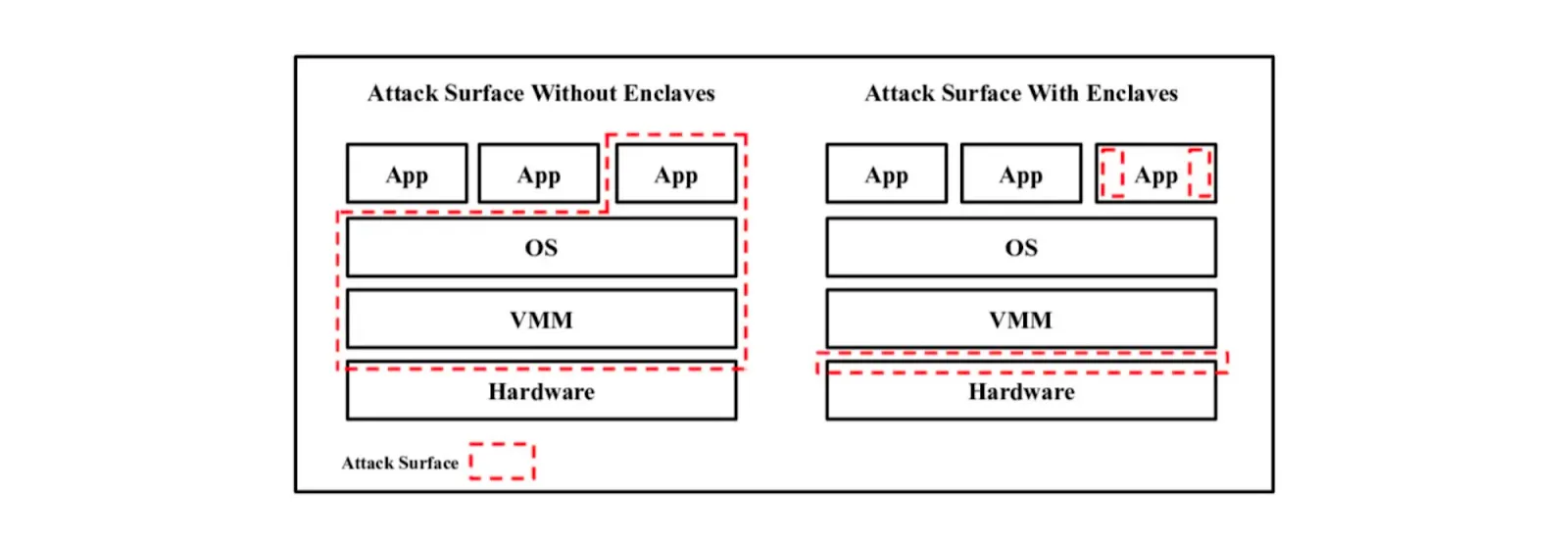
Using TEE as an execution environment (to construct ZK proofs and participate in MPC and FHE protocols) improves security at almost zero cost. In this case, secrets stay in TEE only within active computation and then they are discarded. However, using TEE for storing secrets is a bad idea. Trusting TEEs for a month is bad, trusting TEEs for 30 seconds is probably fine.
Another approach is to use TEE as a “training wheels,” for example, for multi-prover where computations are run both in a ZK circuit and TEE, and to be considered valid they should agree on the same result.
Whom to follow for TEE-{something} updates: Safeheron (TEE-MPC).
It might feel tempting to take all of the technologies we’ve mentioned and craft a zk-mpc-fhe-tee machine that will combine all their strengths:

However, the mere fact that we can combine technologies doesn’t mean we should combine them. We can combine ZK-MPC-FHE-TEE and then add quantum computers, restaking, and AI gummy bears on top. But for what reason?

Each of these technologies adds its own overhead to the initial computations. 10 years ago, the blockchain, ZK, and FHE communities were mostly interested in proof of concept. But today, when it comes to blockchain applications, we are mostly interested in performance. That is to say we are curious to know if we combine a row of fancy technologies, what product/application could we build on it?
Let’s structure everything we discussed in a table:
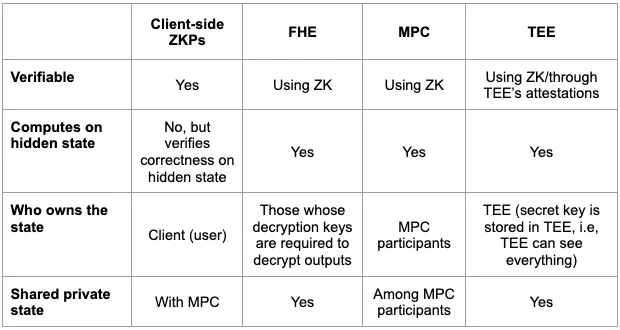
Hence, if we are thinking about a privacy stack that will be expressive enough that developers can build any Web3 dApps they imagine, from everything we’ve mentioned in the article, we either have MPC-ZK (MPC is utilized for shared state) or ZK-MPC-FHE. As for today, client-side zero-knowledge proof generation is a proven concept and we are currently at the production stage. The same relates to ZK-MPC; a number of teams are working on its practical implementation.
At the same time, ZK-MPC-FHE is still at the research and proof-of-concept stage because when it comes to imposing zero-knowledge, it’s know how to zk-prove one bootstrapping operation but not arbitrary computations (i.e. circuit of arbitrary size). Without ZK, we lose the verifiability property necessary for blockchain.
Sources: